

An
Israel-Arafat
Meeting
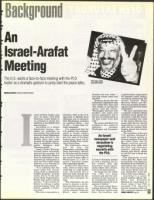
The U.S. wants a face-to-face meeting with the PLO
leader as a dramatic gesture to jump start the peace talks.
DOUGLAS DAVIS FOREIGN CORRESPONDENT
•
sraeli political leaders may
soon sit down with PLO
Chairman Yassir Arafat in
an attempt to break the
deadlock in the Middle East
peace process.
According to a senior
diplomatic source, who
spoke on condition on
anonymity, the high-level
American State Department
team that arrived in the
Middle East last week
pressed the Israeli govern-
ment to establish a direct,
public dialogue with
Chairman Arafat.
Israeli Prime Minister
Yitzhak Rabin reportedly
rejected the proposal, but
Foreign Minister Shimon
Peres is understood to have
signaled his willingness to
meet the PLO leader Arafat
publicly in an attempt to
salvage the peace process.
"It is unlikely that the
peace talks will resume
unless there is substantive,
tangible progress," said the
source, who is "in the loop"
of the State Department's
Middle East policy-making
process. "I have reason to
believe we will see a public
meeting between Peres and
Arafat, probably in Cairo,
very soon."
The move represents a
dramatic shift in the U.S.
approach to Middle East
diplomacy and an admission
that Washington considers
its mediation efforts — and
its will — to have been vir-
tually exhausted.
It is understood that the
U.S. position was communi-
cated to Israeli leaders
before the arrival in Israel
late last week of the State
Department team led by
special Middle East coordi-
nator Dennis Ross.
The diplomatic source
told me that the
Palestinians consulted with
State Department officials
for 30 hours and the Israelis
for 25 hours following the
last round of peace talks in
Washington in a bid to
secure a mutually accept-
able negotiating agenda.
Despite the exhaustive
talks, which at times were
conducted at a high decibel
level, "the bottom line is
that both sides [Israelis and
Palestinians] hated the doc-
ument that emerged," he
said.
"The Americans are not
going to impose a settle-
ment and they are now con-
vinced that progress can
only be achieved if there are
direct, open contacts
e2. 4 4
Will Yassir Arafat
meet with Peres?
between the two sides —
and that means Israel and
the PLO.
"Everyone knows that the
Palestinian negotiators take
their orders from Tunis and
that Arafat is calling the
shots," said the source.
"Washington believes that
Arafat's role must now
become [apparent]. He is
the man in control and he is
the man Israel must deal
with."
The source said there was
unlikely to be a crisis in
relations between
Washington and Jerusalem
An Israeli
newspaper said
Jerusalem is
negotiating
secretly with
the PLO.
if Israel ultimately balked
at such a meeting, but he
did predict that the
Americans would signifi-
cantly reduce their involve-
ment in the peace process.
"As things are," he noted,
"the talks are going
nowhere and and the com-
mitment of vast resources to
an unproductive process is
increasingly perceived as an
exercise in futility."
The source noted that a
meeting between Mr. Peres
and Chairman Arafat could
have far-reaching and
unpredictable implications
for domestic Israeli politics,
including sharpening the
rivalry between Prime
Minister Rabin and Mr.
Peres and possibly threaten-
ing the survival of the Labor
government.
"We have calculated that
a majority of Israel cabinet
ministers would support the
encounter," said the source.
(A poll published last week
in the major Hebrew-lan-
guage daily Ma'ariv showed
respondents to be evenly
split over the whether their
leaders should talk directly
to the PLO.)
The revelation of the new
U.S. position followed a
week of intense activity as
Knesset members from both
the Labor Party and its
Meretz coalition partner
called for direct talks with
the PLO and Chairman
Arafat's political aide,
Bassam Abu Sharif, offered
to visit Tel Aviv to break the
impasse.
The diplomatic source
noted that Mr. Peres met
successfully with Egyptian
President Hosni Mubarak in
Alexandria last week and
that the following day he
told Israel Radio that he
was "optimistic" about the
future of the peace process.
According to a senior °'
Israeli political official, Mr. _
Peres told President cr,
`='
Mubarak he would agree to
=
direct talks if the PLO --1
accepted U.N. Security
Council resolutions 242 and
338, renounced violence and 53
ISRAEL-ARAFAT page 54