

Suburban View
T
In a Tel Aviv
bedroom
community,
sentiment favors
pulling out of the
West Bank
and Gaza.
LARRY DERFNER
ISRAEL CORRESPONDENT
he discussion was
on a never-ending
Israeli topic —
property values. It
took place in a well-fur-
nished, roomy apartment
in Herzliya, a clean, mid-
dle-class town north of
Tel Aviv, part of the
sprawling Dan region
surrounding the big city,
where many hundreds of
thousands of suburban
commuters sit in rush
hour traffic for up to an
hour on their way to and
from work.
This is the heartland
of Israel, the great demo-
graphic bulge in the cen-
ter of the country, an
area of quiet neighbor-
hoods, shopping centers
and malls, good schools
and grass for the kids to
play on. A place for fami-
lies, a place where
Israelis go to live pri-
vate, normal lives.
"You should buy now,
because I think they're
going to make a deal for
autonomy, and the set-
tlers in the West Bank
aren't going to live with
that — they're going to
come streaming over
here looking for apart-
ments, and that's going
to drive the prices way
up," said the woman of
the house, whom we'll
call Tami Elazari.
She'd been talking
about the villa she was
building in an even bet-
ter area with her hus-
band, a businessman
who was away at the
time in Europe. There
were problems with the
contractor, as usual, but
the house was going to
be two stories high, near
the sea, and it would be
worth a fortune.
The couple hadn't
decided whether to sell
their current apartment,
but if they did, they'd
ask for over $200,000
because it had a roof bal-
cony — in Tel Aviv it
would be worth almost
twice as much. And when
the time comes to sell,
Mrs. Elazari said she
won't drop her price. "I
know what I've got," she
said.
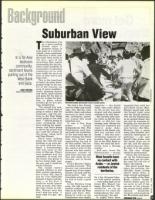
West Bank settlers demonstrate in favor of Israeli control.
She had a few friends
over for coffee and crumb
cake, who, like her, were
middle-class suburban
matrons in their early
40s, intelligent, practi-
cal, women who could
hold their own.
It was a few days
before Israeli
Independence Day. The
Palestinians were fum-
ing inside the territories,
as the near-total ban on
their crossing the Green
Line into Israel was
approaching the end of
its first month. The ter-
ror which had convulsed
the country prior to the
closure was now nearly
forgotten; attacks on
Jews were very rare, and
then only inside the ter-
ritories, not in Israel
proper.
Prime Minister Rabin
sounded buoyant: "The
closure has succeeded
beyond any of our expec-
tations," he said, and the
government had no
immediate plans to call
an end to such a good
thing.
In the Herzliya living
room, the talk turned to
another endless topic —
what to do with the West
Bank and Gaza. Mrs.
Elazari's views on the
Palestinians were totally
negative — she hated
them, they were killers
as far as she was con-
cerned, and she wanted
nothing to do with them.
Her parents held simi-
lar views, so did her hus-
band, so did her two
teenage sons. Except for
when her husband did
reserve army duty,
nobody in the family ever
had any contact with
Arabs — like the over-
whelming majority of
Israelis, they never set
foot in the West Bank or
Gaza. For them the terri-
tories were a foreign
country.
And now, since the
Palestinians — except
Most Israelis have
no contact with
Arabs — or Jewish
residents of the
territories.
for a few thousand labor-
ers with special permits
— were being kept out of
Israel, Mrs. Elazari was
happy. She felt free. "It's
wonderful, we can go
wherever we want for
Independence Day with-
out worrying," she said.
It might have been
expected that with her
anti-Arab views, Mrs.
Elazari would side with
the Israeli right wing
and the Jewish settlers,
who see the Palestinians
as an eternal threat who
can only be overcome by
keeping the territories
under Israeli military
rule forever. But Mrs.
Elazari, like a great
many other Israelis, isn't
terribly ideological or
political — she just
doesn't like Arabs, and
she wants them out of
her life, and the closure
is achieving just that.
For her, it is the model
for the way things
should be permanently.
"Close the territories
off, let the Palestinians
have them, put up a bor-
der and let's be rid of
them," she argued.
But where would that
leave the settlers, the
125,000 Jews living
there? From Ofra, a
large Jewish settlement
in the middle of the West
Bank, settler leader
Yisrael Harel says it's
too early to tell if the
success of the closure
has swung Israeli public
opinion decisively
towards relinquishing
the West Bank and Gaza.
SUBURBAN VIEW page 44
Cn
C:)
-J
CC
43