

110111
Israel. Still Life
I
In Israel, a siren blows
on Yom Hashoah —
and everyone's
thoughts turn to the
Holocaust.
LARRY DERFNER
ISRAEL CORRESPONDENT
f you want to know what
it's like to live in a Jewish
country, be here on Yom
Hashoah — at 10 a.m., to
be exact.
You may have heard about
it, or experienced it during a
visit — a siren blows for two
minutes, and everyone stops
whatever he's doing and
stands silently at attention.
This year, I positioned myself
at one of the busiest corners of
Tel Aviv, Allenby and King
George Streets, at the en-
trance to the outdoor Carmel
Market, to watch.
The siren doesn't start with
a blast — it's a steady drone,
not a very loud one — and
with all the background noise
of traffic and people, a person
doesn't notice it at first unless
he's waiting for it.
Within a few seconds,
though, all the traffic stops;
people stop talking and all you
can hear, on one of the busiest
corners of Tel Aviv, is the
siren.
Against this still life, any-
body going on about his busi-
ness stands out sharply. An
elderly couple kept walking
through the Cannel Market,
until the woman noticed that
everybody else was standing
still, and she grabbed her hus-
band's arm and they stopped.
A good 15 or 20 seconds into
the siren, an old man wearing
shorts was still riding his bi-
cycle down Allenby. I thought,
is he being blasphemous, is he
mentally ill? Apparently not
— just lost in his thoughts. At
the corner of King George he
finally noticed and braked his
bicycle.
As the siren wailed, I
watched the faces. I did not de-
tect any grief or anything that
looked like mourning, not even
anything I would call intro-
spection. When the siren end-
ed, the cars and buses and
people immediately began
moving again, and everybody's
expressions looked complete-
ly normal.
I myself had felt nothing. In
previous years, I remember
seeing pictures in my mind
from the Holocaust. Maybe it
was something I had seen in
a documentary; maybe I was
via
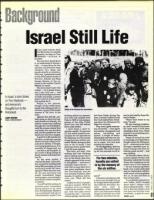
Victims of the Holocaust are remembered.
thinking about my parents,
how they had escaped from
Paris in 1940 or was seeing a
picture of the little Polish
shtetl they had left behind
three years earlier.
I don't know; I can't re-
member exactly. I'm not sure
if I had willed myself to con-
centrate for two minutes on
the Holocaust or if the mental
images had come of their own
accord. Maybe, during my first
year or two in Israel, I had
shed some tears; maybe later
I had felt some sadness.
This time, as I said, I felt
nothing and was thinking
about nothing except what I
saw on the street. And since
nobody appeared to be moved
or thoughtful — and since I
certainly wasn't moved — I
took this to mean that there
was some emptiness about
this Yom Hashoah; that the
two minutes of silence, after
decades of repetition, had be-
come rote. What did this
mean?
I talked to about 10 people,
and got a surprise. With the
exception of one newspaper
vendor in the market — a big
guy with four gold chains
around his neck —I who said,
without apology, that his mind
had been blank during the
siren, everyone I talked to said
they had indeed been think-
ing about the Holocaust for
those two minutes.
They were a good cross-sec-
tion of Israelis — teen-agers
and adults, immigrants and
sabras, hip-looking and
square. A couple of sexily-
dressed girls said they saw one
man who did not get out of his
car to stand, who had kept
smoking his cigarette.
"It was disgusting," said one
of the girls. "He couldn't stand
up for two minutes out of re-
For two minutes,
Israelis are united
in by the memory of
the six million.
spect?"
A Russian immigrant said
a shiver ran through him as
he thought about his grandfa-
ther killed by the Nazis. An-
other man, born in
Afghanistan, said he'd thought
about the Holocaust-related
things he had seen on a visit
to Munich and about the sto-
ries he had read by Isaac Ba-
shevis Singer.
"There were tears in my
eyes," he said.
He was wearing sunglass-
es, and I wouldn't have seen
the tears even if he'd been
standing in front of me. There
seemed to be something sym-
bolic about this.
People all around me were
in mourning, or at least lost in
thought about the Holocaust,
but I — straining to see them
through a reporter's eyes, in-
stead of being with them by
looking inside myself — had
seen nothing.
On Sheinkin Street, the bo-
hemian capital of Israel, Arik
Bernstein looked like the kind
of guy who would give me the
cynic's view of Yom Hashoah
— he was wearing regulation
black Levis, a loose white shirt
and the fashionable intellec-
tual's round, wire-rim glasses.
But no, he also had been in
that certain place.
"I saw pictures, pictures I've
seen before. And I thought
about what I always think
about during the siren — that
this is the only country that
has these two minutes when
everybody...is part of a corn-
ISRAEL page 62