
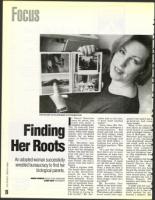

Cheryl Servetter now has photographs of her biological family.
Find'
Her Roo
An adopted woman successfully
wrestled bureaucracy to find her
biological parents.
ADRIEN CHANDLER SPECIAL TO THE JEWISH NEWS
GLENN TRIEST PHOTOGRAPHY
I
f Cheryl Servetter
were an artist, she
could now paint a
complete self-portrait.
The 31-year-old hair
stylist's personal com-
posite, filled with empty
spaces and imagined
details for so many
years, is finally com-
plete.
Ms. Servetter was
adopted as an infant. As
an adult, she ached to
know who her biological
mother was and the rea-
sons she gave up her
baby for adoption.
Without that knowledge,
says Cheryl, she was a
person with only half a
history.
Back in October 1990,
The Jewish News report-
ed on Ms. Servetter's
search for her birth
mother in a story on
adult adoptees. Frust-
rated and disheartened
with an essentially fruit-
less search, the answers
she sought were just
beyond her reach. "What
I'm doing is trying to
find myself," Ms. Ser-
vetter said at the time.
"I don't want another
mother."
Since then, Ms. Ser-
vetter has undergone a
transformation. She
found and met not only
her birth mother, whom
we shall call "Sarah,"
and half-siblings, but
also her birth father —
helping her solve the
burning question: "Who
am I?"
"It's just this feeling
that there are no more
questions, no more mys-
teries and wondering,"
she says. "Especially in
the beginning. It made
my life feel much better,
much more complete.
Then, a little bit later it
made it a little more dif-
ficult because I had to
put everything into
place. Here are all these
extra people; where do I
put them?"
Ms. Servetter first
talked to her birth moth-
er the day her story
appeared in the paper.
That phone call probably
never would have hap-
pened if she hadn't had a
go-between and some
lucky breaks.
Much of the informa-
tion about an adoptee's
birth family is consid
ered privileged informa-
tion in Michigan. Ms.
Servetter had obtained
most of the available
"non-identifying" details
she could, such as her
place of birth, but those
were only scattered
pieces in the puzzle that
was her biological lega-
cy. She admittedly was
at "wit's end."
Her adoption had bee
handled by the Jewish
Family Service. Prior
requests from Ms.
Servetter for any help
beyond the routine infor-
mation allowed by law
were turned down, unti
she enlisted the aid of
Esther Krystal, JFS
adoption and foster care
coordinator.
"I spoke with her and I
asked her if she would b
willing to try to find my
birth mother for me,
because I couldn't. She