

BUSINESS
ENNIES FROM HEAVEN?
s American financial aid to Israel a boost or a burden?
y Elizabeth Applebaum, Assistant Editor
avid Ben-Gurion
had a vision of a
Zionist Utopia.
They would pour
in like pennies
from heaven — the poor, the
despairing, the unwanted. All
Jewish. All socialists. All
helping build up the Jewish
state. Questions about fi-
nancial responsibility would
be secondary to seeing to the
happiness of these workers.
The economy could wait.
David Ben-Gurion's dream
has become a nightmare for
economists.
Since its establishment, Is-
rael has taken in an estimat-
ed $70 billion in donations.
More than $4 billion comes
every year from the United
States, of which $3 billion,
1- =
not including loan guaran-
tees, is provided by the U.S.
government. Another $1 bil-
0
lion is a gift from the Amer-
ican Jewish community.
"American contributions
account for about 12 percent
of Israel's GDP (Gross Do-
mestic Product)," (or $1,500
for every man, woman and
child in Israel), says David
Littmann, senior vice presi-
dent and economist for Com-
erica Bank. "That would be
very positive if it was private,
individual investments going
into private, individual in-
vestment projects."
From 1982-1990, private
foreign investment in Israel
was far less than donations
to the country. American con-
tributions to Israel totaled
more than $39 billion; and
private foreign investments
totaled $129 million.
Some in the Jewish com-
munity label such dependen-
cy inevitable. Israel, they
point out, is still a fledgling
state. The government must
maintain an enormous mili-
tary budget and resettle
0
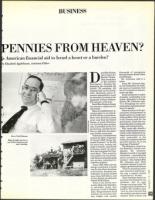
Above: David Littmann
Right: Socialism has been a
way of life in Israel since the
state's founding.
thousands of immigrants
from the former Soviet Union
and Ethiopia.
Mr. Littmann calls it a
crime.
Israel, Mr. Littmann says,
is overwhelmed by its multi-
ple layers of socialism that
are all wrapped in bureau-
cratic red tape.
Israel has become a nation
of apathy, comfortable in its
clutter, dependent on foreign
charity, Mr. Littmann says.
"It is strangling the entre-
preneurship and technical ge-
nius of a people."
Observers point to the gov-
ernment's omnipresence in
Israeli society as a major part
of the problem. Forty percent
of all citizens work for the
government, which also con-
trols food prices, housing sub-
sidies and transportation.
Why, many ask, should a
barely viable political system,
replete with coalitions of un-
happy bed partners and al-
ways answerable to the
whims of countless small but
powerful parties, be in the
business of business?
The Histadrut, Israel's la-
bor federation, further com-
plicates the situation.
Histadrut-owned or managed
businesses — accounting for
about one-third of Israel's
economy — face constant debt,
Mr. Littmann says. Their
standard response to such sit-
uations: government bailouts.
"They're extracting subsi-
dies instead of reforming —
the way a market income
would have to," he says.
Jerry Goodman doesn't ar-
gue that the Histadrut has
problems. But he says,
changes are being made."We
recognize that competition is
healthy," Mr. Goodman says.
"And we have learned that
the model is not state-owned
industry. That's a lesson, and