

SUSAN KNOPPOW SPECIAL TO THE JEWISH NEWS
Orthodox
women are
balancing
careers with
religious
observance.
N
eatly placed upon
the coffee table in
Bela Chopp's South-
field living room
are books which reveal
much about her life. A
volume on women and
psychology sits alongside
a book about Orthodox
Judaism. A book of
Georgia O'Keefe's paint-
ings share space with the
Jerusalem Report.
The 44-year-old psy-
chologist considers her-
self a feminist, an obser-
vant Jew and a role
model to her teen-age
daughters and their
friends.
"We're a little bit like
pioneers," she says,
describing herself and
other Orthodox women of
her generation who chose
non-traditional careers.
Many women balance
work and family. Many
Orthodox Jews balance
religious observance
with secular life. Until
recently, it was the rare
individual who attempt-
ed to do both.
As more and more
observant women enter
the workforce, women
like Dr. Chopp appear
C-7
0
0-
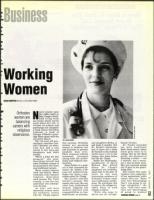
Dr. Janet Snider
less unusual. Orthodox
women are pursuing
careers in medicine, law
and business in greater
numbers than ever.
Their presence reflects
increased tolerance
among both the profes-
sional and religious com-
munities.
Janet Snider is a prod-
uct of that increased tol-
erance. Dr. Snider, a 30-
year-old pediatrician,
began her career a gen-
eration after Dr. Chopp.
She doesn't consider
herself a pioneer. She
insists she's just like any
other busy professional
woman, juggling her
medical practice with
responsibilities to hus-
band Stuart, an attorney,
and daughters Rivka, 2,
and Leah, 6 months. But
Dr. Snider's determina-
tion to carve out a niche
for herself in the medical
world owes a lot to the
women who came before
her like Dr. Chopp.
Rabbi Zev Shimansky,
headmaster of Akiva
Hebrew Day School
where Dr. Chopp's
daughters are students,
notes that in the past 10
years he has seen
increasing numbers of
Orthodox women enter
non-traditional profes-
sions. He attributes this
in part to the college-ori-
ented focus of such
schools as Akiva.
"Girls who come to
Akiva are all college-
bound," he says.
Dr. Snider attended
the more traditional
Beth Jacob school, where
fewer girls went on to
college. But by the third
grade, she dreamed of
becoming a doctor — not
a teacher, not a nurse,
not a stay-at-home mom.
She was unusual among
the 10 girls in her gradu-
ating class.
She recalls that some
teachers were supportive
of her aspirations, while
others were not. "Some
were very discouraging
that I was going to col-
lege altogether," she
says. "And then some
were very discouraging
of going to medical
WORKING WOMEN page 52