

The Haredim
T
Israel's
Orthodox are
fervent
about God
and politics.
CARL ALPERT
SPECIAL TO THE JEWISH NEWS
hey used to be called
the ultra-Orthodox, or
extreme Orthodox, or
sometimes lumped
together indiscriminately as
Chasidim, though that term
embraces a much more lim-
ited span of believers. More
and more the Hebrew term
haredim is coming into use to
identify collectively the
various sects, trends and par-
ties that comprise the fun-
damentalist Jewish right,
many of them bitter foes of
each other.
The name comes from the
Hebrew verb to be terribly
afraid, to be fearful, and is ap-
plied to these groups because
they are God-fearing. Their
basic loyalty and devotion is
to the Almighty.
One who is not a part of this
civilization can not unders-
tand the swirling currents of
sect affiliation and support of
one or another of the rab-
binical authorities who hold
sway — but we can try to
paint a broad picture.
For one thing, not every
bearded, black-hatted, black-
coated Jew is a Chasid. He
may be a member of one of
the so-called Lithuanian
ultra-Orthodox, antagonists
of the Chasidim.
There are different and
mutually hostile schools of
thought among the Chasidim
themselves. Those familiar
with these various trends can
identify even the minor dif-
ferences in costume which set
them apart.
The Haredi community
runs the gamut from the ex-
treme, extreme right, the
Neturei Karta, who refuse to
recognize the State of Israel,
and even make common
cause with the Palestinians,
to the Agudat Yisrael which,
while not Zionist, has been
willing to take part in elec-
tions and serve in the
Knesset and in the govern-
ment in order to benefit from
government budgets and
allocations.
The complete separation of
this society from the outside,
non-religious world is com-
mon to all the groups. Pro-
fessor Menachem Friedman,
of Bar-Ilan University, has
delineated the social develop-
ment in this community. I
abridge his description:
Every young boy, from the
age of 3, enters a special
CC
U)
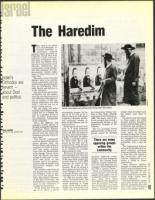
Two men study religious party political posters during Israel's 1992 elections.
socialization process. At the
age of 13 he will go to a
yeshiva where he will almost
completely abandon secular
and vocational studies in
favor of the Talmud and its
commentaries.
At the age of 16-18 he will
move to a more intensive
yeshiva. At age 18-23, he will
marry. He does not serve in
the army. And instead of join-
ing the work force, he enters
a kollel, a salaried yeshiva,
for 10-15 years. He is sup-
ported by his wife and by
yeshiva funds. Thus, he may
be 40 years old and the father
of six children (on average)
before going to work.
Politically, the haredim are
well-organized, but there are
frequent alliances or crossing
of the lines which confuse the
outside observer. In the 1988
elections, the haredi groups
gained 13 seats in the
Knesset. We do not include a
more moderate body, the Na-
tional Religious Party, which
is strongly Zionist, and whose
members serve in the army.
In 1992, the haredim drop-
ped to 10 Knesset seats. The
decline was due in part to in-
ternal bickering (a fringe
group which failed to get a
single seat accounted for lost
votes), • and in part because
the Lubavitcher Rebbe, resi-
dent in New York, withheld
endorsements he had given in
1988. The heavy vote of the
Soviet emigres also caused a
proportionate decline in the
population strength of the
haredim.
The two principal haredi
political bodies are Shas, sup-
ported largely by strongly
There are many
opposing groups
within the
community.
religious Sephardi voters,
though with some Ashkenazi
support, and United Torah
Judaism, largely Ashkenazi,
but with some Sephardi par-
ticipation. Chief component of
the UTJ is Agudat Yisrael.
Since true haredim do not
watch television nor read the
popular daily papers, nor at-
tend public schools or univer-
sity, they draw their
knowledge of what is going on
from the sermons of the reb-
bes, or from their own press.
Some 17 haredi papers, most
of them weeklies, tell their
readers what the editors and
the rebbes want them to
know.
The articles and news items
in these papers are either
strongly polemic, devoted to
human interest tales of fami-
ly devotion and sacrifice, or
concern moral and religious
values of Judaism. Most ar-
ticles carry no bylines,
perhaps because the writers
are yeshiva students who are
not supposed to be earning
any outside income or secular
journalists with a pen for
hire.
The fundamental political
policy of the haredim is to ex-
pand religious influence
wherever possible. They have
no fixed line with regard to
the territories, and can
without compunction sit in
either a Likud or Labor
government.
Their collective political
strength is made possible by
Israel's system of proportional
representation, and they are
strongly opposed to any
reform of the electoral system
which might reduce their
political influence.
The more optimistic among
them point to their growing
families, producing more and
more voters who will have a
voice in the decades ahead.
❑
0.1
C,
CC
w
2
Lu
Lu
91