

Israeli
ART
whose styles range from impres-
sionist to contemporary.
Another collector said that "Tarkay's
images are different from what you see
in Southern homes — (typically) botan-
ical prints. The colors are bold and peo-
ple want to start hanging what's new.
It's a nice change."
Still, plenty of controversy swirls
under this trend's pretty surface.
Many critics scoff at the art that's
emerging from this school, claiming,
that all of the artists are copying from
Tarkay, that little original or mean-
ingful work is being done, and that
much of the art lacks a cultural and
historical significance. And substan-
tial in-fighting is occurring among
artists and their representatives, with
Tarkay's publishers taking legal ac-
tion against other artists for imitat-
ing his work. In a highly publicized,
precedent-setting case that was de-
cided earlier this year, a federal judge
ruled that one Israeli artist could no
longer show her work in the United
States.
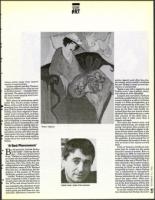
Tarkay's Elegance I.
'6 Real Phenomenon'
y all accounts, Itzchak Tarkay
is the leader – some say the cre-
ator – of the new Israeli school
of art. "Tarkay is a real phenomenon,
an Israeli who has made it to the top,"
says Deborah Sampson of Dvorah Art
Collection. He's "one of the five top-
selling artists in the world," says Har-
riet Rinehart, owner of H.W. Rinehart
Fine Arts, Inc., in Manhattan, the dis-
tributor of the posters of Thomas
McKnight, another top-selling artist.
Indeed, Tarkay's popularity has
been compared to that of Agam, the
Israeli artist who hit the big time in
the 1970s, and whose kinetic art is
now included in the collections of such
museums as the Guggenheim. Still,
critics point out that there are con-
siderable differences between the
Itzchak Tarkay: Leader of the movement.
artists. Agam's work often has Jew-
ish content, and is usually considered
fine art; Tarkay's is seen as more dec-
orative, or commercial.
"Agam is art with a capital A, and
Tarkay is not," says a gallery owner,
who asked not to be identified.
Languid and unrushed, Tarkay's
paintings usually feature one or more
women sitting in a cafe or at home;
nearby is a flower arrangement, or a
bottle surrounded by a few cups. The
women look out into the distance or
down at the floor with briefly de-
scribed faces that are almost always
identical: blue-shadowed eyes, a nose
that consists of two faint dots, a
mouth that is little more than a
shapely red mark.
The colors the women wear, and
those behind them, are heady and
strong: red, green, blue, purple, yel-
low; these colors often appear in ab-
stract blocks which contribute to the
flatness and decorative feel of the
paintings, as well as to their Matisse-
like qualities. A quiet pencil line of-
ten delineates the women's forms, as
well as those of the objects around
them.
Little in Tarkay's childhood indi-
cates that he would one day paint
beautiful scenes of women. Born in
Yugoslavia in 1935, he was interred
in the Mathausen concentration camp
at age 9. After he and his family were
released at the end of World War II,
they returned to their native country,
where the young Tarkay studied
painting. In 1949, he and his family
emigrated to Israel, where Tarkay
won a scholarship to Jerusalem's
Bezalel Academy of Art, Israel's most
famous institution for art. He was to
spend five years there. After com-
pleting his military service, he stud-
ied at the Avni Institute of Fine Art
in Tel Aviv, a school known at the
time for promoting an abstract style.
It was the results of his labor at the
Avni Institute that Tarkay showed in