

Israeli
ART
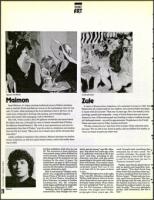
Maimon's Two Women.
A Zule cafe scene.
Maimon
Isaac Maimon, 41, began painting traditional scenes of fathers teaching
sons to read the Torah and Bedouin women in the marketplace when he was
only 13. Later, while studying at the Avni Institute of Art in Tel Aviv, he fo-
cused more on figurative drawing and painting, and eventually began to
paint cafe scenes while managing a cafe in Beersheva.
His work, which is sold in about 60 galleries worldwide and earned about
$4 million last year, is thought by many to closely resemble that of Tarkay.
But Maimon himself denies it. "My work is more spontaneous and more im-
pressionistic than that of Tarkay," says the artist in a telephone conversation
from his Tel Aviv home. "His is nice, but it doesn't have all the elements that
mine does."
Lately, perhaps in response to the criticism, Maimon has begun to produce
bronze sculptures, as well as to paint theater scenes, rather than solely focus-
ing on cafes.
28
Maimon
his first exhibition, held when he was
26. The reactions to that exhibition
were mixed; many critics disliked his
work intensely. Tarkay responded to
that disapproval by putting away his
brushes for the next 15 years. He
picked them up again in 1976 to study
under the painter Moshe Rosenthalis,
and shortly thereafter, developed his
current, distinctive style.
Still, it took time for Tarkay's work,
which was originally published by
Givon Prints of Tel Aviv, to catch on
in the United States, according to
Piers Johnston, co-owner of London
Contemporary Art, the company
which began publishing his serigraphs
(similar to a silkscreen) in 1989.
"Initially, the [U.S.] galleries were
conservative, they thought the color
A native of Buenos Aires, Argentina, who emigrated to Israel in 1962, Zule
Moskovitch, 58, waited until her two children were married before she began
to "paint with all my heart." That was 10 years ago. Now, her cheerful, lively
paintings, pastels and serigraphs — many of which feature men and women
dressed in turn- of-the-century garb and chatting in cafes or walking through
old- fashioned streets — are sold in approximately 30 galleries in the United
States and many more in Tokyo, London and Israel.
"It's like a dream for me," says Zule of her success. Of her optimistic style,
she says, "For me, life is nice, Israel is pretty, and my children live nearby, so
I have no reason to paint any other way."
action was too strong," says Mr. John-
ston. But about four years ago, a few
U.S. galleries ventured to show his
work. And that, according to Mr.
Johnston, was that, with the public
responding to his work with tremen-
dous enthusiasm. The number of gal-
leries carrying Tarkay's paintings and
serigraphs leaped from one or two
to at least 100 in the space of about
a year.
"He'd hit the right nerve at the right
time," says Mr. Johnston, noting that
Tarkay used primary colors at a time
when those colors were seen as too
strong by many artists. Those colors
are now considered "hot" in art cir-
cles. For Phil Sussman, a Maryland
collector who bought three Tarkay
serigraphs three years ago, the
work "brought back something that
reminded one of one's youth. The
carefree attitudes, the people who
are expressing a love of life. It's got
a zest for living that you see in
Toulouse Lautrec's work."
Tarkay says that he doesn't know
why he paints such beautiful, tran-
quil scenes. "You don't know how
many times this question comes up,"
he says, speaking from his home in
Holon, Israel. "People ask me how,
why, and I have no answer." His trav-
els in Europe with his wife, who is in
the fashion business, may have in-
fluenced his subject matter, he says.
And, he adds, "I'm a very optimistic
person. And sometimes, the life is
nice."