

Notebook
Judeo-Christian `Tzuris'
'- GARY ROSENBLATT EDITOR
Rabbis have
long bemoaned
the fact that it is
increasingly dif-
ficult to attract
Jews to join and
attend syna-
gogue. If it's any
comfort, those frustrations
--D are shared by Catholic and
1 Protestant leaders as well,
) whose congregational mem-
berships in this country have
been declining for the last 30
years.
Last week, a three-day
',)Think Tank on Congrega-
tional Affiliation brought to
)Brandeis University in
Waltham, Mass., about 60
jrabbis, Christian clergy,
]) educators and researchers to
II share their findings — and
their feelings — about how
to bring people closer to
,their respective houses of
worship. It was a unique ex-
)derience, blending
I statistical charts with words
)f prayer, the language of
demography and the lang-
uage of theology, and it shed
,light on the conflict between
an American culture that
makes few value judgments
and traditional religions
'that represent absolute au-
thority.
One of the themes to
emerge from the conference
:was that rather than com-
'yete with the ultimate
freedoms of our society, syn-
agogues and churches
should help people deal with
existential questions about
life's meaning and purpose,
',and provide members with a
sense of caring and commun-
ity.
"Perhaps the best way to
resist a decadent culture is
to live a healthy one,"
observed Dr. James Davison
Hunter, a University of
Virginia sociologist. Dr.
Dean Hoge of the Catholic
University of America noted
% that people join a congrega-
tion for four main reasons:
their children's education,
`,personal support in life,
1 friendship, and inspiration
and spiritual guidance.
"These are commodities no
kme else is selling," he said.
! The message was clear: our
religious institutions need to
do a far better job of meeting
I
I
people's needs rather than
blaming them for staying
away.
No one underestimated the
seriousness of the situation.
"Any human institution
that does not replace its
losses will die," said Rev.
Loren Mead, president and
founder of the Albin In-
stitute in Washington, D.C.,
"and the churches repre-
sented in this room are not
replacing their losses." Jew-
ish leaders, it was acknowl-
edged, feel this sense of
crisis strongly since there
are relatively few Jews in
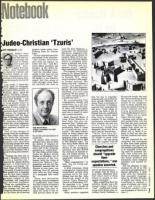
Rabbi Marshall Meyer:
Building a congregation from eight
to 850 families.
the world and assimilation is
on the rise.
In session after session,
statistics were cited to chart
the decline of religious af-
filiation, with estimates that
about half of the American
population is "unchurched."
Dr. Gary Tobin of the Cohen
Center for Modern Jewish
Studies at Brandeis, one of
the sponsors of the con-
ference (with the Union of
American Hebrew Con-
gregations and the Lily En-
dowment), asserted that af-
filiation is even lower, con-
sidering that 50 percent
more Jews say they belong
to a synagogue than really
do.
There were discussions
about the various categories
of unaffiliated, from those
who don't care at all (about 8
percent) to those who iden-
tify strongly with their re-
ligion but rarely if ever at-
tend services (about 20 per-
cent). Dr. Kirk Hadaway, a
researcher for Homeland
Ministries, suggested that
the latter group should be
targeted. Many of these peo-
ple, he said, feel that regular
church or synagogue atten-
dance is optional and irrele-
vant. Churches and syn-
agogues should "upgrade
their expectations," he said.
This message was brought
home by Dr. James Scott of
the Bethany Baptist Church
in Newark, N.J., whose
church attracts 1,000 people
to Sunday services. His
theme was that "without a
vision, the people will
perish." Dr. Scott emphasiz-
ed that "if you don't demand
anything, you won't get
anything. We tell people, 'if
you aren't willing to give of
yourself, don't join.' "
He recommended that
congregations identify and
concentrate on a few key
issues, noting that his chur-
ch deals with social justice,
moral education and politics,
and tries to instill in mem-
bers a sense of purpose.
Rabbi Marshall Meyer of
Cong. B'nai Jeshurun in
New York City also em-
phasized that "without pas-
sion, nothing happens —
particularly when it comes
to transforming spiri-
tuality." His deep commit-
ment to social justice has
helped transform his con-
gregation from a member-
ship of eight families in 1985
to 850 families today. The
first thing Rabbi Meyer did
was create a homeless
shelter at the synagogue,
asserting that this showed
the relevance of Judaism to-
day and helped develop "a
caring community" among
supposedly hardened New
Yorkers.
"Most congregations," he
said, "are not loving com-
munities."
A third clergyman whose
congregation experienced
remarkable growth after
reaching out to the unaf-
filiated was the Rev. John
Steinbruck, pastor of the
Luther Place Memorial
Church in Washington, D.C.
He described it as "going
downhill before it opened its
doors to the homeless in our
midst."
Other speakers suggested
that the key to congrega-
tional growth was to focus on
those already affiliated. Dr.
James Wood, a sociologist at
the University of Indiana,
asserted that congregations
will grow "when clergy so
vitalize the faith of the af-
filiated that the unaffiliated
will become curious about
what they're missing." A
number of the conference
participants acknowledged
that worship services are
often boring and
mechanical, though they
disagreed about how far to
go to "jazz up" the services.
There was also dis-
agreement about whether to
try harder to reach 18-25
year olds — the age group
with the highest drop-off
Churches and
congregations
should "upgrade
their
expectations," one
speaker asserted.
rate in all denominations —
or simply wait for them to
come back. (Statistics show
that about half of them
return to church or syn-
agogue eventually.)
More compelling than the
statistics, though, was a 90-
minute panel with four
"real" unaffiliated people
living in the Boston area, in-
cluding Carole Goodman, a
53-year-old woman who said
she "does everything Jewish
except go to services." A
mother of two daughters,
both of whom married non-
Jews, she talked of trying to
instill Judaism into her
young granddaughter
without offending her son-in-
law. "There are so many
times I bite my tongue."
Perhaps most telling, she
still sounded bitter over the
fact that she never received
a response from the syn-
agogue from which she re-
signed a decade ago — no
phone call or letter of in-
quiry to find out why she
and her husband were drop-
ping out.
It was important for the
clergyman and sociologists
to hear from these private
individuals who gave life to
the statistics and charts, and
to be reminded of the ongo-
ing need for personal con-
tact. One could lose the
thread of humanity amidst
the bleak numbers and
discussions about marginal
members and mental af-
filiates.
But the glimmer of hope
remains for all of us who
care about strengthening re-
ligious affiliation. I came
away with the realization
that successful congrega-
tions, for all their diversity
of beliefs and styles, have
something in common: a
sense of purpose and vision
than can touch, and
transform, people's lives,
one synagogue or church at a
time. ❑