
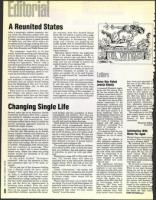

A Reunited States
After a seemingly endless campaign dur-
ing which the American people were sub-
jected to countless promises and proposals;
Tuesday was their chance to speak through
the ballot box, and they did so with a re-
sounding call for change, making Bill Clin-
ton this country's third youngest president
(after John Kennedy and Teddy Roosevelt).
The campaign, especially in its last
weeks, had been grueling and exhausting,
even to those of us watching it. It had, at
times, also been downright loopy, with
President Bush demeaning his office by
calling his opponents "bozos" and a
somewhat paranoid Ross Perot coming into
the race, dropping out, coming back in —
and then spending nearly $60 million of his
own money on his campaign, partly to con-
vince the world that he was no quitter.
And surely, neither was Bill Clinton. He
had endured a savage beating in the
primaries, then an equally brutal lashing
from the Republicans. But now it is time
for the man from Hope, Ark., to offer just
that to the nation: Hope.
When sworn in as president in January,
Bill Clinton will inherit more than the
massive federal deficit that was the target
of Ross Perot's campaign and more than
the economic mess that doomed George
Bush. He will inherit a nation with a sagg-
ing morale and a sense that it has lost its
way. Education is floundering; AIDS,
drugs and violence are plaguing our
youth; health care is exorbitantly expen-
sive; and we have lost our marketing and
industrial savvy to certain Asian and Eu-
ropean nations.
Operation Desert Storm, the highwater
mark of the Bush presidency, briefly in-
flated our nation's ego and spirit. But it
stopped short of ending Saddam Hussein's
reign and was not enough to sustain the
needed vitality of our national life.
Mr. Clinton's task will be to revive our
purpose and spirit as a nation; to ignite our
collective energies; to solidify us, once
again, as a people. Or, as he said Tuesday
night, to work toward the "reunited States
of America."
This will be no small job, and it will take
the full measure of the incoming president.
It will also take the commitment of the
American people, no matter whom they
voted for on Tuesday. After all of the ugli-
ness and name-calling of the campaign, it
is time to set our differences aside and
work together to restore a sense of dignity
and ability to the American enterprise.
Changing Single Life
Several years ago at an American Jewish
Committee meeting in New York, a discus-
sion started to examine current trends in
intermarriage and assimilation. One
sociologist talked about what he called the
newest emerging oppressed minority in
Jewish life: single women.
These were single women in their mid-
to late-30s who had grown up in Jewish
homes, learned customs and traditions, at-
tended religious schools, Jewish summer
camps, celebrated a bat mitzvah, maybe a
confirmation and dated only Jewish boys in
high school and college. But for one reason
or another, relationships with Jewish men
had not resulted in marriage. That
pressure to marry and to have children,
unsaid early, blares out when the young
woman crosses the threshold of 35 and
begins pushing 40.
As the much cliched "biological
timeclock" ticks on, the pressure to date,
and sometimes date out of the faith, in-
creases.
This is just one of the dynamics feeding
into a Jewish world we have called
"singles." Now more than ever, however,
we come to understand that the word
"singles" is not only about young unmar-
rieds fresh from college looking for a mate.
The face of the unmarried person is chang-
ing, and the drive for empowerment is
becoming more evident. Even the word
"singles" is becoming, in a sense, outdated.
Now, we see women in their 50s who've
raised their children, operated the house-
hold budget and the schedules of their
ex-husbands and children. Now they are
called displaced homemakers, and they
are forced into a job market that can be
as cold and cruel as their divorces.
Some people are choosing to pool finances
and even living arrangements. Some ex-
married men learn how to live with room-
mates again. Then there's starting over in
the world of dating, even if it means look-
ing for a mate out of the faith. We now see
gay men and lesbians revealing a lifestyle
many kept secret out of fear. We watch as
they demand to be part of Jewish family,
community and synagogue life.
The examples and the world our children
learn about is often a far cry from the mom,
dad, two children, dog and station wagon
in suburbia we grew up with and ideal-
ized.
Beginning on page 100 in this week's edi-
tion, The Jewish News will take an
expanded look at the alternative lifestyles
singles choose. We'll also look at how the
world around them reacts to these alter-
natives.
Called "Alternatives," the section will
begin this week by examining the growth
of inter-dating between Jews and gentiles.
In future weeks, other issues will be
dissected as well.
Please read and react. Let us know what
you think. If you are living these issues, we
especially want to hear from you. If you are
more of a spectator to the single life, then
understand that what we once called
"family" is not the same.
Home Has Failed
Jewish Elderly
I commend Elizabeth Apple-
baum and The Jewish News
for the two articles Ms. Ap-
plebaum wrote about the tru-
ly deplorable state of affairs
at the Jewish Home for Aged.
She effectively educated the
Jewish community to the
catastrophic conditions and
low level of basic and skilled
care which the residents of
the JHA must endure. It is
these conditions which led
the Michigan Department of
Public Health to charge 179
pages of violations, including
four Level A violations, in
August and 123 pages of
violations, including four
Level A violations, in a
resurvey this month.
It is apparent that the con-
ditions described in these
violations are not of recent
origin.
For years the officials at
JHA admitted residents in
need of skilled, highly profes-
sional medical and nursing
care. Families and residents
were told they would receive
the care which was needed.
Now the community is in-
formed that the JHA was
never designed to provide
highly skilled and acute
levels of care!
Ms. Applebaum indicated
that the survey team found 18
residents in one unit alone
with open wounds which were
not properly treated and that
one of the Level A deficiencies
was in the area of infection
control. My mother was a
resident of the JHA. She died
an excruciating death in
February 1987 from such
open, infected wounds and
there is the emotional pain
which families carry with
them forever when someone
they loved and entrusted to
the care of the JHA dies in
pain and suffers.
One tenet of Judaism is (,
that the elderly are to be (I
cared for with dignity and
respect. How tragic it is that
the JHA has fallen so far 1
from the mark. Many people II,
associated with the JHA —
board members, administra- !
tors, admission personnel,
physicians, supervisors and'
staff — stood by and allowed_ ,
this calamity to unfold . . .
The conditions in the JHA,
must surely stand as one ofl
the darkest hours in the
history of this Jewish
community.
Rozanne Sedler
Southfield
Satisfaction With
Home For Aged
We don't know which rumors,
to believe. What is really go-
ing on at Borman Hall?
My husband and I visited,
many homes before choosing
Borman for our mothers, who
have been at the Home ove
five years. We are very fre-
quent visitors. When they
were capable of discussing
their living conditions, both
of them expressed satisfactio
with their care.
We all want our loved ones
to have tender, loving care.
When we are upset because
things are not as we would I
like them to be, we direct our
criticism toward the Home. I I
know that there is much that
needs to be improved, but I
also believe that Borman isl
far superior to most of the (,
homes in this community. I
Over the years this is what()
I have seen: the residents and
the Home are kept clean.
HOME FOR AGED/page 8