

Time Passages
Rochelle Iczkovitz and Sheila Charlip help uncover Israel's past.
LESLEY PEARL STAFF WRITER
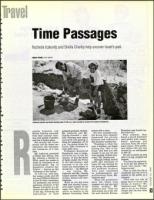
Rochelle Iczkovitz and Sheila Charlip woke at 4:30 a.m. each morning to uncover the remains of Sepphoris.
ochelle Iczkovitz and
Sheila Charlip returned
from their summer vaca-
tion with shards of pottery
and bits of broken glass.
Not exactly the crown
jewels, but for these two
educators, the remnants
are treasures of a lost
time.
Ms. Iczkovitz, principal
of Hillel Day School, and
Ms. Charlip, a teacher at
Hillel, spent two weeks in
Israel as volunteers on an
archaeological dig at
Sepphoris, present day
Tzipori — known as the
"ornament of the Galilee."
At 4:30 a.m. each day,
the women awoke and left
the small Kibbutz Hanaton
to join 50 other volunteers,
two professors and several
graduate students of the
Hebrew University in a 20-
minute bus ride to the site
of the dig. Following the
instructions of their
assigned graduate student,
Ms. Iczkovitz and Ms.
Charlip shoveled — care-
fully cleaning each object
uncovered and passing it
along for inspection. At 10
a.m. the group broke for
lunch, then returned to
work until 1 p.m.
Professors discovered
Sepphoris was a large,
two-level city in the 1st
century. It was the home
of Rabbi Judah the Prince
in the 2nd century, and
rumored to be the site
where his commentary to
Jewish law — the Mishnah
— was written. Ms.
Iczkovitz and Ms. Charlip
helped unearth Sepphoris'
streets, homes and mar-
ketplaces.
Work on the dig since
1985 had already uncov-
ered major mosaics on the
upper level. They are cur-
rently on display at the
Hebrew University. Each
mosaic tells a story.
Six feet underground,
the group this summer
discovered the private
kitchens and mikvaot of
this formerly wealthy city.
"Standing in what was
once a kitchen, you begin
feeling like 'this is my
house.' But then you also
wonder if you are not just
some invader of these trea-
sures," Ms. Charlip said.
Although finding animal
teeth and remnants of
home life was exciting for
the group, the professors
and graduate students
were more interested
in archaeological and
architectural data, Ms.
Iczkovitz said.
"They (the professors)
have the whole area
mapped out and can spot
things quickly," Ms.
Iczkovitz said. "They can
find streets out of the rub-
ble and identify Roman,
Byzantine and Jewish lay-
ers of the city."
This summer, they
found a paved limestone
road pitted with wagon-
wheel markings and
columns from the city's
main street. The profes-
sors believe the city was
covered by an earthquake
in 363 CE.
No one re-enters an area
after it is dug, mapped and
cleaned.
"You have the opportuni-
ty to be the last person to
touch this place," Ms.
Iczkovitz said.
That is until the dig is
completed and the area is
opened to the public as a
museum.
"This was our way of
going back to Israel and
living its history," Ms.
Iczkovitz said. "We were
able to act on our dreams.
People don't do that often
enough."
❑