

•
ti
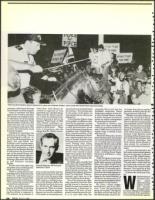
Right-wing demonstrations against trading land-for-peace were a hallmark of Baker's trips to Israel while Yitzhak Shamir was prime minister.
smoother, safer travel through
the territories would be scrapped.
Even if contracts had been
signed, they would be cancelled.
The money was needed for jobs,
for education, for all the things
the Likud had neglected, Prime
Minister Rabin explained. The
order of the day was to cut back
new housing in most parts of the
country; the settlements would
be hit the hardest.
Suddenly the opposition was
jolted out of its silence. They're
not storming the walls yet — so
far it's the odd demonstration, an
angry but non-violent con-
frontation with housing inspec-
tors who came nosing around a
West Bank settlement, a failed
attempt in the Knesset Monday
to bring down the government,
and, on the lunatic fringe, tele-
phoned death threats against a
couple of Labor Party ministers,
Housing's Binyamin Ben-Eliez-
er and Finance's Avraham
Shohat.
But the voice of the right-wing
has gotten loud, and the govern-
ment can't help but hear it.
"Rabin is acting like the just-
elected governor of the 51st state
of the U.S.," said Yehiel Leiter, a
spokesman for the Council of Set-
tlements in Judea and Samaria.
"We're posturing ourselves like
an American protectorate."
This is one of the opposition's
themes; that Rabin is crawling
to the Americans, that he's shap-
ing his policies in response to
U.S. pressure. In an allusion to
28
FRIDAY. JULY 31. 1992
Peace Now, Ariel Sharon de-
scribed the approach as "loan
guarantees now." Another theme,
taken up by Mr. Sharon and oth-
ers, is that the slashing of set-
tlement housing is akin to the
despised "White Paper" of 1939,
when British mandatory au-
thorities stopped Jewish immi-
gration to Eretz Israel.
These
sorts of accusations, plus the
charge that Mr. Rabin's conces-
Binyamin Netanyahu: Will he assume
leadership of Likud?
sions would inevitably lead the
Arabs and Americans to demand
even more once the peace talks
resumed, were hurled during the
right-wing's no-confidence mea-
sure in the Knesset. Before the
government beat back the move
by a 59-48 vote, Mr. Rabin told
his opponents: "There is no basis
for the no-confidence motions,
because we won the confidence
of the public on the positions we
announced and clarified before
the election...We told the pub-
lic the entire truth before we
were elected, and we will now im-
plement it."
Prime Minister Rabin's claim
to the public's confidence is dis-
puted by the opposition, at least
in regard to the Jewish public. At
a small demonstration across
from the Knesset during the no-
confidence vote, Yitzhak Klar, a
burly, bearded resident of the
West Bank settlement of Kedu-
mim, noted accurately that a ma-
jority of Israel's Jewish voters
had supported parties that fa-
vored holding onto Judea,
Samaria and Gaza forever. It
was the Israeli Arab vote, plus
the loss of tens of thousands of
Jewish votes, wasted on small
right-wing parties that didn't
make it into the Knesset, which
gave Mr. Rabin his majority, Mr.
Klar pointed out.
He added, again correctly, that
most voters who supported Shas,
the Sephardi ultra-Orthodox par-
ty in the government, also are
against giving up territory. 'We
represent the majority of Jews in
Israel," he maintained. 'This gov-
ernment won't dare try to do
what it's talking about doing."
One of the reasons the right-
wing opposition has been slow
getting started is because the
Likud is in such sorry straits. Its
headquarters, a skyscraper in
the heart of Tel Aviv, is tem-
porarily closed because the par-
ty is in such debt from the
campaign that it can't pay the
building's employees. Likud
leaders are so jealous of each oth-
er that Yitzhak Shamir, aching
to retire, has given up trying to
broker an orderly arrangement
for choosing his successor.
Primaries to choose a new
leader have been unofficially
called for sometime before the
end of 1992, but no one knows
exactly when, or indeed if, they
will come off.
Binyamin Netanyahu, Israel's
great communicator, has jumped
out as the Likud's dominant fig-
ure. A Gallup Israel poll, taken
among the Likud's rank-and-file
recently to gauge their choice for
new party chief, showed Mr. Ne-
tanyahu lapping the field of his
rivals — including Benny Begin,
David Levy and Sharon — many
times over.
Until the Likud crowns a new
king, the unofficial leader of the
Israeli right appears to be Rafael
Eitan, Army chief of staff during
the Lebanon War and founder of
the Tsomet (Crossroads) party.
Tsomet, which stands for Eretz
Israel but also stands against po-
litical corruption and special priv-
ileges for the ultra-Orthodox, is
the fastest-growing party in Is-
rael, having quadrupled its Knes-
set presence in this election.
Mr. Eitan, a blunt, craggy-
faced farmer, said in an inter-
view, "I give this government
about six months." He figures
that Shas and the left-wing, sec-
ular Meretz party cannot co-ex-
ist longer than that as coalition
partners, at which point the Ra-
bin government will crack.
Whether or not this prediction
comes true, the forces in the op-
position, especially the settlers,
plan to make the coming months
uncomfortable ones for Yitzhak
Rabin. Their lawyers are already
drawing up Supreme Court chal-
lenges to the housing cutbacks,
there will be more no-confidence
motions in the Knesset, more
hounding of Shas Knesset mem-
bers to bolt the government, pub-
lic relations campaigns, and
fund-raising drives abroad to
raise money for privately-fi-
nanced construction in the terri-
tories.
A massive demonstration, the
first major street protest against
the new government, is planned
for the eve of Mr. Rabin's depar-
ture to the U.S., for his Aug. 10
meeting with President Bush.
"It's just taken a little while for
us to galvanize ourselves," said
Mr. Leiter of the Council of Set-
tlements. "Our inactivity at first
was due to the effects of shock."
It seems the shock has worn
off.
bile the threat of
imminent mili-
tary action
against the Iraqi
regime of Sad-
dam Hussein
has again reced-
ed, senior officials in Jerusalem
have warned of the possibility
of renewed Scud attacks against
'