

- INA FRIEDMAN
Israel Correspondent
sraeli settlers in the oc-
cupied territories seem to
I
have gotten over the in-
itial shock of the national
election and are sounding
optimistic, albeit tentative.
People have begun "to
realize that the demon isn't
really
so terrible," is how Eli
,.,
evy, secretary of the set-
tlement of Elon Moreh, ex-
plains the reaction to the
election upset. "The mood
has mellowed to a kind of
`wait-and-see' stance. The
fact that Tzomet (the right-
wing component of the
evolving coalition) will
imbably enter the govern-
ment has done a lot to
assuage fears."
Such calm was unexpected
in a place like Elon Moreh.
Perched high above Nablus
(the biblical city of
' Shechem), Elon Moreh is the
epitome of what Israel's
prime- minister-designate
Yitzhak Rabin calls a
"political settlement" in the
occupied territories. (He has
sought to distinguish bet-
! ween "security set-
r' tlements," which are of stra-
tegic importance to Israel,
and "political settlements.")
> Elon Moreh is also the
very watchword of the set-
tlement enterprise in
.Samaria (the northern part
of the West Bank) and, as
such, already a part of
Israeli folklore. The name
Elon Moreh was first applied
> not to a particular site but to
the settlement group that
defied
the first Rabin
,
; government, back in July
I 1974, by trying to establish
itself near the ancient site of
Sebastia. That initial at-
' tempt at settlement was
thwarted.
But when the group tried
„again in December 1976, the
government permitted it to
remain "temporarily" in a
nearby army camp. Six mon-
ths later, Menachem Begin's
Likud government came into
power, and the prime-
minister-designate made a
I
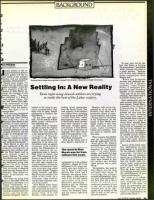
Artwork from the Los Angeles Times by Matt Mahurin. Copyright C 1989, Matt Mahurin. Distributed by Los Angeles limes Syndicate.
Settling In: A New Reality
Even right-wing Jewish settlers are trying
to make the best of the Labor victory.
beeline to the camp to pro-
claim triumphantly that
there will be many Jewish
settlements in Samaria like
Elon Moreh.
He was quite right about
that. Yet the history of Elon
Moreh proper continued to
be a turbulent one.
In 1979, when 15 families
decided to leave the original
group and settle closer to
Nablus, they were steered to
a site expropriated from the
villagers of Rujeib,
southeast of the city. This
time the government was
supportive of the move, but
the settlers came up against
resistance from another
source: the Palestinians of
Rujeib appealed the ex-
propriation order to Israel's
High Court of Justice, and
won. (This rendering of the
drama is pared down to the
bare facts, but at the time
the court case caused a na-
tional sensation.) At first the
settlers threatened that,
court or no court, they would
never leave Rujeib. Tempers
cooled, however, and Elon
Moreh was soon settled a few
miles to the north, on a
wind-swept ridge overlook-
ing the most exquisite scen-
ery in the country.
Elon Moreh today bears
little resemblance to collec-
tion of caravans set down 13
years ago. Its population has
grown from 12 to 230
families (1,200 people), in-
cluding recent immigrants
from the Soviet Union. The
vast majority of the settlers
are religious Jews, including
a unique group of about 250
converts from Peru whose
physiognomy clearly attests
to their Indian stock but who
trace their ancestry to the
Marranos. Another promi-
nent feature of Elon Moreh
is the high proportion of
Sephardi Jews there (about
half of the population), a un-
common feature in most
West Bank settlements.
Just as the ethnic cast of
Elon Moreh's population is
The mood in Elon
Moreh was far from
militant this week.
variegated, so is its political
affiliation. Almost all of the
settlement's 570 voters nat-
urally cast their ballots to
one of Israel's right-wing
parties. But there was a
thorough mix among them,
with about a fifth going to
each of the two lists closely
associated with Gush
Emunim's philosophy —
Hatehiya and the National
Religious Party — and the
rest spread among the
Likud, the Orthodox Shas,
and the radical right-wing
Moledet.
Hatehiya will not be rep-
resented at all in the next
Knesset. Only Shas has a
reasonable chance of enter-
ing the coalition, but it lacks
a strong stand on the future
of the settlements. So the
people of Elon Moreh have
ample reason to fear that
after more than seven fat
years, under successive
Likud governments, they
are about to embark upon
lean ones.
What concerns the settlers
most are two possibilities:
that the settlements will be
"dried up"by Mr. Rabin's
promised change in national
priorities; and that
autonomy for the Palestin-
ians — an early Rabin
pledge —will be the first step
toward the creation of a Pa-
lestinian state. What con-
cerns other Israelis is that
the settlers may forcibly
resist policies not to their
liking.
Nevertheless, the mood in
Elon Moreh was far from
militant this week. If
anything, the settlers
sounded philosophical. After
the local rabbi explained to
his flock that life is like a
maze in which it's
sometimes necessary to turn
to the left to reach the
ultimate goal on the right,
people set to looking at the
pros as well as the cons of
the new situation.
"It may turn out for the
best that Rabin is forming
the government," speculated
Asher Vazaneh, the owner of
a small grocery, "because
he'll be even more afraid to
make concessions than
Shamir was."
"Rabin has promised
security and continued ser-
vices for all of Israel's
citizens," says Pinhas
Fuchs, a computer pro-
grammer and founding
member of the settlement.
"That may not be the ideal
situation, but neither does it
sound like 'drying' us up."
Such assessments may be
more accurate than their au-
thors suspect. Yisrael Harel,
a member of the Council of
Communities in Judea,
Samaria, and Gaza, has
pointed out that over the
past two years, building
starts have been made on
some 20,000 units in the ter-
ritories, close to a third of
which have already been
purchased and a fifth of
which will be inhabited by
the end of the summer. Ac-
cording to his arithmetic,
that works out to an addition
of 100,000 Jewish settlers
over the next three years,
unless the Labor govern-
ment takes steps to prevent
it.
And as of the latest coali-
tion negotiations, no such
steps appear to be planned.
On the contrary, Labor has
reportedly conceded to
Tzomet that all contracts
signed up to Election Day
(June 23) will be honored, so
that the 15,000 units cur-
rently under construction
and all road work in pro-
gress will be completed.
Thus Mr. Rabin may fulfill
his campaign promise to halt
the establishment of new
"political settlements.",
Yet ironic as it sounds,
after such a punishing elec-
tion campaign and the
claims of a "new dawn" in
Israel, his government may
well finish what Ariel Sha-
ron started and go down in
history as implementing the
policy of the Likud.
THE
nn-Rorr ,IFWISH NEWS
31
filaMh_VI
BACKGROUND