

ERTAINME
That Voice
H
As Marge
Simpson or in
her new movie,
Julie Kavner
comes out of
her shell.
TOM TUGEND
Special to The Jewish News
i, this is Julie Kay-
ner," the phone
caller from New
York says. The in-
troduction is hard-
ly necessary. That voice, the
distinctive Bronx rasp of
Marge Simpson which has
been unkindly likened to a
creaky gate hinge in need of
oiling, is unmistakable.
Although she has been on
television for 17 years and is
appearing in her fifth Woody
Allen film, it is a safe guess
that to the present generation
of tube viewers, Ms. Kavner is
recognized by that inimitable
voice rather than her face and
body.
That peculiar form of
anonymity is likely to change
with the critical success of her
first Hollywood starring role.
In This Is My Life, she por-
trayed a single Jewish mom
who sells cosmetics at Macy's
but dreams of making it big
as a stand-up comic. As she
starts the climb up, her two
daughters are left to the care
of a succession of odd baby-
sitters and resent their
mother's self-absorption and
prolonged absences. Ulti-
mately, Ms. Kavner has to
resolve the by-now-familiar
conflict of the successful
career woman between job
and family.
Ms. Kavner, at 41, is not
overwhelmed by her increas-
ing visibility. She is that show
biz rarity, a truly modest per-
son, and when colleagues in
her ego-inflated trade talk
about her, they use such
words as self-effacing, hard-
working, talented, naturally
funny, reclusive and
unknowable.
However admirable such
traits, they make Ms. Kavner
a tricky subject for inter-
viewers, who invariably
remark on how she loathes
discussing her personal life,
or, for that matter, opening up
about her work.
"I'm very, very private and
I don't enjoy talking about
myself to strangers," she
bluntly told one reporter for
a major national magazine.
But once past an initial
awkwardness, Ms. Kavner
responds courteously, even if
she rarely volunteers infor-
mation on her own.
Julie Deborah Kavner was
born in Burbank, a Los
Angeles suburb, the second
daughter of native New
Yorkers, on whom she model-
ed her rich Bronx stage
accent.
Her neighborhood was
largely gentile and at home,
she recalls, "I was brought up
in a very liberal Jewish back-
ground that mainly gave me
a sense of ethics and what's
right and wrong, rather than
L
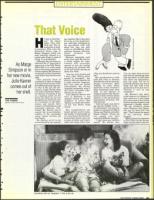
Julie Kavner with her "daughters" in This Is My Life.
6
a
8
3
',4
I
what you should eat and not
eat!'
Her grandparents on both
sides had come to America
from Russia and her parents,
though native-born, spoke
Yiddish to each other,
especially if they wanted to
keep something from their
kids. In the absence of
religious practice, Ms. Kavner
seems to find a certain ethnic
identity in the generational
transmission of certain Yid-
dish phrases.
"Just try to get a non-Jew to
say specific Yiddish words —
it's impossible," she says, but
makes an exception for Meryl
Streep and English comedian
Tracey Ullman. "Those are
two people who have
mastered different accents.
"I don't have any children
myself," Ms. Kavner says,
"but my older sister has two
kids and it's interesting what
they pass down, so when they
talk about the bellybutton,
they say pipik. It'll be in-
teresting whether that sort of
thing will still hold a few
generations down the line or
whether it will be lost
altogether!"
Ms. Kavner's only struc-
tured exposure to Judaism, if
that, came as a 4 and 5 year
old, when some of the Jewish
families banded together and
organized a Sunday school.
"We got children's stories
about Passover and Chanu-
kah, not any deep stuff," she
says. "That's about the extent
of my learning about
religion!'
Talking about her character
in This Is My Life, Ms. Kavner
takes another stab at the sub-