

GENERATIONS
AMY J. MEHLER
Staff Writer
y
ou have to look a lit-
tle closer for Sharon
Alterman these
days. She's up to her
neck in Detroit Jew-
ish history.
Mrs. Alterman, arch ar-
chivist for the. Jewish Fed-
eration of Metropolitan
Detroit, is a regular visitor
at the Walter P. Reuther
Library of Labor and Urban
Affairs, located in the center
of the Wayne State Univer-
sity campus.
When she's not at the Fed-
eration picking through
boxes of old annual reports
and cartons of yellowing
photographs, there's a good
chance she'll be on the top
floor of the Reuther Library,
dwarfed behind 10-foot-high
steel bookshelves
What's the secret to
cataloging more than 100
years of Jewish communal
service?
"One box at a time," said
Mrs. Alterman, who does it
that way to keep her sanity.
"You can't do it quickly be-
cause it's the ultimate
treasure hunt."
The Reuther Library, es-
tablished in 1960, houses
more than 8,000 linear feet
of United Automobile
Workers union records plus
records of other labor
unions, including the Air
Line Pilots Association, the
United Farm Workers and
the American Federation of
Teachers. It is also the de-
pository of the personal pa-
pers of labor leaders such as
Walter P. Reuther, Jerry
Wurf and Cesar Chavez.
Philip P. Mason, director
of the Reuther Library, said
the library is excited about
the Federation archives.
"We go after records that
typify community in-
volvement and work on
behalf of individuals," Dr.
Mason said. "These will fit
beautifully into our urban
holdings."
Mrs. Alterman, certified in
archive preservation from
the Reuther Library, follows
a specific system. First she
heads for the Federation's
filing cabinets.
90
FRIDAY,APRIL 17, 1992
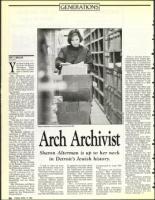
Sharon Alterman is on the treasure hunt of her life.
rch Archivis
Sharon Alterman is up to her neck
in Detroit's Jewish history.
"I look at what we have
and determine what's of
lasting value," she said.
"You want to make sure you
get rid of as many duplicates
as possible."
Then she begins a detailed
inventory. Reports, papers
and scrapbooks are stored in
air-tight, brown archive
boxes; photos and old news-
paper clippings slip into spe-
cial plastic sleeves.
"One of my goals in work-
ing with the Federation and
its agencies has been about
educating everyone about
the importance of records
management and records
retention," Mrs. Alterman
said. "People save without
really understanding what's
OK to throw out and what's
good to save."
Mrs. Alterman goes
through each Federation
department and agency,
spreading her message. She
thinks that by the time she's
finished, she'll have
warehoused' at least 300
boxes.
"Archives are precious
history," Mrs. Alterman
said from deep within the
bowels of the Reuther's
windowless, temperature-
controlled archive room.
"These archives reflect this
community's patterns and
trends."
Some of Mrs. Alterman's
favorite finds are examples
of community work still go-
ing on today.
She's found adver-
tisements from United Ser
vice for New Americans. The
USNA was a constituent
agency of the United Jewish
Appeal and received support
through the Allied Jewish
Campaign of Detroit.
The pictures show the
odyssey of a man, his wife
and four children, survivors
of Nazism, from the day they
set foot in America to the
day they settled in a Mid-
western community.
One photo was taken just
after landing. They're smil-
ing, but still carry the look of
war-torn Europe. They look
worn, in shock and ragged.
The next photo, supposedly
taken 24 hours later, shows
the mother and children,
dressed fashionably, walk-
ing seemingly carefree along
a city street. Other .photos
show the family members
enjoying their first real bed
in years, washing their hair
is with plenty. of soap and hot
water and listening to
>. USNA workers • at a reset-
tlement meeting.
"Today, the people we call
2 $ 2.
New Americans are mainly
from the former Soviet
Union," Mrs. Alterman said.
"But the experience of ac-
culturation is still pretty
much the same."
Something else Mrs.
Alterman learned was how
prevalent the Yiddish lang-
uage used to be in Detroit.
"Many of the old news-
papers were in Yiddish, as
were many old brochures
and fliers," she said.
Also marked for the
Reuther Library are the pa-
pers of Philip Slomovitz,
editor emeritus of The Jew-
ish News. Members of the
Jewish Historical Society of
Michigan have worked
steadily for months from Mr.
Slomovitz's office at The
Jewish News, cutting, clipp-
ing and boxing his records
and papers.
Mrs. Alterman predicts
the archive business will
keep her busy for the next
two to three years.
"I have the unique oppor-
tunity of looking back and
preserving a bit of Detroit's
Jewish history for the
future," she said." ❑