

OPINION
On Different Wavelengths
GARY ROSENBLATT
Editor
The rains in
Jerusalem two
weeks ago were
heavy and con-
stant. But when
I complained to
a cab driver on
King George
Street that I was cold and
soaked, he berated me for my
insensitivity. Didn't I know
that Israel desperately need-
ed rain?
He was right, of course.
Like Jews around the world,
I add a phrase to the daily
prayers during the winter
months for the wind to blow
and the rain to fall in Israel.
But I guess those words
didn't bridge the gap for me
between ritual prayer and
reality until I saw how
grateful Israelis were for the
"miserable" weather, help-
ing to counter their serious
drought.
Just another small exam-
ple of the differing percep-
tions between American and
Israeli Jews. For all of our
shared heritage and con-
cerns, we have a chasm of
misunderstanding between
us that is at times
humorously, at times mad-
deningly, wide.
It's not just in terms of pol-
itics and diplomacy, where
Israelis feel constantly em-
battled and misunderstood,
convinced that the world
does not appreciate how
precarious their day-to-day
security is, despite their
military advantage over the
Arab world.
We Americans tend to be
more optimistic and
trusting. Sit down and make
peace with your enemies, we
say. If you've got a problem,
talk it Out.
But such an approach
seems incredibly naive to an
Israeli with a sense of histo-
ry, who has fought in wars
against Arab states and is
wary of being trapped into
making concessions that
could not be won on the
battlefield.
Even on the social, situa-
tional and psychological
levels, Israelis have a diff-
erent view, colored by a
sense of historical fatalism
and a shared national obses-
sion: survival.
These differences in the
way Israeli and American
Jews approach life affects
everything from war and
peace to defining a "lavish"
bar mitzvah.
When I was in Israel last
summer to attend the bar
mitzvah of the son of close
friends — Americans who
lived in Jerusalem this past
year — I discovered that the
Israelis in attendance were
most impressed that there
was a bottle of wine on every
table, and Coke and Sprite,
both diet and regular, in
abundant supply. Not exact-
ly extravagant by American
standards, but an eyebrow-
raiser in Israel.
And Israelis marveled at
the fact that American Jews
plan these affairs a year or
two in advance: picking the
bar mitzvah date, booking
the synagogue or hall, and
making the arrangements
with caterers.
In Israel, they explained,
no one begins to plan until a
American and
Israeli Jews have a
chasm between us
that is at times
humorously, at
times maddeningly,
wide.
couple of months before the
event. "Living in the Middle
East, where anything can
happen, and often does,"
noted an American woman
who has lived in Rehovot for
more than a decade, "it just
doesn't make sense to plan
too far in advance."
As proof, she cited the fact
that her son's bar mitzvah,
scheduled for last February,
had to be postponed due to
the Persian Gulf War.
And weddings and bar
mitzvahs in Israel are not
only less costly than similar
events in this country, but
decidedly more informal.
The fact that the Shabbat
bar mitzvah we attended at
Kibbutz Lavi was hosted by
American Jews who had
been living in Israel caused
confusion for a number of
guests, about evenly divided
between Americans and
Israelis, as to how to dress.
As I dressed for Friday
evening services, I decided to
forgo my usual sport jacket
and necktie and to wear my
leather sandals. As long as
I'm in Israel, I reasoned, I
may as well look the part.
Imagine my surprise when
I walked into shul and found
that the Israeli men, figur-
ing their hosts were Ameri-
can, wore suits, ties and
formal shoes.
In many ways, life in
Israel is simpler and more
wholesome. One finds
teen-agers, and even adults,
socializing in the evening by
getting together to sing
Israeli folksongs. I shudder
to think how my own
teen-agers would respond to a
similar invitation in
Baltimore.
Still, Israeli life becomes
more "Americanized" all the
time. "L.A. Law," one sea-
son behind, is the hot televi-
sion show there, the Chicago
Bulls are the darlings of
Israeli kids who a genera-
tion ago hardly knew about
basketball, and Carvel's,
Ben & Jerry's and Pizza Hut
(all kosher) are the fast-food
rage.
It's all part of the love-hate
relationship Israelis have
with American Jews. They
criticize us for remaining on
the sidelines while they play
the game. They mock us as
pseudo-Zionists yet are en-
Talmudic studies, and Jew-
ish philosophy.
Officials at the Orthodox
university say that finances
caused what they are calling
a "restructuring." Accor-
ding to a document released
to the press by the univer-
sity, the graduate school
"will have a deficit of
$560,000" this academic
year, and student demands
to keep open the graduate
school amount to "asking us
to commit financial suicide,"
according to Sam Hartstein,
YU's director of public rela-
tions.
The student body at
Yeshiva is known more for
its scholarship than ac-
tivism, but the intensity of
the protests last week to the
surprise announcement sug-
gest that more is at stake
than the diplomas of its pre-
sent student body.
"This is a defining mo-
ment for centrist Or-
efforts are under way to ask
thodoxy," says Robert
Dr. Lamm and the board to
Klapper, a YU rabbinic stu-
reconsider.
dent and one of the protest
"We realize that the un-
organizers. "We think the
versity is facing serious fi-
closing of Revel would have
nancial difficulties, but
a tremendous negative im-
there is a sense that this
pact both on the Yeshiva
move was taken too hastily"
Semicha (ordination) pro-
and would not represent a
gram and the undergraduate
great savings in dollars.
college, and, more impor-
Proponents of keeping
tantly, on the entire Jewish
Revel open noted that
community."
Sheldon E. Socol, vice presi-
He added that the closing
dent for business affairs, told
"would undermine the pos-
the board of Yeshiva College
sibility of an intellectually
last week that the savings to
confident Orthodoxy in Nor-
the university would only be
th America, and will close
$250,000-$300,000, accor-
one of the few opportunities
ding to a well-placed source.
for Orthodox women to study
Others, however, claim that
Jewish texts."
the real savings to the uni-
Jay Bailey, editor of The
Commentator, t h e • versity is closer to $100,000,
since closing Revel will not
undergraduate student
impact on indirect expenses
newspaper which broke the
such as the Office of the
story of the proposed closing
President, security, and
of Revel, said that the
maintenance.
majority of faculty and
According to a report in
students are united in their
opposition to the move, and
Contiued on Page 18
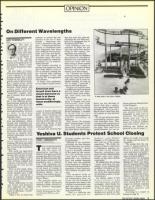
A water slide in the Golan Heights.
fluent and easy lifestyle here
in the Diaspora.
The best proof is the in-
creasing numbers of Israelis
who quietly leave their
homeland to start over in
America. We shake our
heads and say "it's a
shame," but are we ready to
leave our creature comforts
and take their place in
fulfilling the biblical im-
perative to live in Israel. 0
Yeshiva U. Students Protest School Closing
YOSEF I. ABRAMOWITZ
Special to The Jewish News
T
hree hundred students
last week rallied out-
side the main ad-
ministrative building at
Yeshiva University and then
occupied the office of its presi-
dent, Dr. Norman Lamm. Stu-
dent leaders tacked onto the
president's door a petition
with 1,100 signatures pro-
testing a December 3 decision
of the board of trustees to
close down the Bernard Revel
Graduate School, "one of
Yeshiva University's jewels,"
according to a recent Middle
States Report.
The graduate school cur-
rently offers advanced
degrees in Bible, Jewish his-
tory, Semitic languages,
Yosef I. Abramowitz is a Wex-
ner Graduate Fellow in Jour-
nalism.
THE DETROIT JEWISH NEWS
7