
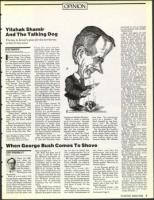

Yitzhak Shamir
And The Talking Dog
The key to Israel's plan for the territories
is that it has none.
ZE'EV CHAFETS
Special to The Jewish News
I
n the lexicon of Israeli po-
litical slang, the phrase.
"maybe the baron will
die" occupies a special place.
It is the punch line of a fable
about a Russian nobleman
who decides to kick the local
Jews off his land. A delega-
tion is appointed to appeal
the decision, but the baron is
adamant: The Jews must go.
As they depart, a rabbi
stops to admire the baron's
wolfhound. "It's a beautiful
dog," he says. "Can it talk?"
"Don't be absurd; dogs
can't talk," says the baron.
"Jewish dogs can talk,"
the rabbi says. "I could teach
yours to talk in a year."
"All right," says the
baron. "You have one year.
If the dog talks, you can
stay. Otherwise, you go."
On the way home, the
Jews are crestfallen. "Rabbi,
what have you done?" One
says. "You know you can't
teach a dog to talk."
"That's true," admits the
rabbi. "But a year is a long
time. Who knows, the dog
might die, the baron might
die . . ."
That bit of folk wisdom has
defined Jerusalem's think-
ing on the territories ever
since they were first cap-
tured in the Six Day War.
Ze'ev Chafets is editor of the
Jerusalem Report, from
which this piece is printed.
From the very outset,
American policy has been
that Israel must leave the
territories in return for
peace. A succession of
American presidents has,
more or less forcefully,
demanded it. Israel's reac-
tion to such demands, from
the Rogers Plan to the
Reagan Plan, has been to
wait. And every time, the
baron has eventually died.
Jerusalem was able to get
away with this because it
was dealing with a series of
weak presidents. Mr.
Johnson and Mr. Nixon were
preoccupied with the war in
Vietnam and, in Mr. Nixon's
case, Watergate. Mr. Ford
was a caretaker; Mr. Carter,
an unpopular flake with
little congressional support.
And Mr. Reagan was content
to wait (perhaps because he
believed that the dog would
actually talk).
It has taken almost 25
years, but there is now a
baron in Washington who
wants the Jews out — now.
Unlike his predecessors,
George Bush is unfettered
by Cold War preoccupations,
virtually free of domestic
constraint and completely
innocent of sentimental
attachment to Israel. Only
three years ago, Mr. Bush
was still being derided as a
wimp. Today, he is arguably
the most powerful American
president in history.
Mr. Bush not only has
power, he knows how to use
it. Just ask Panama's Gen.
Noriega or Saddam Hussein.
When it comes to dealing
with foreigners, George
Bush is one mean sucker.
Yitzhak Shamir should have
figured this out a long time
ago, but the message ap-
parently didn't register.
Early on, when Mr. Bush
told him that he wanted a
land for peace deal, Mr.
Shamir responded by telling
him that "the territories
won't be a problem." Mr.
Bush thought he was hear-
ing a "yes." Mr. Shamir
thought he was giving him
the usual talking dog story.
For the past few months,
as Mr. Bush and Secretary of
State James Baker made it
increasingly clear that they
were serious about a set-
tlement freeze, Mr. Shamir
When George Bush Comes To Shove
GARY ROSENBLATT
Editor
These are diffi-
cult times for
American Jews
as they watch
the bitterness —
and the stakes —
grow between
Washington and
Jerusalem.
Many of us are angry with
George Bush and frustrated
with Yitzhak Shamir. But
we are also deeply conflicted
about where we stand in this
battle between American
and Israeli interests because
we used to think that those
interests were the same, and
they no longer are.
Mr. Bush has gone out of
his way to put the onus of
the Mideast stalemate on
Israel, to make the set-
tlements a major issue of
contention, and to cast pro-
Israel lobbyists as working
against American interests.
Most of all, though, we fear
that his sympathies lie
closer to the Arab cause than
to Israel's and that he and
his administration approach
the Mideast peace con-
ference with no particular
empathy for the Jewish
state.
If Mr. Bush is our vision of
a WASP Republican, then
Mr. Shamir is our stubborn
Eastern European uncle, the
one we love as family but
who embarrasses us in
public with his outspoken
views about "the goyim."
We may agree with him,
but we cringe nonetheless.
Uncle Yitzhak, we want to
say, can't we talk about this
when we get home?
Just this week, Mr.
Shamir addressed the
Knesset in Jerusalem and
lashed out at the Bush ad-
ministration. The ostensible
issue was the postponement
of loan guarantees for Soviet
Jewish immigrants, but the
real issue is trust. Or the
lack of it.
Mr. Shamir's world view
was forged by the Holocaust,
the world's abandonment of
the Jews, and like his
predecessor and political
mentor, Menachem Begin,
he sees politics most clearly-
in terms of whether one
stands with, or against, the
Jewish people. There are no
shades of gray.
In his Knesset speech, he
criticized Mr. Bush for his
loan guarantee delay, an ac-
tion, Mr. Shamir said, that
struck at "the deepest foun-
dations of Jewish and
Zionist action."
Surely George Bush
doesn't see it that way. But
that's the point.
This unlikely couple — the
smooth American
Continued on Page 10
continued to act as though
he was dealing with another
witless baron.
Again and again, he said
that American loan guar-
antees had nothing to do
with the peace process. He
made it plain that he ex-
pected to get the guarantees
as well as the "routine" $3
billion or so in annual aid,
while giving the American
administration nothing in
return. Less than nothing;
Mr. Shamir went out of his
way to register contempt for
the Americans by plunking
down a couple of settlements
every time Mr. Baker got off
the plane in Israel.
If, in the end, Mr. Shamir
was truly "stunned and
amazed" by Mr. Bush's
linkage of aid to a set-
tlement freeze, as press
reports have suggested, it
was because, after 25 years,
Israeli prime ministers have
gotten out of the habit of
taking their American
counterparts seriously.
Mr. Shamir is unlikely to
make that mistake again,
but it may be too late. For
one thing, he has nowhere to
turn. With the Russians out
of the game, he can no longer
sell Israel as a "strategic
asset." Congress is not likely
to buck the powerful Mr.
Bush, especially when he
frames the issue in terms of
vital American interests.
Nor can American Jews be
counted on. In any real con-
frontation between the U.S.
and Israel, our American
cousins will say to us what
Tonto said to the Lone
Ranger: "What you mean
`we,' kimosabe?"
Even new elections won't
help Mr. Shamir. They
might buy a few months but
Mr. Bush, a shoo-in in 1992,
can wait. And in any upcom-
ing campaign Labor could
argue, plausibly, that a
Likud victory would seri-
ously endanger American
economic aid.
The prospect of coming off
the dollar cold turkey would
be enough to get even
Shimon Peres elected.
Mr. Shamir has only one
hope left — the Palestinians.
In the past they have always
found a way to wrest defeat
from the jaws of victory, and
they may do it again. If the
PLO refuses to come to the
peace conference, Mr. Bush
may decide to establish the
next outpost of the New
World Order someplace else.
It is a slim chance, but
possible. In the next few
months, Yitzhak Shamir can
be counted on to do every-
thing possible to make the
PLO dog say the magic
words: No deal. ❑
THE DETROIT JEWISH NEWS
7