

that while all Jews were
observant in Ethiopia and
had the Tanach — the Five
Books of Moses, the Pro-
phets and the Writings —
they lacked the Mishnah, or
Oral Law, as well as the ear-
ly commentaries, the
Midrashim, Rashi and other
bodies of writing. As a con-
sequence, there is a large
gap between Jewish obser-
vance in Ethiopia and that
of mainstream Judaism in
Israel and worldwide.
Now, Mr. Zagai says, the
gap must be filled in. To
help accomplish this, Mr.
Zagai and his fellow rab-
binic students founded Orit
Torah, the only organization
of Ethiopian immigrants
which teaches religion and
tradition. When not study-
ing for their rigorous, nine-
year course of training,
members of Orit Torah often
are lecturing in Amharic on
the holidays at any of the 68
absorption centers through-
out the country in which
new immigrants from
Ethiopia are settled.
At the approach of the
Hebrew month of Elul, the
telephone in Mr. Zagai's _
Kiryat Yovel apartment
rang constantly one even-
ing. Each time it was the
same caller: Avigail Hadad,
general director of the
Amichai Movement, a
volunteer movement that
organizes activities on
Jewish heritage for former
Ethiopians in absorption
centers. Mr. Zagai and Ms.
Hadad were busy coor-
dinating a series of
seminars on the High
Holidays with Yossi Harel,
head of the Jewish Heritage
Division of the Jewish
Agency's Department of Im-
migration and Absorption.
The half-day seminars, to
be given at each of the ab-
sorption centers in which
the former Ethiopians are
living, were intended to
cover many of the basics on
the month of Elul: Rosh
Hashanah, Yom Kippur, the
Days of Awe and Sukkot, the
Selichot services, the shofar,
the traditional apple and
honey and other syMbolic
foods, the sukkah.
Mr. Harel's Jewish
Heritage Division sponsors
the seminars, which are in-
tended to reach some 20,000
former Ethiopians in the ab-
sorption centers, about
17,500 of whom have ar-
rived since January.
Amichai works closely with
Mr. Harel's department on
the efforts. Orit Torah sup-
plies most of the lecturers.
"What we are trying to do
is help them absorb the
change and the details they
lost since they left Israel
2,500 years ago," Mr. Harel
says of the triad's concerted
efforts. "With our lectures,
we start by explaining to
them what the Oral rIbrah is
and why they didn't have all
these things in Ethiopia."
For instance, Mr. Harel ex-
plains, tefillin didn't exist in
Ethiopia. The Jews there
were familiar with the
passages in Deuteronomy
that set out the command-
ment for tefillin, but the ac-
tual explanation of what
tefillin are comes from the
Oral Law. Nor do they
observe Chanukah.
many years to master. Only
the kessim know it.
Thus, he explains, "The
general family from
Ethiopia, even though they
are very religious, if you put
them alone they will lose
because they need the kes."
Each of the lectures con-
ducted by the Jewish
Heritage Division includes
two Amharic-speaking lec-
turers from Orit Torah and
one rabbi. Participating in
many of these lectures is
Rabbi Yosef Hadana, the on-
ly ordained Ethiopian-born
rabbi.
"They have the will to
learn the religion, also to
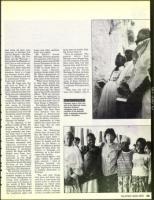
Ethiopian Jews at their first
visit to the Kotel and, below,
Operation Solomon
immigrants and an Israeli
volunteer at the Diplomat
Hotel, a temporary absorption
center in Jerusalem.
Even the Ethiopian
Jewish form of prayer dif-
fers, Mr. Harel says. They
have three major tefilot —
the Prayer of Sacrifices, the
Prayer of Angels and the
Prayer for the Return to
Zion — in addition to special
prayers for Holy Days. Yet
brachot, or blessings, are
unknown, as is the silent
prayer the Amidah.
Nor do ritual objects — the
tallit, tefillin, the prayer
book, mezuzot — exist in
Ethiopia. Instead, the
kessim, or priests, take on a
major importance in terms
of leading observance in
Ethiopia.
"The only holy things
they have, and that's very,
very few, is some books the
kessim have in Ge'ez (the
language in which their
Torah is written)," Mr. Harel
explains. Ge'ez is an ex-
tremely difficult language
to learn, he adds, and takes
THE DETROIT JEWISH NEWS
25