
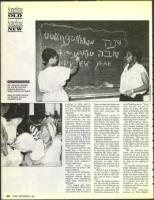

Soat
UJA Press Serv ice/Shai Zakai
New immigrants Ishimatet,
left, and Nau send Rosh
Hashanah greetings in
Hebrew, Amharic and English.
Below: An Israeli volunteer
and Ethiopian Jew at an
absorption center.
continue to listen and to
learn Torah and observe the
mitzvot," Rabbi Hadana
says of those who attend the
seminars.
According to Mr. Zagai,
two problems are associated
with teaching the im-
migrants who came on both
Operation Moses in 1984
and on Operation Solomon.
The first problem is teach-
ing them proper - observance.
Whoever arrived in Israel at
a young age can adjust and
learn to observe Judaism
properly. However, it is dif-
ficult with the elderly to ac-
cept additions to what they
observed in Ethiopia.
The second problem, Mr.
Zagai says, is the issue of
the Jewishness of those who
come from Ethiopia. Prior to
Operation Moses, Israel's
chief rabbinate insisted that
whoever came undergo a
ritual immersion.
"They said, 'You:re
Jewish, but not quite; " Mr.
Zagai explains.
As a result, he maintains,
previous waves of im-
migrants rebeled against
religion, even abandoning
what they observed in
Ethiopia.
"The people who came
with Operation Moses were
ready and happy to learn
and observe the mitzvot as
26
FRIDAY, SEPTEMBER 6, 1991
they are observed today, but
because of the immersion
issue they became angry
and quit learning," he
charges.
Following a series of
strikes by the newcomers
brought to Israel on Opera-
tion Moses, the chief rab-
binate has, dropped its in-
sistence on ritual conver-
sion. The issue isn't even
mentioned today, Mr. Zagai
says. Instead, the rabbinate
accepts the kessim as
witnesses regarding an im-
migrant's Judaism.
Because ritual immersion
is no longer an issue, those
who came on Operation
Solomon are more receptive
to learning about modern
Judaism, Mr. Zagai says.
Still, there is a right way
and a wrong way to present
his subject matter to the im-
migrants, he adds. First,
whenever he lectures on a
holiday, a kes is seated next
to him.
"Before I give a lecture, I
let the kes give a blessing
and tell a little on the sub-
ject, and he feels I respect
him."
Next, Mr. Zagai explains
how the holiday is observed
in Israel and in Ethiopia in
a manner both old and
young can understand. He
likens his comparison to the
art of making gravy: "To all
that you do, you put in
spices to make the gravy
tasty. In Ethiopia, you make
the gravy and that's all.
They don't put in spices. I
add the spices and also add
anything that's lacking."
Mr. Harel agrees. "Accor-
ding to the experience we
have gained working with
the new immigrants from
Ethiopia, we know we must
start by giving them talks
about what they used to do
in Ethiopia. They are very
religious people. We are
building on what they used
to do, and we are continuing
what they used to do in
Israel.
"We are learning from
them, and we are pushing
ourselves to give a lot of
honor and love to what they
brought with them and step
by step we are adding to
that."
As a result, lectures on the
High Holidays start with
how the immigrants observ-
ed them in Ethiopia. Next,
slides are shown about the
holidays in Israel, followed
by an explanation of the ma-
jor prayers and the at-
mosphere the new im-
migrants will find in Israel
on the holidays. -
"It's very important
because on Yom Kippur,