

TORAH PORTION t"'
AGENCY FOR JEWISH EDUCATION RESOURCE CENTER
CO-SPONSORS WITH
TEMPLE SHIR SHALOM AND TEMPLE KOL AMI
AN
Letting Our Clergy
Be Jews For Us
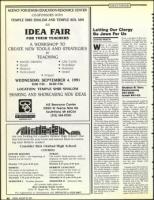
IDEA FAIR
FOR THEIR TEACHERS
LEONARD WANETIK
Special to The Jewish News
A WORKSHOP TO
CREATE NEW TOOLS AND STRATEGIES
for
TEACHING
•
•
•
•
Jewish Identity
Torah
History
Holocaust
• Prayer
• Life Cycle
• Holidays
• Hebrew
• Israel
WEDNESDAY, SEPTEMBER 4, 1991
8:00 P.M. - 10:00 P.M.
LOCATION: TEMPLE SHIR SHALOM
SHARING AND SHOWCASING NEW IDEAS
AGENCY FOR JEWISH EDUCATION
THE RESOURCE CENTER
AJE Resource Center
21550 W. Twelve Mile Rd.
Southfield, MI 48034
(313) 354-1050
Jewish &fixation *work
I I ill IN
0:0111
Are you looking for a quality Hebrew High School? One
that will motivate your teens and interest them in contnu-
ing their Hebrew studies?
Consider Bais Chabad High School
COURSES
Monday 7:15 p.m.-8:10 p.m.
TORAH
The weekly Torah portion, with
emphasis on Rashi and the classical
commentaries.
Monday 8:15 p.m.-9:10 p.m.
MISHNA
The study of the bedrock of
Jewish laws, including logical
reasoning and moralistic teachings.
Thursday 7:15 p.m.-8:10 p.m.
HEBREW LANGUAGE
A continuation of the study of
Hebrew, with emphasis on the
current spoken language.
Thursday 8:15 p.m. 9:10 p.m.
JEWISH HISTORY
Starting at 1648 — the beginning of
Modern Jewish history.
-
SEMESTER II February May
October-January
All courses take place at:
Bais Chabad Torah Center
5595 W. Maple Rd., West Bloomfield
For registration or information call: 855 6170 or 626 1807
SEMESTER I
-
-
52
FRIDAY, AUGUST 30, 1991
-
W
hat is the proper
role of a religious
leader amongst the
Jews? Is it to be an in-
termediary? Is it to say the
prayers and study on behalf of
the congregation?
The sedra Ki Tavo provides
us with strong direction in
this regard — the answer is a
firm "no!' Each Jew is respon-
sible for his or her own con-
nection and relationship with
God. The religious leader is
there to assist, to facilitate,
but not to "do" in the place of
a Jew.
There are two settings in Ki
Tavo which prove this point.
The first is the elaborate
and highly structured presen-
tation of the bikkurim — the
first fruits. The description
given in Devarim (Deuteron-
omy) 26:1 onward is expand-
ed upon in Tractate Bik-
kurim. A group from an area
would go up to Jerusalem
with all of the first fruits of
the village. It would be met
outside Jerusalem by a
delegation which would ac-
company it to the Temple,
where each person would go
up to the Temple himself, car-
rying his basket, and make
the proper declaration before
the priest.
Even the king would carry
his own basket to the Temple,
not using an intermediary or
agent. Nor did the priest
make the declaration on
behalf of the individual — it
had to be made by the person
bringing the first fruits.
Over time, people's
knowledge of Hebrew declin-
ed. The learned could come to
the Temple and make the pro-
per declaration in the proper
language, but the untutored
could not. Did Judaism
evolve, then, into having the
priest say the proper words on
behalf of the unlearned in-
dividual? No. Not only were
the unlearned assisted, but,
in order to spare anyone em-
barrassment, the priest
began to say the words first
for all individuals to repeat.
The priest became a helper,
not an intermediary, in carry-
ing out a mitzvah.
In like manner, we find in
27:1-8 the commandment to
erect stones upon which, ac-
cording to many commen-
tators, were to be written at
Leonard Wanetik is a member
of Congregation B'nai Moshe
and Young Israel of West
Bloomfield.
least a synopsis of Devarim.
In verse 8, the explicit com-
mandment is made that the
writing be ba'er haytayv,
"very plain" or "easy to
understand." It was not to be
up to the priests to tell each
Jew what the law was. It was
each Jew's responsibility to
read and understand the law.
(In later years, a m'turgeman,
or translator, would translate
the Torah as it was read so
that each person could under-
stand it in his own language.)
It was, then, the leader-
ship's job to help each Jew by
making the law as simply
understood as possible by ex-
plaining it, by expounding on
it, by teaching it, but not by
becoming the exclusive group
for observing it. Otherwise,
Shabbat Ki Tavo:
Deuteronomy
26:1-29:8;
Isaiah 60:1-22.
the commandment could be
stated without the addition of
ba'er haytayv.
Over the last number of
decades, Judaism has, for
whatever reason, forgotten
these roots. More and more
we looked to "Professional
Jews" — be they rabbis, can-
tors, or educators — to do our
studying, our learning, and
our performance of mitzvot
for us.
A rabbi today is expected, in
many cases, to be the bikkur
cholim (visiting the sick) com-
mittee, for example. He is ex-
pected to be in shul regular-
ly to make up a minyan,
although we may be too busy.
He or the cantor is expected
to be our intermediary in
prayer, to seek that special
spark or connection with the
Holy One, blessed be He, and
to pass that spark on to us
through a few (very few) well
chosen words of wisdom. This
is not authentic Judaism as
described in Ki Tavo. This is
not the way things were
meant to be.
Instead, as Ki Tavo tells us,
we are required to state our
own formula when we come to
pray. We are required to study
the stones which are written
plainly for all to see. We must
shoulder our own obligation
to learn and to do. We must
seek our own spark.
Our rabbis, our cantors, our
educators are there to help.
We must look to them for that
help and guidance. We must
expect them to be able to ex-