

Photo by Reu ter/U PI
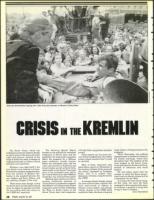
Anti-coup demonstrators arguing with a Red Army tank crewman on Moscow's Gorky Street.
CRISIS IN THE KREMLIN
The Soviet Union, which has
undergone enormous positive change
in recent years in the areas of human
rights and glasnost, teetered on the
verge of chaos this week, in danger of
slipping backward in history toward
darkness and repression.
Whether it can right itself in the
near future or not remains to be seen.
Events have outpaced comprehension,
from the removal of Mikhail Gor-
bachev to the stand-off between the
new leaders and Boris Yeltsin, and
the seeming collapse of the coup.
What seems clear, though, is that
the Soviet move toward reform should
never be taken for granted and that
the two million Jews who remain in
the USSR feel imperiled.
28
FRIDAY, AUGUST 23, 1991.
The following Special Report
focuses on the outlook for continued
emigration of Soviet Jews, and the
possibility of a large-scale evacuation
effort; the prospects for a Mideast
peace conference, already tenuous
before the attempted coup; and the
views and concerns of American and
Israeli leaders as well as Soviet Jews,
interviewed in the Soviet Union just
prior to the attempted coup, and in
the United States just after Mikhail
Gorbachev was removed from power.
Reading these reports one will en-
counter conflicting opinions. A
United States Congressman suggests
that Moscow will continue the current
emigration policy for fear of offending
the West; an Israeli expert on the
Soviet Union fears that emigration
will halt if the coup plotters somehow
prevail.
Some experts say the peace pro-
cess will be unaffected by this week's
events; others maintain that it could
be derailed.
Most of these interviews took
place before reports on Wednesday of
the seeming collapse of the coup and
the notion, expressed by President
Bush, that if it indeed fails,
democracy will take a leap forward in
the USSR.
A common thread, though, among
the views of Soviet Jews, whether they
were interviewed in Odessa or
Detroit, is that sudden, and perhaps
violent, change in the USSR spells
trouble for Jews, who have a long and
tragic history of being treated as the
scapegoat.
Natan Sharansky, who • suffered
imprisonment in the Soviet Union for
his Zionist yearnings, writes from
Jerusalem that "the problem of the
Jews trapped in the Soviet Union
must again become the focus of the at-
tention of American and world
leaders."
He and others assert that the
manner in which the Soviet govern-
ment treats its Jewish citizens will be
a barometer for the West.
In a sense, the more events chang-
ed this week, the more the basic
message for Jews remained the same:
do whatever is possible to bring Jews
living in fear to freedom.
Gary Rosenblatt