

ISRAEL
INA FRIEDMAN
Special to The Jewish News
T
he shuttered shop on
Saladin Street, the
Champs-Elysee of east
Jerusalem, was once (and
not very long ago) an
emblem of the intifada. It
symbolized not only a de-
fiance of Israeli rule and a
willingness to make great
sacrifices for the Palestinian
cause but a fear of the
"shock forces" that "enforc-
ed solidarity" with the
uprising and could set a
merchant quaking in his
boots by merely lighting a
cigarette in front of his shop.
Walad besaker balad ("A
child can close down a city")
was one of the popular say-
ings to emerge from those
days.
Now, on a midsummer's
Saturday morning, when the
streets of west Jerusalem
are all but deserted,
downtown east Jerusalem is
teeming with shoppers and
choked by a veritable traffic
jam. Whole families are out
window shopping together or
stocking up on fresh herbs
and vegetables from
villagers who spread their
produce on the sidewalk
fronting the Old City wall.
The clothing, lingerie and
shoe shops on Saladin
Street are doing a brisk
business. Cafes are full,
travel agencies have
customers and Israeli pro-
ducts are back on grocery
shelves. Even the bookshops
have works by Israelis (in
English and Arabic)
displayed prominently in
their show windows.
Are all these signs that the
uprising has spent itself? Is
the intifada finally over?
That question crops up
with inordinate frequency in
Israel, and Palestinians
mock the Israelis for forever
taking the pulse of their
uprising and regularly pro-
nouncing it dead. It must be
said, however, that though
the intifada may live on, it
has undergone a sea change
since the end of the Gulf
War.
Many are the signs that
life is returning to normal in
Ina Friedman, a Jerusalem-
based free-lance journalist,
reports for us on the Mideast.
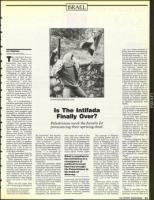
A rock-throwing Palestinian youth.
Is The Intifada
Finally Over?
Palestinians mock the Israelis for
pronouncing their uprising dead.
the territories. But equally
evident is a steep rise in
violence perpetrated with
"hot weapons": guns,
grenades, and explosive
devices. For over three years
the PLO preached the gospel
of a "white (bloodless) in-
tifada" — a struggle in
which defiance and self-
reliance, not terrorism, were
the means by which the Pa-
lestinians would redeem
themselves.
Now the situation looks
somewhat like a throwback
to the days when the "armed
struggle" against Israel was
waged out of clandestine
cells by an audacious few,
while the majority of the Pa-
lestinians practiced
summud (a passive strategy
of "holding out") and waited
for salvation from afar.
That life is returning to as
normal as it can be in east
Jerusalem and the occupied
territories is almost in-
disputable. The schools have
been open for most of this
year, and even where cam-
puses remain closed the uni-
versities are functioning in-
formally out of hotel rooms
and other facilities. After
the disastrous days of the
Gulf War, when the Palesti-
nians spent weeks under
What is manifest in
the territories is a
resurgence of
political ferment
that has brought
the Palestinians to
the brink of
disarray.
curfew and were then barred
from entering Israeli ter-
ritory, close to 100,000
laborers have been issued
permits to work inside Israel
(mostly in the construction
industry building housing
for new immigrants).
The upsurge in Palestin-
ian buying power has ex-
pressed itself not only in a
flurry of shopping but in a
return to recreational pur-
suits — eating out, jaunts to
the beach, soccer games in
east Jerusalem — which
were taboo during the
ascetic days of the rebellion.
The civil courts remain
paralyzed, and there are still
no Palestinian policemen at
work, so that thefts are a
scourge and a return of old-
time "law and order" seems
a distant dream. Still, the
number of people murdered
as alleged collaborators has
declined to three or four a
week from an average of 10 a
week just a few months
back.
Observing these trends,
the Israelis have chosen to
encourage them by meting
out carrots after years
of wielding the stick. Not
only have they eased various
restrictions on the Palestin-
ians, in a sharp reversal of
policy they are now fostering
the development of a distinct
Palestinian economy — lay-
ing the groundwork for new
industrial areas, granting 90
licenses for factories in the
West Bank, offering special
tax breaks to new industries,
and lowering income tax
rates for employees. They
have also licensed new credit
institutions to handle the
$75 million grant to the ter-
ritories from the European
Community and ensure that
it has the maximum impact.
Yet there is also a dark
side to the recent shift in
gears: an escalation in
violence throughout the ter-
ritories as stones give way to
bullets and grenades. Until
recently the armed attacks
focused on military targets,
with soldiers being fired on
in Hebron, Ramallah, and
Rafah.
Last weekend alone,
Israeli patrols were attacked
by a grenade in Ramallah (a
dud, as it turned out) and
shots near Tulkarem.
In an even more ominous
development, for the first
time in the history of the oc-
cupation, terrorists
penetrated an Israeli set-
tlement (Otniel, in the
southern Hebron Moun-
tains) and planted a time
bomb that caused property
damage but fortunately no
loss of life.
"Israelis imagined that if
they crushed the intifada,
they would have peace and
quiet," an employee of an
east Jerusalem bookshop
commented sourly. "They
never thought that it might
be replaced by something
worse."
The new trends notwith-
standing, what remains en-
trenched in the territories is
the postwar pessimism
about the odds of obtaining
an equitable settlement of
the Palestinian problem.
As the "weakest link" in
the chain leading to a peace
conference, the Palestinians
were told that they would
have to yield on the ticklish
issue of including a repre-
sentative from east
Jerusalem in their delega-
tion.
What is manifest in the
territories is a resurgence of
political ferment that has
THE DETROIT JEWISH NEWS
31