
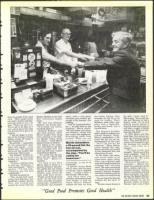

ness was simple: First, hard
work. "Most people think
you push a button and busi-
ness just comes to you," he
says. "That's not how it is.
You've got to be there at 7
a.m., you've got to like what
you do and you've got to be
creative.
"I had my finger in every
part of the business: buying,
selling, hiring. Of course, I
didn't sleep much . . ."
He and Alex — responsible
for the restaurant's more
than 100 salads —even
helped cook. "We wore bow
ties so our ties wouldn't fall
in the soup," Morris says.
The Samuels' brothers se-
cond rule in business
acumen was "Be nice to the
customers."
"I'd have a customer come
in and say, 'Tomorrow, I
want sweetbreads,' " Morris
recalls. "I'd tell him,
`Tomorrow, you will have
sweetbreads.' "
The food was good, too.
"The corned beef sand-
wiches were delicious," says
Southfield resident Murray
Tait, who worked just
around the corner from the
Eastern Market at the Gold
Star restaurant supply
house.
Mr. Tait says Samuels
Brothers was always busy.
"Everybody ate there;
everybody liked it."
Samuels Brothers used
only fresh produce, which
Morris bought first thing
every morning in the East-
ern Market. Cakes, bread
and cookies — which Morris
passed out free to children —
were baked at the restau-
rant. And Morris and Alex
always bought their own
meat and fish from vendors
in the Eastern Market.
"You would hear the ped-
dlers call out,. 'Fresh fish!
Fresh fish!' " Morris re-
members.
It's hard to pin down
Morris when it comes to a
Samuels Brothers' specialty.
The gefilte fish was always
popular, he says. So was the
chicken soup, which the
chefs made from scratch.
"People would line up on the
street" for the fruit bowl,
which included pineapple,
cantaloupe, blueberries,
strawberries and honeydew
melon, while a local sports
columnist just couldn't get
enough of the Samuels' rice
pudding.
"And the homemade blint-
zes — we sold them by the
hundreds," Morris recalls.
"We had cheese and cherry
and blueberry, served with
sour cream and applesauce.
Everything made from
scratch. When you say
Morris remembers
a 20-pound fish the
two set out,
accompanied by
the sign, "You'll be
eating me
tomorrow."
`homemade,' it has to be
homemade."
A favorite during World
War II, when meat was hard
to come by, was a vegetable
steak. "I couldn't make it
fast enough," Morris says.
And when meat was
available, the brothers found
their brisket in high de-
mand. Morris himself
selected the best cut from
the kosher butcher, then
trimmed all the fat to be
used for kishke. Their
Salisbury steak plate, com-
plete with a vegetable,
potato and bread, was a
mere 65 cents.
The Samuels brothers
didn't stand for ordinary res-
taurant displays, either.
Morris remembers a 20-
pound fish the two set out,
accompanied by the sign,
"You'll be eating me
tomorrow." When electric
trains became the rage,
Morris and Alex put several
on the restaurant floor and
offered them for sale.
In the winter, the restau-
rant served coffee in an
eight-ounce glass rather
than a cup, so patrons could
wrap their hands around the
steaming brew and keep
warm. The water was heated
on a large, coal stove. In the
summer, Samuels Brothers
welcomed customers with its
new, modern air-conditioning.
The one thing the Samuels
brothers did not serve: li-
quor.
"We had a liquor license in
the safe; I never used it,"
Morris says. "So you ask me,
why not? Because we had a
family trade. (If we had
offered liquor) maybe a
friend of mine would come in
and take a couple of drinks
and go crazy. What was I go-
ing to do with him?"
In 1940, Morris and Alex
faced their first serious set-
back: the restaurant burned
down. They paid $20,000 in
repairs and managed to open
the business two months
later, this time as a
cafeteria.
"We had youth and
strength," Morris says of the
quick comeback. "And if I
made $1, I didn't go out and
spend $1.50. We were
Depression people."
Samuels Brothers'
customers — Morris esti-
mates the restaurant served
half a million each year —
included farmers, lawyers,
doctors, journalists and just
about everybody who work-
ed near the Eastern Market.
The Detroit Tigers were fre-
quent patrons, as was Al
Borman, father of former
Farmer Jack owner Paul
"Good Food Promotes Good Health"
THE DETROIT JEWISH NEWS
57