

Art
ELLEN BERNSTEIN
Special to The Jewish News
ob counselors at Jewish
community agencies
around the country have
their hands full teaching Soviets
how to make it in the American
workplace. Here are some of
their observations about the
working world they left behind.
• Soviets are assigned jobs by
the government. So a job inter-
view doesn't exist in their
thinking.
• For many Soviets, their first
job is their job until retirement.
They have trouble understand-
ing the capitalistic concept of
"moving up."
Accustomed to waiting in long
lines for everything Soviets don't
understand the concept of mak-
j
Undoing The Soviet Work Ethic
ing an appointment. They just
show up at a place.
• Some Soviets have difficulty
understanding the concept of
selling themselves in an inter-
view. They don't realize that
modesty is not appreciated. They
speak in a self-deprecating man-
ner and apologize profusely for
their halting English.
• Others are seen as overly
aggressive and pushy in an in-
terview. They come from a socie-
ty where such behaviors are
necessary to get what they want.
But they don't understand the
need to employ polite, diplomatic
phrases in conversations.
• During interviews, Soviets
often talk about irrelevant
things. They tend to say "Uh
huh, oh sure, oh yes," when
they don't understand what is
being said. They also can be
non-expressive and wooden
during interviews.
• Soviets often believe a hand-
shake and a warm smile after
an interview is tantamount to
getting the job.
• The older Soviets, in par-
ticular, are concerned about loss
of job status. They take enor-
mous pride in job titles. It often
means more to them than a good
salary. While not always true,.
"engineers" sometimes turn out
to be low level technicians; entry
level bookkeepers to high end
accountants call themselves
"economists."
• Soviets tend not to be as
cosmetically oriented as
Americans.
• The predominate profession
among the Soviets is "engineer-
ing." Since Jews are not allowed
into certain professions, many
studied civil, mechanical and
electrical engineering at univer-
sities. For the past few decades,
Soviet universities have cranked
out a disproportionate number
of civil, mechanical and elec-
trical engineers for the govern-
ment's extensive construction
and road building. The Soviet
Union is filled with research
and design institutes that used
to employ 20 engineers for a
Dash
Continued from preceding page
JVS' Mrs. Nurenberg says
the Jewish community
needn't fault Soviets for
coming here and wanting
"the same things we want —
the big house, two cars,
manicured lawns."
"The missing link is what
is involved in getting from
one point to another," she
says. "Some of them say we
break the dream. They see
instant affluence, but that is
not bad. We don't live here
the way they do in Russia.
"We need to help them to
walk through the system.
Even a doctor working in a
laboratory will learn just by
using the language on a dai-
ly basis," she says. "We en-
courage work, not welfare."
A Council of Jewish Fed-
erations survey of the six
largest resettlement cities —
New York, Chicago, Los
Angeles, San Francisco,
Philadelphia and Boston —
shows that 10 to 40 percent
of Soviets are off general as-
sistance at the end of four
months, the amount of time
provided for by federal
guidelines. The government
has yet to cut the funds at
the end of the deadline.
A study by the Council of
Jewish Federations — which
tracks the immigrants of
1979 and shows they earn
incomes comparable to the
average American family —
suggests the new immi-
grants will become suc-
cessful by American stan-
dards.
"This wave will be more
successful with business,"
Mrs. Drits says. "With
glasnost and perestroika and
open cooperation in the
Soviet Union, they have
gained more expertise."
Adds Marty Benson,
"Compared to how my
grandfather had it, they are
already doing well." ❑
Ellen Bernstein of the Atlanta
Jewish Times, our sister
paper, contributed to this story.
50
FRIDAY, JUNE 7, 1991
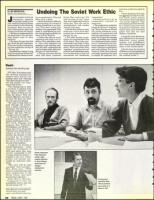
Soviet newcomer
Yuriy Klyusner,
center, pays
careful attention
to Karol Moxley,
supervisor for
refugee
employment
services.
Employment
specialist Meir
Stauss teaches
work skills to a
class at JVS.
task that could be handled by
five.
• Soviet physicians don't enjoy
the prestige of American doc-
tors. Soviet Jewish parents
would more likely brag about
"my son the engineer." They
are typically paid less than fac-
tory workers and must work
in primitive conditions. They
receive seven years of medical
school that does not meet
Western standards.
• At age 50, many Soviets con-
sider themselves to be retired.
Relatively young grand-
mothers and grandfathers
don't want to work when they
come to the United States.
• Soviets from the big cities
of Moscow and Leningrad tend
to be more sophisticated about
the working world.
❑