

WHEN RECESSION HITS HOME
Tight Pocket ooks
/ 4
The Allied Jewish Campaign is directly
impacted by purchasing power.
Staff Writer
=
or the first time
in a decade, the
Allied Jewish Cam-
paign — the major
arm of the Detroit
Jewish community that
raises funds here and in
Israel — is projecting a
decrease in gifts. .
And this is not an accident,
according to economist
David Littmann.
Historically, the total
amount of money pledged
has risen each year. But the
percentage of dollars col-
lected has increased by a
smaller percentage during
tough times (such as the
recession of 1981-82).
The amount of money
pledged each year is directly
related to purchasing power,
said Mr. Littmann, first vice
president and senior
economist for Manufacturers
National Bank.
"During recession, people
close their pocketbooks
sooner," Mr. Littmann said.
"They don't buy clothes;
they take fewer trips to res-
taurants and fewer outings.
They downscale home im-
provements. They don't buy
cars or appliances."
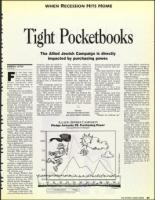
Mr. Littmann analyzed the
dollar amount pledged to the
Campaign from 1980
through 1990 against real
purchasing power, the
amount of money available
to the consumer after taxes
and inflation (see graph).
"This is an excellent cor-
relation suggesting that
growth in real income is a
major factor determining
vigor and growth of pledges,"
Mr. Littman said.
The Jewish Welfare Fed-
eration of Metropolitan
Detroit expects to raise $27
million during the 1991
Allied Jewish Camapign —
$1.5 million short of its goal
and a figure lower than the
1990 Campaign, which
brought in $27.3 million.
Although Federation offi-
cials attribute the dip to the
,
recession, they are quick to
point out that the commun-
ity has generously allocated
an additional $21.3 million
for Operation Exodus, the
emergency campaign to
resettle Soviet Jews. Donors
were asked to pay Exodus
pledges over a three-year
period.
"The Campaign must be
down because of the reces-
sion," Federation Executive
Vice President Bob Aronson
said. "But morale is still
excellent. We have done ex-
tremely well, and there is an
upbeat feeling in the com-
munity.
"Psychologically and fi-
nancially, we are trying to
come back," Mr. Aronson
said. "It will get better soon.
Next year will be challeng-
ing. But there are positive
indications on the horizon."
The recession, which lit-
erally means negative
growth over two consecutive
quarters, has its seeds back
in 1986 when the Federal
Tax Reform Act was elim-
inated. This took away many
benefits for builders and
marked the beginning of
the tough times for the real
estate industry. Tight
monetary policies also im-
pacted the building market
beginning in 1988.
In 1989, the Federal Re-
serve Board tightened loan
rules for banks, thereby
reducing aggressive loan
policies and cash flow.
Banks grew more cautious.
Sources:
Manufacturers National Bank
and Jewish Welfare Federation.
There was restrained growth
of bank reserves and len-
ding.
Auto sales started to drop
and employment gains
descended. By 1990,
employment started tumbl-
ing. The Persian Gulf crisis,
which began last August
and ended in January, hurt
consumer confidence.
And all of this was
augmented by recent federal
tax increases.
Mr. Littmann said this
recession has lasted longer
than forecasters initially
projected. It is not as bad as
the recession of '79 when
local unemployment, now
10.7 percent, skyrocketed to
17 percent and mortgage
rates, now averaging 9.5
percent, were up to 18.5 per-
cent.
"Things are picking up,"
ALLIED JEWISH CAMPAIGN
Pledge Amounts VS. Purchasing Power
(Annual Percent Changes)
Illustration by Scott Mattern
IF
KIMBERLY LIFTON
Purchasing Power
said Sam Kreis, executive
vice president in charge of
lending for Comerica Bank.
"Activity picked up after the
war started. It was anticipa-
tion. My phones haven't
stopped ringing."
Despite the economic
downturn that began in the
second half of 1990, Oakland
County will continue to add
jobs this year, University of
Michigan economists said.
George Fulton and Donald
Grimes, researchers for U-
M's Institute of Labor and
Industrial Relations, are
predicting that the Oakland
County private-sector econ-
omy will grow five times as
fast as the state in the next
two years.
Oakland County, they
said, has the highest per-
sonal income per capita in
Michigan (averaging
$24,448), ranking 27th
among the 3,107 counties in
the United States.
"For the first time in eight
years, the nation is in a
recession and the resiliency
of Oakland County's econo-
my is being tested," the U-M
economists said. "But we
expect the county to bounce
back with its customary
vigor."
Mr. Fulton and Mr.
Grimes said employment
growth (in mostly non-
manufacturing jobs such as
service industries, compu-
ters and engineering) will
climb 4.6 percent by the se-
cond half of 1991. In 1992,
employment in the county is
expected to grow at an
average annual rate of 4.1
percent. ❑
Pledges
Source: Manufacturer's National Bank, Jewish Welfare Federation
THE DETROIT JEWISH NEWS
37