

WHEN RECESSION HITS HOME
"We will have a down Campaign
this year and the reason is
recession.
•
Bob Aronson,
executive vice president,
Jewish Welfare Federation
Crunch
Continued from preceding page
ding jobs and doing repair
work. Many of the remodel-
ing jobs have gone to large
contractors, who also need
work, he says. He has no
future bookings. Last year,
he was booked solid through
June.
Fortunately, he says,
Saundra is a teacher, with a
decent salary and good
benefits. Yet this has put a
crimp in their lifestyle.
"We go out to eat maybe
one time a week — if that,"
he says. "We used to not
even think twice about
eating out four times a week.
"We have cut down on un-
needed trips and we are not
buying any new clothes," he
says. "We can't afford a
vacation."
Like many people during
hard times, Mr. Josephson
has also cut his advertising
budget and charitable gifts.
"Before we weren't so
cautious," Mr. Josephson
says. "Now every penny
counts."
Companies are merging
and closing to economize.
Many at the middle
management level are get-
ting lost in the shuffle. Col-
lege graduates and those
with master's degrees are
having trouble securing en-
try level jobs.
The recession has stripped
the national economy of
about 1.5 million jobs since
last summer, leaving
newcomers to the job market
in the lurch. Some economic
experts say the pool of entry-
level jobs has shrunk 30 per-
cent from last year.
"It's a very frustrating
thing," says Steve Lipsen,
30, of Wixom, who has a
master's degree in marketing
and is looking for a job in
advertising or public rela-
tions.
He lost his sales job at the
end of 1990 and hasn't found
anything since.
36
FRIDAY, MAY 3, 1991
"The reason I can't find
work is because things are so
rough that everything I am
looking for is being taken by
those who have a lot of expe-
rience and are out of work
because of the recession,"
Mr. Lipsen says.
"I interviewed for a job at
a bank as an account exec-
utive. They called me back
and said they liked me, but
said they hired a vice presi-
dent from another branch
who was laid off.
"Before it was hard," Mr.
Lipsen says. "Now it is im-
possible."
Greg Orley, a partner with
Oxford Investments of
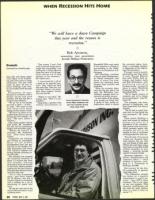
Home improvement business
owner Ralph Josephson has
seen few customers during
these tough times.
Bloomfield Hills, says much
of the recession is related to
over-building in the 1980s.
There is an abundance of of-
fice space.
Bob Skandalar, president
of Acorn Asset Management,
an Oxford enterprise, says
three of every five. com-
panies are reporting lower
incomes than analysts had
predicted.
When the economy stops,
even the big guy has to cut
back, Mr. Skandalar says.
Lifestyle changes haVe oc-
curred at all levels, he says.
In the midst of the gloom,
some people are doing well.
A group of four young en-
trepreneurs chose to ignore
the economic signs, laun-
ching a mortgage company
in September at the beginn-
ing of the recession.
Through word-of-mouth,
networking and long hours
of work, Howard Babcock
and Jack Wolfe, both at-
torneys, and Andrew Jacob
and Rob Silverstein, with
marketing and sales
backgrounds, mustered
forces to create Worldwide
Financial Services Inc. of
Bloomfield Hills.
"We've heard rumors of
recession and we've chosen
not to participate," says Mr.
Jacob, 30.
The company was incor-
porated in September, and
they closed their first loan in
January.
"We've had so much busi-
ness that we just hired two
loan processors," Mr. Jacob
says.
Their secret: Building is
slow and re-sale of existing
homes are slow as a
byproduct of the recession.
But interest rates are lower,
which prompts people who
normally are not in the
market to buy or re-finance
existing properties, they say.
Worldwide Financial
would not disclose their
sales figures, but say they
are well ahead of their goal.
Within the next three years,
they hope to close $50 to $60
million annually in mor-
tgages — securing enough
capital to launch a bank.
Economic indicators — in-
flation, unemployment and
interest rates — show
evidence of recovery, accor-
ding to a University of
Michigan forecalt.
But recovery for the Jew-
ish community in general
could take years.
"The Federation already
has taken on a massive
commitment to social ser-
vices," says JFS's Alan
Goodman. "But it can't take
on any new projects. With
recession, resettlement and
the need for more dollars,
there is a limit to what we
can do."
❑