
Hava Nedeber Ivrit: Feeling Comfortable With Ruth
By NIRA LEV
Nira Lev is associate professor of
Hebrew language and literature at
the Midrasha College of Jewish
Studies.
Kol Pesach, when we sit at
shulchan ha'seder reading in the
Haggadah about the arba-ah
banim, I recall the night of the
seder when we first met Ruth (not
her real name). Ruth became our
krovah when her achot married into
our mishpacha. We were told that
Ruth, who was twelve years old at
the time, was be'emet like a three-
year-old developmentally. "Ruth
me'fageret," we were told. We
asked no she'elot about Ruth. Her
horim and her achot, our new
krovah, were open and comfortable
with this noseh. We were the ones
who had a be'aya, who did not feel
comfortable.
The p'geesha with Ruth was a
total hafta'ah. She was yalda
n'eema, smecha and me'numeset
who was comfortable with all the
anashim zarim that she met, and
who had perfect nimmusim. Our
three-year-old ben became her best
chaver and both were "ge'im and
sme'chim to ask the "arba
kusheeyot" together. That seder
was the hatchala of ye'chasim
me'yuchadim and chaverut krova
with Ruth and her mishpascha.
On the night of that seder
rishon we did not yet know the
whole seepur about Ruth. Only
later did we learn that ka'asher
Ruth nolda, her horim were
advised to leave her in beit-ha-
cholim until they can find mosad
mat'eem for "yeladim me'fagrim
kasheh" (that is how she was
diagnosed). Her horim, who had an
older bat home, consulted several
rof'eem, who repeated the same
hamlatza: "Do not take her home!
This tinoket will never walk, talk or
be capable of understanding or
caring who raised her. Taking her
habaytah will be unfair to her achot
and to you."
Ruth was lucky. Her horim
were akshanim — as the rof'eem
described them — and decided to
raise her ba'bayit, with her older
achot and refused to believe the
doctors' diagnosis. Ruth became
merkaz ha'chayim of the
mishpacha. They never "hid" her.
She was included in all their
activities. They all devoted sha'ot
rabot to teach her and train her.
Their chayim was not easy, but
ha'yom Ruth ne'suah to a gever
like her. They live on a kibbutz, they
both work at simple jobs and kol
pa'am when we meet them in Israel
we are surprised at what they can
do and understand. Yes, they are
L 10
-
FRIDAY, MARCH 15, 1991
anashim me'yuchadim and the
meser of their seepur is clear and
encouraging.
Meelon (Dictionary)
kol
Pesach
shulchan
arba'ah
krovah
karov
achot
mishpacha
be'emet
me'fageret
me'fager
she'elot
she'ela
horim
noseh
be'aya
p'geesha
hafta'ah
every
Passover
a table
four
relative (female)
relative (male)
sister
family
really
retarded (feminine)
retarede (masculine)
questions
question
parents
subject
problem
meeting
surprise
girl
pleasant
happy
polite
people
strangers
manners
son
friend
proud (plural)
proud (singular)
happy (plural)
the four
seder questions
beginning
hatchala
relations
ye'chasim
special (plural)
me'yuchadim
chaverut
friendship
close (feminine)
krova
rishon
first
story
seepur
ka'asher
when
nolda
was born (feminine)
nolad
was born (masculine)
beit- ha'cholim
the hospital
yalda
n'eema
smecha
me'numeset
anashim
zarim
nimmusim
ben
chaver
ge'im
ge'eh
sme'chim
arba kusheeyot
institution
mosad
suitable
mat-eem
children
yeladim
retarded (plural)
mefagrim
severe, hard, difficult
kasheh
daughter
bat
doctors
rof'seem
doctor
rofeh
recommendation
hamlatza
baby girl
tinoket
(to) home
habaytah
stubborn (plural)
akshanim
stubborn (singular)
akshan
at home
ba'bayit
center
merkaz
(the) life
ha'chayim
many hours
sha'ot rabot
today
ha'yom
married (femine)
ne'suah
man
gever
every time
kol pa'am
special
anashim me'yuchadim
people
message
meser
story
seepur
Keshet Camping Program
Assists Special Families
By GERARD W. KAYE
"I have set my bow in the
clouds, and it shall serve as a sign
of the covenant between Me and
the earth." — Gen. 9,14.
With these words, God created
yet another notion of responsibility.
When you see children afflicted,
covenant becomes questionable.
The all too often asked "What is it
that God wants when babies are
born disabled" can only be
"As important as the
program is for the
disabled youngsters, it
is no less so for their
parents and siblings
who rarely have the
opportunity for a simple
family vacation."
understood in the context of our role
in the continued creation of the
world.
It is in this light that the Keshet
Family Kallah at Olin-Sang-Ruby
Union Institute was created. Keshet,
the organization, is a two hundred
member support group for Jewish
families with disabled children,
children whose disabilities range
from serious to multiple to profound.
Combining the commitment of high
school students from the Chicago
and Northern Federations of Temple
Youth with the clear need of these
families for both respite and the
informal environment inherent in
camp, Union Institute became the
site for a three day Kallah jointly
undertaken with Keshet.
Between 10 and 12 families
come to Union Institute in
Oconomowoc, Wis., each August
where they meet over 30 volunteer
teens who will work with their
children. In addition, college
students and occupational and
physical therapy professionals join
together with the Camp staff to
create this unique venture.
As important as this program is
for the disabled youngsters
themselves, it is no less so for their
parents and siblings who rarely
have the opportunity for a simple
family vacation. This Kallah plays
that role for many.
The elements of the Kallah
itself center around a variety of
activities including a heavy
recreational emphasis on waterfront,
sports and horseback riding. These
activities are available to the Keshet
kids themselves along with their
siblings and parents. No activity is
excluded for any child because of
their disability.
Parental involvement is among
the most difficult aspects of the
Keshet Family Kallah since most
parents of the profoundly disabled
have rarely had the chance for
anyone else to take care of their
children. Great care and sensitivity
must be extended to the parents as
a result. For this reason, among
others, there are two volunteer
teens for every Keshet camper and
a team of professional staff behind
the teen-agers providing them with
both guidance and emotional
support. The teens sleep with the
Keshet kids as they do with their
siblings. Parents, therefore, are
allowed to sleep alone and usually
undisturbed.
Who benefits most from this
program? Clearly, the families who
participate derive a great deal of
enjoyment and relaxation as well as
a sense of "normalcy." But the
greatest recipients from the
experience are first the volunteer
teens and secondly those who are
not even in attendance but come to
learn that it is possible to provide
such experiences for disabled
children and their families in a
familiar environment.
But now, of course, for you.
Keshet Family Kallah also exists for
you in order to remind us all of the
bow placed by God in the clouds.
Keshet, the Hebrew for rainbow,
exists to remind us all that we are
responsible as well for this covenant
between humankind and God and
that these children are placed on
earth in our trust in order that we
may celebrate the continued
mitzvah of finishing the work of
Creation.
Gerry Kaye is director of the Olin-
Sang-Ruby Institute in
Oconomowoc, Wisconsin. For
additional information about the
Keshet Family Kallah, please contact
Mr. Kaye at 100 W. Monroe Street,
Chicago, Illinois, 60603.
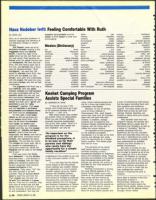
Scanned image of the page. Keyboard directions: use + to zoom in, - to zoom out, arrow keys to pan inside the viewer.
March 15, 1991 - Image 162
- Resource type:
- Text
- Publication:
- The Detroit Jewish News, 1991-03-15
Disclaimer: Computer generated plain text may have errors. Read more about this.