

ENTERTAINMENT
Bitter Friends
•
. .
A JET
production,
based on the
Pollard spy
case, makes the
audience
examine its
attitudes toward
Israel and
America.
Cr
AARON HALABE
Special to The Jewish News
itter Friends, the
Jewish Ensemble
Theater's third pro-
duction this season,
explores the conflic-
ting loyalties many
American Jews feel
toward Israel, the United
States and often toward each
other.
Although the play is fic-
tional, author Gordon
Rayfield says the Jonathan
Pollard spy case provided the
inspiration for the story.
Rayfield wrote Bitter Friends
in the spring of 1987, shortly
after Polldrd was sentenced.
"I thought that the case pro-
vided a very interesting lens
through which to view the
whole question of Ameri-
can/Jewish attitudes and
relationships to Israel."
Bitter Friends describes a
crisis of conscience faced by a
nationally prominent Ameri-
can rabbi. He learns that
an old friend's son has
given Israel classified infor-
mation vital to its security,
but intentionally withheld by
U.S. politicians. Rabbi Arthur
Schaefer, a committed Zion-
ist, must decide if David
Klein is a Jewish hero, a
dangerous fanatic or a victim
of political manipulation by
Israeli and American officials
bent on using him for
political purposes.
Playwright Rayfield, 40,
says Rabbi Schaefer goes on
an emotional journey that ex-
plores a moral dilemma:
When does an individual life
outweigh the considerations
of a state? The story, he says,
analyzes how an individual
can be "run over by the forces
of history and power politics
and what the morality of that
is."
Robert Grossman, a 15-year
veteran of many of Detroit's
largest theatrical venues, por-
trays the rabbi. Mt Grossman
says his character becomes
the conscience of the play
through his interaction with
Klein, the Israeli ambassador,
and a friendly U.S. congress-
man.
"He's kind of the inter-
locutor. Pieces of the story are
unfolded in a series of
monologues where the rabbi
asks questions that speak to
the conscience of the play. Us-
ing tongue-in-cheek and self-
deprecating humor, the
author develops the ideas of
the play through some of the
rabbi's speeches.
"The rabbi is almost a
Greek chorus figure," Mr.
Grossman says. "He par-
ticipates in the action of the
play, but he comes out of the
action between scenes to
discuss with the audience his
feelings and metaphorical at-
titudes!"
The spy, David Klein, is por-
trayed by Allan Fox. Mr. Fox
appeared in The Merchant,
JET's first production this
season. A 1983 University of
Michigan graduate, Mr. Fox
holds a Master of Fine Arts
degree from California In-
stitute of the Arts. He has
acted in numerous television
productions, including "21
Jumpstreet," "Highway to
Heaven," and "Unsolved
Mysteries."
Of the Klein role, Mr. Fox
says the character is
motivated by the memory of
his father who was active
worldwide in support of
Israel. "He was a larger-than-
life man, a hero. He and the
rabbi were role models for the
young Klein," Mr. Fox says.
"And what Klein does is
nothing more than what his
upbringing taught him to do.
The value of his life is mean-
ingless in comparison to the
survival of the Jewish people.
To him, the Jewish people are
more important."
Mr. Fox tries to draw out
the complex motivations and
relationships between him
and other characters. "The
acting process is like a
sculptor who looks at the
piece he's going to sculpt. He
looks in the rock and the
sculpture already exists. And
then he does his best to
enhance what is already
there and take away what is
not necessary," he says.
Mr. Rayfield describes his
character interrelationships
as complicated and they take
intractable moral and
political stands. Therein, he
adds, lies the dramatic ten-
sion of the play. "I tried to
make these relationships as
complicated as possible on the
theory that the more com-
Q.
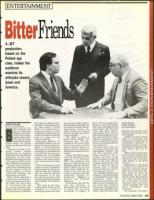
Charles McGraw,
Robert Grossman
and Andrew Dunn.
plicated they are, the more
dramatic and exciting it is for
the audience.
"Despite all of (the rabbi's)
skills in conciliating and
politicking, he finds that for
bureaucratic, diplomatic or
ideological reasons, everyone
is locked into a position they
don't want to give up," he
says.
"What I tried to do is to give
each character a logical posi-
tion to express and show how
they clash. And to me that's
what politics is all about
anyway."
Mr.Rayfield is well-versed
in politics. He received his
doctorate in political science
from City University of New
York where he wrote his
dissertation on the Arab-
Israeli conflict. He hopes the
play raises questions about
the relationship between
American Jews and Israel
and the attitudes they hold
about Washington and
Jerusalem.
"At one point in the play,"
THE DETROIT JEWISH NEWS
69