

THE
MYSTERY
• -301%-,
1'14'
What is the
"bridegroom of
blood"?
(Exodus 4:24-26).
After per fiDrming God's
miracles before Pharoah,
Moses arrives at the home
of his father-in-law, Jethro.
With him are his wife,
Zipporah, and his sons.
God then commands
Moses to return to Egypt.
Moses sets out on his
journey, then stops to rest
along the way.
Next, the Torah states:
"And it came to pass on the
way at the lodging-place,
that the Lord net him, and
sought to kill him. Then
Zipporah took a flint, and
cut off the foreskin of her
son, and cast it at his feet;
and she said: "Surely a
bridegroom of blood art
thou to me" So He let him
alone. Then she said: "A
bridegroom of blood in
regard of the circumcision."
R
abbi
Elimelech
Silberberg of Bais
Chabad of West
Bloomfield explains that the
youngest son of Moses and
Zipporah had yet to be cir-
cumcised. Moses temporarily
postponed the brit because to
have performed the circumci-
sion while on route could
have proved dangerous.
But he should have per-
formed the mitzvah the
first instant possible, not
even taking time to sit and
rest, Rabbi Silberberg says.
When Moses did not do as
God commanded, Rashi
says that God sent a ser-
pent to attack him. Seeing
the serpent, Zipporah real-
ized it was a punishment
7N01
liffii;f46en; -11
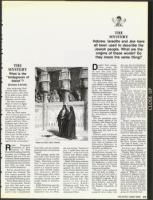
Moses and Aaron before Pharoah.
from God, and she quickly
performed the circumcision
herself.
This passage marks the
first time in the Torah that
a woman serves as a mohel.
To-day, Halachah prefers
that a man perform the
ceremony because brit
milah is a mitzvah incum-
bent upon Jewish males,
not females, Rabbi
Silberberg says. Still, when
no qualified man is
available, Jewish law does
accept women as mohelim,
he says.
Rabbi Silberberg says the
"bridegroom of blood"
remark was directed at
Zipporah's son. In effect,
she was saying, "because of
you, I could have lost my
husband." A son's brit is so
critical that Moses might
have perished because he
neglected the ceremony.
Rabbi Silberberg stresses
that the remark should not
be regarded an accusation
against the child. Earlier
in the Torah, Rachel names
her younger son ben oni,
"son of my pain" (later,
Benjamin), when she dies
while bearing him. The
name is not meant
negatively, Rabbi
Silberberg said. Like the
use of the "bridegroom of
blood," it is simply a
statement of fact.
espite their synony-
mous usage, the
words Hebrew, Israel-
ite and Jew each have
distinct meanings, says Gene
Schramm, professor of Semi-
tics and linguistics at the
University of Michigan.
Dr. Schramm says the
word Hebrew originally ap-
plied to all the descendants
of Avraham, including
Arabs, the Edomites, the
Moabites and the Jews.
The word "Hebrew" (Ivri)
was used to describe
Avraham because he
descended from peoples liv-
ing across the Ever
(Euphrates) River. But it
was never a term Avraham
or any other "Hebrews" ap-
plied to themselves. Instead,
it was a description applied
by outsiders, or non-
Hebrews.
The two exceptions occur
when Joseph speaks of his
brothers, with whom he was
in conflict, as "the Heb-
rews," and when Israelites
discuss Israelite slaves,
whom they also refer to as
"Hebrews."
Ethnic and religious
groups typically do not apply
to themselves terms used by
outsiders, Dr. Schramm
says. Just as Gypsies call
themselves Romanis, so
Jews spoke of themselves as
Israelites, not Hebrews.
Israelites' self-
identification became fur-
ther fine-tuned with the use
of "Jew" (Yehudi) which
served to separate those who
believe in the Oral Law from
the Sadducees, a small sect
who followed the literal
words of the Torah. Both
groups are Israelites.
The word "Jew" is derived
from the tribe of Judah —
but it had to travel quite a
journey before arriving in
the English language. From
the Greek Judah came the
Latin Judaicus, and finally
the French Juif. "Jew" is
the English translation of
Juif
"Jewish" is the generally
accepted term today, but
this, too, has its limitations.
Dr. Schramm notes that the
current outside group,
Christians, are hesitant to
use the word, "Jew." They
prefer to say, "He's a Jewish
person."
For many years, Jews did
not refer to the language as
Yiddish because it contained
the seemingly offensive Yid _ ;
instead, they called it
"Jewish."
The word "Israel" has
undergone numerous
changes since it first ap-
peared in the Torah, Dr.
Schramm says. Today, Jews
generally speak of Israel as
the Zionist homeland. But
when Christians sing the
Christmas song with the
lyrics, "Born is the king of
Israel," they are speaking of
Israel as the Jews, and
Mormons refer to their home
state, Utah, as "the true
Zion."
"Israel" experiences fur-
ther changes when paired
with am, people, or eretz,
land. Am Yisrael generally
means all Jews — both those
in and outside the State of
Israel, Dr. Schramm. says.
Jews who do not recognize
the state's existence will not
speak of "Israel." They pre-
fer Eretz Yisrael, literally
"the land of Israel," not to
give credence to statehood.
Zionists use Medinat
Yisrael, the State of Israel.
Theodor Herzl dreamed of
"a Jewish state," but when
Israel was established the
word "Hebrew" began to ap-
pear everywhere, Dr.
Schramm says. Today, the
Histadrut continues to speak
of itself as the union of
"Hebrew workers."
Dr. Schramm believes this
usage of "Hebrew" was in-
tentional: It appears to iden-
tify Jews as a nation rather
than a religion. Further-
more, Jews knew Christians
were most familiar with the
term; as they sought support
for the new state, they pre-
ferred to use the word most
familiar to the outside
group, Dr. Schramm says.
THE DETROIT JEWISH NEWS
21
CLOSE U P
THE
MYSTERY
Hebrew, Israelite and Jew have
all been used to describe the
Jewish people. What are the
origins of these words? Do
they mean the same thing?