
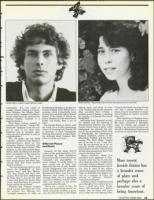

Michael Chabon: Judaism "doesn't feel like a burden."
marginality. Yet, the range of
younger Jewish writers is tremen-
dous. Someone like Allegra Good-
man is totally steeped in tradition.
On the other hand, for someone like
Michael Chabon, Judaism is a
lingering shadow.
"Only those writers steeped in
Judaism will survive," warned Mr.
Solataroff. "Judaism is not the sub-
ject it used to be when anti-
Semitism was so rampant, espe-
cially now that pluralism is such an
established fact."
"The old greats are not being'
replaced," cautioned Judy Meltzer,
undergraduate dean at the
Baltimore Hebrew University, who
teaches modern Jewish fiction. "The
question is who will succeed them.
Bellow, Roth and Malamud had dif-
ferent perceptions of the American
Jewish experience. They were
secure and comfortable enough in
their Americanness and their Jew-
ishness that they could question
their Jewishness.
"The new generation did not expe-
rience the Yiddishkeit of their
parents' time," said Mrs. Meltzer.
"Yet, they deeply feel their Jew-
ishness. This has been settled more
for them than it was for the older
writers, but there are always other
issues. Anti-Semitism, for example,
keeps rearing its ugly head."
Novelist and essayist Cynthia
Ozick worries that many new Jew-
ish writers are offering only
"vestigial remnants of what our
grandparents thought, or giving us a
random Yiddish word. What I see is
sociology, which is essentially much
of what we've already had [in Jewish
fiction]. If the future of Jewish fic-
tion in America is to be memories of
Bubbe and Zeyde, then I see no
hope."
For Jewish fiction to thrive, said
Ms. Ozick, for it to offer penetrating
visions of contemporary Jewish life
in America, it must "incorporate
thinking about Israel, or start think-
ing seriously about Judaism. Eth-
nicity is not the way to go."
Different Places
and Roots
Virtually all the major Jewish
writers of the past generation were
surrounded by their Jewishness
from early in life. It was everywhere,
irrefutable and unavoidable: on
street corners, in candy stores, in
their speech and in their soul.
Malamud, the son of poor Russian
Jewish immigrants, was raised in
Jewish Brooklyn; Bellow, the son of
Russian-born Jews, was born near
Montreal and raised in Jewish
Chicago; Roth, son of a struggling
insurance salesman, was the story-
teller and jokester in his Jewish
neighborhood in Newark.
Theirs was a world of Jews. No
matter how much being Jewish con-
fused, infuriated, troubled, or gnaw-
ed at this triumvirate, it still largely
Allegra Goodman: "My generation has much less ambivalence and more love of self."
defined them and much of their
work. Traditionally Jewish elements
often pervaded their writing: a
puckish sense of humor, a questing
for identity, a Talmudic-like search
for answers.
Reflecting Jews' dispersal around
the country and the lowering of
discriminatory barriers, the newer
Jewish writers have a more varied
background. As virtually the only
Jew in her elementary school class
in Westchester, the classmates of
Rebecca Goldstein, author of The
Mind-Body Problem and the forth-
coming, The Dark Sister, "leaned
over to be nice to me. I was their
Jew. By not growing up in an ex-
clusively Jewish environment, one
knows [more of] other cultures than
did the other generations that wrote
almost only about Jews."
Allegra Goodman, whose first
published story appeared in Com-
mentary when she was 17, was rais-
ed in what she calls a "traditionally
Orthodox" family in Hawaii, a situa-
tion which probably gave her a front-
row seat to some of the culture
clashes that pepper her book: kosher
luaus, an Orthodox Yom Kippur ser-
vice on a veranda on Oahu, the
mixing of Hebrew, Yiddish,
Hawaiian and English.
And Steve Stern recalled growing
up in Memphis "where there were no
Jews. I could have been Presby-
terian. We belonged to a Reform
temple with an organ with pipes,
and a rabbi who wore flowing robes.
Living in the South, envying friends
who had a strong Southern tra-
dition, it never occurred to me that I
had a tradition on which I could fall
back, also."
After ramblings in England and a
sojourn on a commune in Arkansas,
Mr. Stern returned to Memphis,
when he "finally got around to
writing. I set one novel I wrote in my
late 20s in Elizabethan England and
wrote lots of stories that were set in
More recent
Jewish fiction has
a broader sense
of place and
perhaps also a
broader sense of
being American.
THE DETROIT JEWISH NEWS
49