
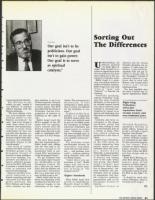

Our goal isn't to be
politicians. Our goal
isn't to gain power.
Our goal is to serve
as spiritual
catalysts."
termining Jewish identity.
The decision on gay
rabbis, he said, "makes it
very difficult" to continue
official dealings with the
Reform rabbinate.
"We have talking, work-
ing relationships with
leading rabbis in the
Reform movement," he
said, "and we're trying to
make them aware of our
concerns and sensitivities,
trying to make them
understand our fear not
just that this decision is a
bad decision, but that this
decision coupled with other
decisions...(is) ultimately
extremely divisive to the
Jewish people."
One arena of conflict
between the RCA and non-
Orthodox groups is the
Synagogue Council of
America, a loose confedera-
tion of six Orthodox, Con-
servative and Reform re-
ligious umbrella groups,
such as the RCA. SCA tries
to present a united Jewish
front in interfaith and
governmental dealings.
However, the SCA is cur-
rently embroiled in a
dispute regarding who has
veto power over SCA dele-
gation selections. The
SCA's Reform and Conser-
vative members say dele-
gate selection is up to in-
dividual agencies, who pick
representatives according
to given quotas. The RCA
has sided with the Union of
Orthodox Jewish Con-
gregations of America in
insisting on the right of
veto.
Rabbi Angel said the
RCA's support of the OU
stems from his organiza-
tion's concern that the
Reform organizations
might some day pick a gay
rabbi or "patrilineal Jew"
to be part of a SCA delega-
tion.
"We can't have people
like that representing us,"
Rabbi Angel said, adding
that the veto issue is im-
portant enough to be
potentially fatal to con-
tinued RCA participation
in the Synagogue Council.
"We get attacked from
the so-called right-wing for
our membership in the
Synagogue Council. We
pay a price for our associ-
ation with the Reform and
Conservative movements.
But it's a price that we've
been willing to pay so far."
Rabbi Angel said he can
forsee the possibility of the
breakdown of the SCA over
"internal breaks in the
mechanism of the organ-
ization. The veto power is a
mechanism. If that
mechanism is taken away,
then it will be very difficult
for the Orthodox to con-
tinue."
To give in on this, he ex-
plained, is a compromise
the RCA cannot abide. Nor
is there any political need
to give in, he added, given
the resurgence of strength
American Orthodoxy has
experienced in recent
years. "Orthodoxy is feel-
ing more strength now, so
it's asserting itself. We feel
very confident and secure,"
he said.
The Orthodox versus
non-Orthodox division, he
reluctantly concluded,
could well end with Ameri-
can — and perhaps even
world — Judaism splitting
along Halachic lines into
two distinct faiths.
"I don't like to ever say
anything is lost," Rabbi
Angel said, but he de-
scribed the current situa-
tion as being at "the
dangerous level."
Higher Standards
When Rabbi Angel first
arrived at Congregation
Shearith Israel in 1969,
rabbis accommodated
Sorting Out
The Differences
u
nderstanding the
difficult political
vise Rabbi Marc D.
Angel finds himself in re-
quires an appreciation of the
various positions that have
been staked out in the con-
temporary Orthodox world.
Rabbi Angel is a propo-
nent of so-called centrist or
modern Orthodox Judaism.
Rabbi Angel also uses such
terms as "open" and
"tolerant" to describe his
thinking.
Generally speaking,
centrist Orthodoxy recog-
nizes the value of secular
education, is less severe in
its attitude toward Jewish
law, and is relatively more
inclined to increased par-
ticipation by women in re-
ligious and leadership roles
than those on the Orthodox
right.
Centrists also favor in-
volvement in the larger,
non-Jewish, society and
have been willing to work
with non-Orthodox Jews on
a variety of issues. They
also attach religious
significance to the state of
Israel.
Right-wing Orthodoxy,
on the other hand, ad-
vocates separation from
secular society and non-
Orthodox Jews. For exam-
ple, Rabbi David
Hollander, a past president
of the Rabbinical Council
of America and leading
voice of the right within
that group, says Rabbi
Angel's primary goal
should be to "draw a clear
line of demarcation" bet-
ween Orthodox and non-
Orthodox Jews by ending
all associations with Jew-
ish religious umbrella
organizations such as the
Synagogue Council of
America.
Agudath Israel of
America and the various
Chasidic dynasties are ex-
amples of right-wing Or-
thodox organizations.
Agudath does not get in-
volved in groups such as
the Synagogue Council of
America because it be-
lieves that to work with
Reform and Conservative
rabbis only helps
legitimize them.
Nor does Agudath give
the state of Israel any re-
ligious significance. Rabbi
Right-wing
Orthodoxy
advocates
separation from
secular society and
non-Orthodox Jews.
Yitzchok Brandriss,
Agudath's director of
public affairs, termed his
group's attitude toward
Israel as "non-Zionist."
Rabbi Angel and other
centrist Orthodox leaders
are criticized by the right
for their perceived leniency
on the issues. That
criticism, to which they are
highly sensitive, comes
from both within the RCA
and from groups such as
Agudath.
Rabbi Basil Herring, an-
other RCA official, said he
expects most of the
pressure on Rabbi Angel to
come from outside the
organization. "Agudath is
continually trying to push
the RCA to the right," he
said.
It should be noted that
within Orthodoxy, there is
virtually no left wing.0
THE DETROIT JEWISH NEWS
I.R.
31