
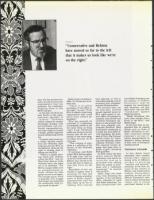

"Conservative and Reform
have moved so far to the left
that it makes us look like we're
on the right."
June. For the previous two
years, he had served as the
organization's first vice
president, the traditional
stepping-stone to the
RCA's top spot.
In the past, the RCA has
been known as the organ-
izational upholder of
"modern" Orthodox
values; respect for secular
knowledge, dialogue with
non-Orthodox and non-
Jewish representatives,
and what might be termed
a kinder, gentler approach
toward interpreting Jewish
law.
In recent years, however,
a widely reported assault
from the Orthodox right
wing has put the RCA on
the defensive. Some say the
right is already close to
taking over the RCA.
"There's a rapidly grow-
ing 'black hat' element
within the RCA," said one
West Coast observer of the
Orthodox scene, who asked
not to be identified. "The
RCA's younger rabbis have
an uncompromising at-
titude, whereas the older
group was not as stringent.
This younger group, which
is generally even younger
than Angel, has radicalized
the membership while try-
ing to push its agenda."
Rabbi Angel would beg to
differ. Or at least put it an-
other way.
"There is no great
movement of the RCA to
the right," he said. "If the
RCA is indeed a right-wing
organization they could
never have elected me
president."
What has occurred, he
continued, is "a tightening
of standards (which) is not
the same thing as being
right wing. Different
rabbis are trying to do this
because they see the com-
munity is now more recep-
tive than, let's say, 10, 20
years ago.
"This raising of stan-
dards is a reflection of the
success of the Orthodox
rabbinate."
If anything, said Rabbi
Angel, RCA actions appear
to be right wing "only be-
cause the Conservative and
Reform have moved so far
to the left that it makes us
look like we're on the
right."
Regardless of how one
chooses to explain what is
occurring, it's clear that
since he became president,
much of Rabbi Angel's
organizational time has
been taken up by the in-
fighting these tensions
have spawned, as well as
with public damage control
stemming from newspaper
accounts of those battles.
The accounts have, for
the most part, revolved
around reported moves by
RCA right-wingers to cen-
sure rabbis who attempt to
maintain intra-Jewish and
interfaith theological dia-
logues on the grounds that
they have allegedly com-
promised Halachah. Most
prominently mentioned as
a target has been Rabbi Ir-
ving Greenberg, the presi-
dent of CLAL, the National
Jewish Center for Learn-
ing and Leadership, and an
ordained Orthodox rabbi.
The reported censure at-
tempt took place prior to
Rabbi Angel's becoming
RCA president.
No RCA action has been
taken against Rabbi
Greenberg, who said in an
interview that he is
precluded from talking
about the matter in accor-
dance with a "settlement
agreement" he reached
with the RCA.
Rabbi Angel also shied
away from discussing the
specifics of the Greenberg
affair, although he noted
that Rabbi Greenberg "has
been a friend of mine" ever
since Rabbi Greenberg was
his teacher at Yeshiva
University, that he
respects his commitment
and intentions, and that
there never was any RCA
"witch-hunt" against
Rabbi Greenberg.
"Rabbi Greenberg, like
every other member, has a
forum in the RCA," said
Rabbi Angel
At the same time, he em-
phasized that he regards
efforts such as those of
Rabbi Greenberg to pro-
mote consensus among
Judaism's various re-
ligious denominations as
doomed to failure because
of their lack of theological
common ground.
Narrower Grounds
In fact, Rabbi Angel
lamented, what common
ground there remains
among Jews of different
stripes is growing
"narrower and narrower"
primarily, in his view, be-
cause of the actions of
Reform and Conservative
leaders. Particularly
upsetting, he said, are the
Reform movement's deci-
sions to ordain homosexual
rabbis and to accept
patrilineal descent in de-