
The Challenge
The sixth-grade class of Hillel Day School is sponsoring
a letter-writing contest, open to everyone in the commun-
ity. The contest —for the most and best letters written —
begins Oct. 29 and ends Nov. 26. Letters are to be written
to the class' adopted refusenik family, Roman and
Svetlana Sorkin and their children Igor, 16; Renata, 13
and Khanna, 2.
The class will purchase an ad in The Jewish News with
the winner's name and photograph.
Contest rules:
1) Children under 6 may draw pictures. Each picture
equals one letter.
2) Each written letter must be at least five sentences
long.
3) No Xeroxed or duplicate letters.
4) Letters must include a 45-cent stamp, an envelope
addressed to the Sorkins and the writer's return address.
DO NOT SEAL ENVELOPE. The Sorkins' address is:
Roman and Svetlana Sorkin
RSFSR
g. Penza 440028
ul. Udarnaya, d. 22, kv. 24
5) Letters should be personable and friendly. Discuss
your school, family, pets and hobbies. Do not say anything
negative about the Soviet Union or the government.
6) Include a slip of paper with your name, age, address,
regular and Hebrew school and phone number.
7) Bring or mail letters to Hillel Day School, 32200 Mid-
dlebelt Rd., Farmington Hills. There will be a mailbox for
contest letters on a table by the school's front door.
2
Soviet Union for freedom in
the United States; her
grandmother, who lives in
Baku, still awaits an exit
visa.
One of two Soviet immi-
grants in the class, Olga
tells her classmates that life
in the Soviet Union is quite
different from that in the
United States. But she
doesn't speak of economics
or political freedoms; Olga
describes the discrepancies
in terms of ice cream.
"In Moscow, you have to
stand in line for two hours to
get ice cream," she says. You
could go elsewhere for the
dessert, "but it would be the
same thing."
The students are constant-
ly raising their hands. They
want to know: what does the
word "defect" mean? When
a refusenik emigrates, could
the family he leaves behind
be punished?
Often, they speak of their
own immigrant families.
Hillary Rubin announces,
"My father came from Ger-
many." His journey was
difficult, she says, adding,
"My mom, on the other
hand, is from Buffalo."
From her fourth-grade
class, Mrs. Granader steps
down the long hall to her fif-
th and sixth-grade students,
who are starting work on
their big project: a contest
encouraging support for
Soviet Jewry (see box).
The room smells of peanut
butter and potato chips and
is filled with the sound of
lunch bags and soda cans be-
ing opened.
The students bring letters
they have received from
their "adopted" refuseniks.
The letters speak of the
family's hobbies and their
pet dog. Sometimes, post
cards of animals and land-
scapes are included.
"We want the (Soviet)
government to know that we
care about the families,"
says Jessica Alter of her
many letters to Soviet Jews.
Adds sixth-grader Sarah
Goldfein, "How could I just
stand by when somebody
needs help?" ❑
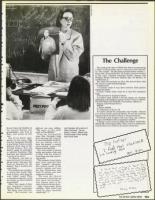
Judy Granader with a picture of
Valery Zelichenok: "We are
seeing a miracle." (Below right):
Students speak of their feelings
about Soviet Jewry.
\IQ
11-
N 5
CO
vei
...11-N
(
v,
1/4\
t
kcy,
V.e
'
•
;
\C
0 ‘-ki
1 C3
THE DETROIT JEWISH NEWS
103
Scanned image of the page. Keyboard directions: use + to zoom in, - to zoom out, arrow keys to pan inside the viewer.
October 26, 1990 - Image 103
- Resource type:
- Text
- Publication:
- The Detroit Jewish News, 1990-10-26
Disclaimer: Computer generated plain text may have errors. Read more about this.