

I HOLIDAYS
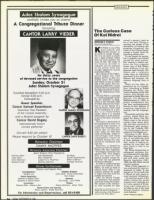
Adat Shalom Synagogue
cordiolly invites you to attend
A Congregational Tribute Dinner
honoring
-
CANTOR LARRY VIEDER
The Curious Case
Of Kol Nidrei
BERNARD S. RASKAS
Special to The Jewish News
K
for thirty years
of devoted service to the congregation
Sunday, October 21
Adat Shalom Synagogue
Cocktail Reception 5:30 p.m.
Dinner 6:30 p.m.
Followed by
Guest Speaker,
Cantor Samuel Rosenbaum
Executive Vice President
of the Cantors Assembly,
CANTOR SAMUEL ROSENBAUM
and o Musical program by
Cantor David Bagley,
internationally known
concert performer
Couvert $40 per person
Please respond by October 10
CANTOR DAVID BAGLEY
Honorary Chairman
DANNY KNOPPER
Honorary Associate Chairmen
Adat Shalom Post Presidents
Sol Moss
Gerald Rosenbloom
Milton Shiffman
Rudolph Shulman
Joel Gershenson
Max Goldsmith
Judge Ira G. Kaufman
Norman Leemon
Norman Allan
Julius Allen
Irwin Alterman
Barbara Cook
Dinner Co-Chairmen
Sharon and Martin Hart
Arrangements
Shabbat Kiddush
Beverly Liss
Guest Hospitality
Judy Leder Elaine Rosenblatt
Pam Salba
Beverly & Robert Dock
Babette & Willard Posen
Paul Magy Larry Wolfe
Sponsors
Invitations
Tickets
Roberta Blitz Arlene Lubin
Sidney Feldman Asher Tilchin
Reservations and Seating
Terron Leemis Shelly Newman
For Information and Reservations, call 851-5100
24
FRIDAY SEPTEMBER 28. 1990
ol Nidrei is one of the
most popular and
powerful prayers to
be found in Jewish liturgy.
Yet it is not really a prayer
but a legal formula which
does not even mention the
name of God. The origin of
its famous melody is
unknown and its inclusion
in the prayer book was
strongly opposed by several
prominent rabbis.
The setting of Kol Nidrei,
which begins the Yom
Kippur service, is that of a
Jewish court. Two people
hold Torah scrolls at either
side of the cantor, thus con-
stituting a Beth Din, a court
of three which is required for
the legal procedure of gran-
ting the dispensation from
vows.
The Kol Nidrei is preceded
by a brief paragraph invok-
ing the Academy on High,
which is the heavenly body
of rabbis. Because the recita-
tion is in the nature of a
court procedure, which could
not be conducted on a holi-
day, it is recited before
sunset. Since it is chanted
before dark, it is the practice
to put on the tallit, or prayer
shawl.
The text is a declaration of
the annulment of vows. It is
a precise legal formula in
which the worshiper pro-
claims that all personal
vows, oaths, etc. that they
made unwittingly, rashly or
unknowingly (and which
consequently cannot be
fulfilled) during the year
should be considered null
and void.
However, it should be
pointed out that the Talmud
(Yoma 8:9) says explicitly,
"Yom Kippur atones for sins
against God. Yom Kippur
does not atone for sins
against another human be-
ing until one has placated
the person offended."
In order to understand the
nature and function of Kol
Nidrei, we must go back to
biblical times, when it was
common practice for people
to make vows that could not
possibly be honored.
After the Second Temple
was destroyed, this practice
continued among the people.
The leaders of the commun-
ity were troubled, for they
Rabbi Bernard S. Raskas is
rabbi emeritus of the Temple of
Aaron in St. Paul, Minn.
viewed a person's word as
his or her bond. Failing to
convince the people of the
desirability of avoiding rash
promises altogether, the
rabbis of the Talmud finally
created a formal ritual for
annulling unkept vows.
No one knows for certain,
but it probably was started
around the ninth century.
Rav Amram's siddur con-
tains the first complete
known text of Kol Nidrei,
quite different from the
talmudic legal formula. Kol
Nidrei was a collective
rather than an individual
annulment. It is a mixture of
Hebrew and Aramaic, the
common language then in
use.
There are two other ex-
planations for its introduc-
tion. According to Rabbi
Mordecai ben Hillel, who
lived in Germany in the 13th
century, this formula was
instituted by Rabbi Meir ben
Baruch, the Maharam
MeRothenburg (d. 1293), to
permit transgressors who
had been excommunicated
because of their defiance of
communal regulations to
worship with the congrega-
tion.
Toward the end of the 19th
century, Joseph Bloch pro-
posed the theory that Kol
Nidrei arose in the seventh
century when secret Jews,
who had been converted to
Christianity after persecu-
tion by the Visigoths (590-
711), would come to the syn-
agogue on Yom Kippur eve.
According to Mr. Bloch,
Kol Nidrei was their expres-
sion of overwhelming grief
at their apostasy, and was
their means of seeking ab-
solution for vows they had
been forced to take to an
alien faith.
Mr. Bloch claimed that in
subsequent centuries, dur-
ing persecutions by the later
Byzantine rulers (700-850),
and still later under the
Spanish Inquisition (1391-
1492), the Kol Nidrei served
a similar purpose.
When it first appeared, it
was condemned by many ge-
nerations of rabbis. It was
opposed on the grounds that
it offered an easy means to
avoid personal obligations.
The spiritual power of Kol
Nidrei among the people
resisted every challenge put
to it over a period of 10 cen-
turies, and it comes down to
us today as one of the most
beloved liturgical elements
in all Judaism.
Jewish Telegraphic Agency