

R
American
Jewish
philanthropy
was tested as
never before on
behalf of
Operation
Exodus, a $420
million effort to
resettle Soviet
Jews in Israel
and America.
By year's end,
predictions for
resettlement in
Israel in the
next few years
reached the
billions of
dollars.
The Testing Of American
Jewish Philanthropy
A
merican Jewry this year
launched an unprecedented
campaign on behalf of
Soviet Jewry resettlement.
And while the dollars raised
were impressive, the questions raised
remain unanswered — namely
whether the community is prepared
to sustain the emergency level of
philanthropy necessary over the next
few years and whether the immi-
grants who arrive in America will
live Jewish lives.
In addition to meeting the costs of
resettlement for the 50,000 Soviet
Jews expected to come to America
annually, local Jewish communities
are committed to acculturating them
Jewishly and helping to pay for
Soviet Jews settling in Israel.
Operation Exodus, the United
Jewish Appeal's national emergency
campaign, was created in January
and pledged to raise $420 million
over three years from American
Jewry for Soviet Jewish resettlement
in Israel.
An emergency general assembly of
the Council of Jewish Federations
was held in Miami in early February
to determine how communities
should be assessed. The delegates
agreed on a policy of "equitable col-
lective responsibility," or, in simpler
terms, for communities to commit to
pay their fair share for the
resettlement.
American Jewish leaders
acknowledge that many of the Soviet
Jews who came to America in the
1970s were lost to the Jewish com-
munity. Though they were provided
52
FRIDAY, SEPTEMBER 21, 1990
for in terms of housing and employ-
ment, not enough was done for them
in terms of Jewish acculturation. As
a result, a number of communities
have made a major effort to reach
out to the current crop of im-
migrants, whose knowledge of and
attachment to Judaism is often
marginal.
Volunteers are being recruited to
participate in direct family to family
programs, synagogues are providing
instructional services and classes,
and Jewish communal agencies are
encouraging the newcomers to par-
ticipate in religious activities.
But the major concern is still
financial. Communal leaders are
worried about going back to con-
tributors, after requesting emergency
funds this past year, and acknowl-
edging that the emergency is more
long-term than temporary. Soviet
Jews may be leaving the USSR at a
rate of more than 150,000 a year for
the next five or 10 years. How long
will American Jewry continue to
bear the burden?
And how will community services
be affected on the local level? With
the U.S. economy approaching a
recession, polls indicating that
younger American Jews feel less at-
tached to Israel and Jewish causes,
and Jewish federations worried that
centralized giving may have peaked,
the ability to maintain the current
level of fund-raising — not to men-
tion increasing that level — will be a
major challenge in the year ahead. ❑
E
Making The Talmud
More Accessible
I
he image of a bearded Israeli
rabbi discussing the publica-
tion of his latest book on
"Good Morning America"
was unusual enough, but
when the American public learned
that the book was the Talmud, it
was clear that this was a unique
event.
The rabbi was Adin Steinsaltz, a
soft-spoken Jerusalem scholar who
has spent the last two decades
translating the Talmud, the multi-
volumed compilation of the Oral
Law, from Aramaic to Hebrew. He is
halfway through that mammoth
undertaking and now, with Random
House as his publisher, has produced
the first volume of the English
translation of his Hebrew version of
the Talmud.
As Arthur Magida noted in a
Detroit Jewish News cover story
on the event, "this was the first time
that the Talmud had come out of a
major, mainstream publishing house,
one with the resources to produce an
edition more graphically attractive
than many that had preceded it —
and the resources to mount a full-
scale promotion for the Talmud, a
peculiar turn of events given that
the Talmud has survived reasonably
well minus a media blitz for about
1,300 years."
The Steinsaltz English Talmud has
been greeted by hosannas from some
Jewish leaders who are hopeful that
making the Talmud more accessible
to American Jews may spur a re-
newed interest in Jewish study. The
Talmud is the source of Jewish law
whose study has been the base of
Jewish religious life for centuries.
But until now, its Aramaic text and
complexities of logic have made it
almost solely the domain of scholars.
It is those scholars who are most
skeptical about Rabbi Steinsaltz's ef-
forts. Many Orthodox rabbis see the
Steinsaltz Talmud, be it in Hebrew
or English, as a crutch, a Cliff Notes
summary, rather than an authentic
textual experience.
They scoff at the media attention,
including full page ads from Random
House in the New York Times pro-
claiming: "Read It. Study It.
Treasure It. As you never could
before."
Still, the fact remains that one
million copies of Rabbi Steinsaltz's
Hebrew translation of the Talmud
are in print. He has translated 21
volumes of an anticipated 40-volume
set. It is expected to take the rabbi,
who is 52, another 15 years to com-
plete the project.
As for the English translation,
Random House reported sales of
25,000 of the Talmud, now in its
third printing. And a second volume
is due out next year.
Clearly, the interest in the Stein-
saltz Talmud in English is an indica-
tion that there are numbers of Jews
seeking to connect with their Jewish
heritage. Whether they will delve
into, or simply read, the Talmud, and
whether that experience leads them
to further Jewish study, remains to
be seen. In the meantime, Rabbi
Steinsaltz sits in his Jerusalem of-
fice, chipping away at the notion
that the wisdom of the Talmud is
out of bounds to every Jew. EJ
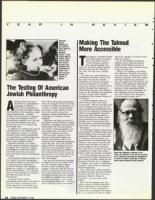
Rabbi Adin Steinsaltz, translator of the
Talmud into Hebrew for the last two decades,
was in America to promote his translation of
a volume in English, published by Random
House amidst extensive media attention.