

, 77
•,3
E
I
A
N
E
E
W
A Distancing Between
The U.S. And Israel.
R
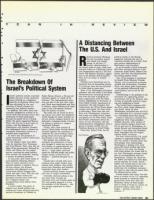
Artwork from Narsgay by Ned Lreink. Copyright. 1990.1.9wwity. Dismbuted by Los Ankles Tines Syndicabk
The Breakdown Of
Israel's Political System
I
srael's political system unraveled
before the eyes of the world this
year, pointing up a desperate
need for an electoral reform that
was advocated by the vast
majority of Israeli citizens but
ignored by her political leaders.
In addition, the Labor party has
virtually collapsed as a result of in-
ternal strife and external events that
undermine its basic philosophy.
Though the public favors Yitzhak
Rabin, the party supported Shimon
Peres, who has yet to lead Labor to
victory. And the alignment of
Palestinians with Saddam Hussein
has undermined Labor's reliance on
reasonable Palestinian parties in a
possible peace negotiation.
At year's end, the prospect of
Labor returning to power seems more
remote than ever.
In the cabinet, there were defec-
tions by ministers Ezer Weizmann
and Ariel Sharon. Then came the col-
lapse of the government, followed by
Labor and Likud, the two largest
parties, courting the small parties,
most notably the Orthodox, making
a variety of political promises.
At one point, after many weeks of
such political jockeying, Shimon
Peres of Labor seemed to have
patched together a coalition. But at
the last minute, two Knesset
members with allegiance to the
Lubavitcher Rebbe changed their
minds and their votes. This not only
prevented a Peres victory but
prompted outcries from those who
felt a religious leader was
manipulating Israeli politics from
Brooklyn.
A month earlier, the power of
religion over Israeli politics was
underscored when national television
carried a broadcast in Yiddish by
Rabbi Eliezer Schach, a 92-year-old
Orthodox leader, to 10,000 of his
followers. The unprecedented atten-
tion was due to the fact that Labor
and Likud were deadlocked and Rab-
bi Schach, whose followers had eight
seats in the 120-member Knesset,
held the balance of power.
The rabbi was on record as favor-
ing Likud, but Labor was hoping he
would change his mind. Instead, he
did not discuss religion directly but
delivered a stinging rebuke of Labor
for failing to practice or support
traditional Judaism.
Finally, after three months of
inertia, Likud leader Yitzhak Shamir
stitched together the narrowest of
coalitions (61 seats) without Labor,
giving Israel the most right-wing
government in her history.
But already the coalition has
outlasted the predictions of many
who thought it would not survive.
And despite an unprecedented out-
cry from the public for electoral
reform — large rallies, petitions
signed by 500,000 people and public
hunger strikes across from the
Knesset — political life goes on as
usual.
Israelis have reacted with more
cynicism than anger. Rather than
sustain their protests, they simply
shrug their shoulders and distance
themselves from their leaders.
Israel's political system, as proven
this year, is simply unworkable.
Ironically, electoral reform is the
one cause that virtually all
American Jews and Israelis agree on.
The only people opposed to it are
the members of the Knesset — the
only people empowered to affect
change. ❑
elations between Washing-
ton and Jerusalem waxed
and waned, but mostly
waned, in the last 12
months, deteriorating to
the lowest point in years. Only such
external events as a Palestine Libera-
tion Organization raid on a 'Ibl Aviv
beach and Saddam Hussein's aggres-
sion in the Persian Gulf seemed to
force the U.S. closer to Israel's
position.
Perhaps more disturbing were in-
dications that an increasing number
of American Jews feel less attached
to Israel than in years past.
Most of the Washington-Jerusalem
problems were the result of the Bush
administration's increasing frustra-
tion with the lack of progress on
peace negotiations with the Pales-
tinians, highlighted by Secretary of
State Baker's public expressions of
impatience. He told Congress that
Israel knows the White House phone
number and should call when ready
to talk peace. There were also con-
flicts over Washington's insistence
that Israel not settle Soviet Jewish
immigrants on the West Bank, Presi-
dent Bush's statements about the
status of east Jerusalem, and the
administration's unhappiness when a
group of Israelis settled into the
Christian Quarter on Good Friday.
When Sen. Robert Dole, the Re-
President GEORGE BUSH
publican leader in the Senate,
suggested reducing the level of
American foreign aid to Israel, there
were serious repercussions in
Washington and Jerusalem.
In an unusually critical statement,
Ibm Dine, executive director of the
American Israel Public Affairs Com-
mittee, said that the administration
was tilting against Israel.
Part of the problem is attributed
to Israeli Prime Minister Yitzhak
Shamir, who is perceived as narrow-
minded and intransigent. President
Bush, who places great importance
on his personal relationship with
world leaders, has no use for Mr.
Shamir.
Contributing to the problem is the
formation of a right-wing Israeli
government, led by Mr. Shamir, after
months of shameful political jockey-
ing and infighting in Israel.
The United States dialogue with
the PLO, which Israel objected to,
was finally called off after
Washington concluded that the PLO
was responsible for a terrorist attack
on a Jerusalem beach this spring.
Israel's I-told-you-so attitude was
heightened when Iraqi president
Saddam Hussein, after months of
vicious threats against Israel that
fell on deaf ears in Washington, at-
tacked Kuwait and threatened Saudi
Arabia. It was then that President
Bush responded with the largest
military airlift in history.
For now, Israel and the U.S. stand
together in opposing Saddam Hus-
sein: but Israel is worried about the
increasingly close relationships
Washington is forging with Arab
states like Saudi Arabia and Syria.
The fear is that after the Persian
Gulf crisis abates, the Arabs will in-
sist that Washington pressure Israel
into an accommodation with the
Palestinians. Neither Mr. Bush nor
Mr. Baker are believed to have deep-
seated empathy for Israel. Jewish
leaders are worried that in the corn-
ing year the administration may
undermine the confidence necessary
for Israel to.take risks for peace that
the administration seeks.
Jewish leaders also worry that the
sense of erosion in the U.S. regarding
Israel extends to American Jews,
particularly those born after the
Holocaust. Many of these people
tend to think of Israel as a given, an
historical reality, rather than a
fragile — perhaps miraculous —
creation. ❑
THE DETROIT JEWISH NEWS
51