

FINE ARTS
Photo by Glenn Triest
O
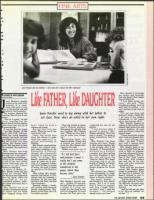
Janis Roszler with her children: "I don't quit until I capture the little neshomas."
ELIZABETH APPLEBAUM
Assistant Editor
anis Roszler's teacher
looked at the little firl's
drawing of a swan.
Janis had spent a long
ime on the picture and was
nvinced it was beautiful.
The teacher admired the
drawing. Then he tore it into
pieces.
"Now do it again," he told
Janis, teaching her the
lesson that if you can make a
piece of art once, you can do
it a second time.
It was her first art lesson
— one Mrs. Roszler, of Oak
Park, still finds relevant.
When her young daughter
recently ran across the yard
1 and slipped on top of a draw-
ing her mother was com-
pleting, Mrs. Roszler didn't
panic. She had done it once,
she reasoned. She could do it
again.
Mrs. Roszler has been
drawing since she was a girl,
but only now is her work —
pastel sketches of children —
coming to the forefront. She
is one of two local artists
whose drawings are on
display at the Tiferet
Gallery in Oak Park.
A native of Skokie, Ill.,
Mrs. Roszler never had any
formal art training. What
she did have was inspiration
from her father, whom she
described as "an ac-
complished amateur artist"
who spent time every day in
studio.
Mrs. Roszler sat in on
Tuesday evening community
art classes with her father
and "tagged along with
Li FATHER, Like DAUGHTER
Janis Roszler used to tag along with her father to
art class. Now, she's an artist in her own right.
him" when he took a
summer art course.
But her first love was
music. When she was 9, she
took up the viola.
Later, she would turn
down the chance to make
music her career as it re-
quired performing on
Shabbat.
Mrs. Roszler continued her
artistic and musical inter-
ests while studying at the
University of Illinois,
though she eventually
majored in business and
foods. In college, Mrs.
Roszler completed her first
major art piece: an oil pain-
ting of a haggard woman
and child. Painted in shades
of brown, the work is based
on a picture in The Family of
Man.
After college, Mrs. Roszler
married and settled in Pitt-
sburgh with her husband, a
physician. By the time they
moved to Oak Park, she had
three daughters.
Between raising a family
and working with numerous
Jewish organizations, Mrs.
Roszler found little time left
for artistic pursuits.
Then she visited Avraham
Leaf's Tiferet Gallery.
Discussing the exhibits with
her husband, Mrs. Roszler
said, "Those are nice. But I
can do some nice things,
too."
Returning home, she
began to sketch. Using a box
of pastels her father had
given her, Mrs. Roszler drew
a picture of a rabbi.
Rabbis soon gave way to
"It's not just faces
and features I want; I
really feel I get some
of the children
transferred to the
paper, where they
become alive."
— Janis Roszler
Mrs. Roszler's favorite sub-
ject — children. For two-and-
one-half days she worked on
a picture of a young, red-
haired boy she found on the
cover of a magazine. It would
become the first piece she
completed for sale by the
gallery.
"I was nervous when I
started to sketch," Mrs.
Roszler admitted. "But I just
said to myself, 'I'm going to
make something they'll
love.' "
Mrs. Roszler has been
drawing ever since, though
it often means starting late
in the evening, after a full
schedule of homemaking,
working as a dietetic
counselor and then getting
her three daughters to bed.
She also serves as the
Yeshivat Akiva PTA board
chairman and is on the
boards of Family to Family
and Project Achim, an Or-
thodox program for Soviet
Jews.
She chooses her subjects
from photographs in maga-
zines or books. Her favorite
theme is Hasidic children.
She doesn't hesitate to
ask friends for their family
photos. "But a lot of times
they'll bring in portrait
shots from a studio. That's
not what I want. I want the
out-takes — the pictures
nobody wants you to see."
Mrs. Roszler's drawings
are solemn and haunting;
that she doesn't draw happy
faces is deliberate.
"I love these moody pic-
tures," she said. "That
thought-provoking, kind of
quiet part of a person — it's
very exciting to get that on
paper.
"It's not just faces and
features I want; I really feel
I get some of the children
transferred to the paper,
where they become alive."
Mrs. Roszler begins by
making a light outline of her
subject, then colors it in and
creates shadows. At each
point she strives to show the
pensive mood.
"I know the picture is done
when I get an intensive feel-
ing —everything just
clicks," she said. "I don't
quit until I capture their
little neshomas (souls)."
Mrs. Roszler plans to do-
nate all profits from her art
work to Aleh, an organiza-
tion that aids severely brain-
damaged children. With of-
fices in New York, London
and Israel, Aleh workers
care each day for the chil-
dren and plan weekend
outings for them.
Even with her new-found
success, Mrs. Roszler keeps
things in perspective. When
she runs into a problem, she
doesn't hesitate to turn to
more experienced artists.
"Just the other day I called
my father and said, 'I'm hav-
ing difficulty drawing some
eyes. Can you help me?' "
she said.
"And he told me just what
to do. He's my resident art
adviser." D
THE DETROIT JEWISH NEWS
123