

PURELY COMMENTARY
Gaza Strip
Continued from Page 2
an important element in the
Gaza history.
The Gaza historical record
calls for study and research
from earliest times. There are
the exciting details about
Samson and Delilah. There
are the many changing
periods and the records in
Scriptures and in events in
the ancient and medieval
times.
The current concerns com-
mence with the rebirth of the
State of Israel. In the New
Jewish Encyclopedia edited
by David Bridger there is this
important paragraph:
Gaza — The border strip
between the State of Israel
and Egypt. Following the
war between Israel and the
Arab nations in 1948, it
became the scene of
repeated attacks by Arabs
on the neighboring Jewish
settlements.
Historically Gaza is the
Greek transcription of the
biblical "Azzah," one of the
chief cities of the
Philistines. Jews lived in
Gaza after the destruction
of the Temple, perhaps
throughout the entire
medieval period. There
were Jews there at the end
of the 18th century when it
was captured by Napoleon.
Before the Gaza area was
placed under Egyptian
control, the administrative
center of the Jewish set-
tlements in that district
was located in the city of
Gaza.
There is much to be read
about the developments that
occurred since 1948. Of
special interest is one of the
earliest reports about obser-
vations in Gaza by eminent
personalities. Prof. Norman
Bentwich, one of the most
distinguished British Jewish
scholars of this century wrote
about his experiences in
Jewish Observer and Middle
East Review (no longer
published). Under the title
"Reconciliation in Gaza: First
Chance for Arab Refugees,"
he told of avenues that were
opened by Israel for access to
Arabs to study at the Hebrew
University in spite of the
spreading animosities. He
opened his essay with these
explanatory comments:
The most intractable ele-
ment of the most intrac-
table problem of the Arab
refugees from Palestine is
the group of mass encamp-
ments in what is known as
the Gaza Strip. In that
coastal area of the
Philistines, which was oc-
cupied by the Egyptian ar-
my during Israel's War of
Independence, 311,000
44
FRIDAY. MAY 4. 1990
refugees were registered
with UNRWA in January
1967; though the numbers
may have been inflated. Of
them 200,000 were living in
camps.
In addition more than
100,000 Palestine Arabs,
who were permanent resi-
dents in the Strip from
Gaza to Rafa (the interna-
tional boundary between
Egypt and Palestine), have
remained. The Strip is 25
miles long and four to six
wide, with a total area of
140 square miles, of which
half is sand-dune. The
main cultivation of the per-
manent inhabitants is
citrus fruit. The density of
population is 3,000 to the
square mile, which is
highest in the world for a
rural area. Refugees are
three-fourths of the total.
The major part have liv-
ed since 1948 in the rough
and crowded hutments
which are distributed in
eight camps. All are under
the care and administra-
tion of UNRWA (United Na-
tions Relief and Works
Agency for Palestine
Refugees). Since 1967, the
area has been occupied by
the Israel Forces; but UNR-
WA remains responsible
for the shelter and feeding
and the health and educa-
tion services of the
homeless multitude.
The original vast tent-
camps have given place to
streets of one-storey
hutments, made of mud-
bricks or, more recently, of
concrete blocks. Nearly
half the refugee families
have constructed, or
found, a room of their own.
For years I had wanted to
visit these oases of misery;
but it was not till Israel's
occupation that it was
possible.
Norman Bentwich and Ab-
ba Eban represent the in-
tellect of Jewry and Israel
that invites Arab refugees in-
to the portals of the Hebrew
University. They would never
condone injustice while join-
ing with us in being horrified
by rock throwing at Jewish
neighbors, thereby in-
stigating to terror.
In his account of his visit to
Gaza in 1968, Prof. Bentwich
explained that such a tour
was prohibited until the ad-
ministering of the area by
Israel. He noted the Gaza
population in that year as
having been 311,000. Now it
is estimated as 650,000 and it
is filled with hatred. Coopera-
tion as an aim toward amity
could have resolved the
mounting difficulties. The
fanning of hatreds, which was
especially evident in poison-
ed textbooks, started the hate
mongering with the youngest
in the population.
Had the best minds been
placed at the task of building
an honorable society, rock
throwing could have been
obviated.
In the media aspect, an ef-
fort at dealing with history
and its experiences factually
and not by contributing
toward granting the terror
mongers an ability to glorify
the bitterness sparked by the
rock throwers might have
resolved many ills.
Accreditations to views like
those of David Ben-Gurion,
Abba Eban and Norman
Bentwich can help clarify
historical occurrences.
Such is the appeal for assur-
ing honest and honorable
historiography. ❑
Hadassah
Continued from Page 2
the Pope's meeting with
Arafat on April 6 in the
Vatican than it was with
the Carter-Arafat meeting
in Paris, with French
President Francois Mit-
terand in attendance.
But if you read the texts
of those meetings carefully,
Carter's statements were
far more critical of Israel
and supportive of the PLO
than were the Pope's.
Earlier, Carter had at-
tacked Israel for its
"abuse" of the human
rights of the Palestinians,
and then Carter was
quoted in Paris saying,
"Arafat was doing all he
could to promote the peace
process."
There is a continuity in
Carter's constant criticism
that is viewed as anti-Israel
and it is important that his
most recent most damaging
views receive due condemna-
tion from an eminent Jewish
spokesman.
❑
NEWS
I
Nudel: Israel
Slowing Aliyah
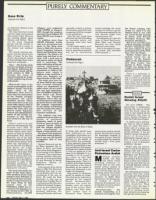
Jerusalem from the Mount of Olives.
of stress that should have
been publicized in Arab
newspapers everywhere as a
recognition of the cause that
operates for the benefit of
their readers. It is a message
to Jews, especially those who
often fail to come forth in sup-
port and defense of Jerusalem
and Israel as a matter of pride
in what our people do in the
areas to be defended. It is a
reminder to all of us and to
our critics as well that
Hadassah is not alone in
dispensing justice. That it is
symbolic of the high idealism
and moralism in the aims of
Jerusalem as the capital of
Israel with Hadassah as the
citadel of humanism.
High esteem for Hadassah
should be spoken by Arabs.
They flock to the institutions
operated by the women's
Zionist movement.Their
trachoma was cured for
decades, since the earliest
years of this century. Their
children were born there.
Their leaders came to
Hadassah from Islamic
centers to be cured by Jewish
doctors. Yet they fail to salute
the humanism centered in
the capital of Israel. They fail
to acknowledge the immense
benefits from a truly great
movement. ❑
Anti-Israel Carter
Patronizes Arafat
eetings between
Arafat, the Pope
m and Jimmy Carter
including numerous in-
dividual Jews as well, have
caused serious concern in
Jewish ranks. While the ses-
sions with the Pope were ag-
gravating, those with Carter
are considered especially
repulsive by Rabbi Marc
Tanenbaum, the distinguish-
ed student of Jewish
historical developments. In a
syndicated column he stated,
in reference to Carter:
Paradoxically,
the
Jewish community, as I
sensed it, was angrier over
Tel Aviv (JPFS) . The
government is deliberately
slowing the rate of aliyah
from the Soviet Union be-
cause it can't absorb all the
immigrants who want to
come, former Prisoner of
Zion Ida Nudel has charged.
"A million and a half peo-
ple want to come to Israel,
but we limit the flow,"
Nudel said at a press con-
ference with other Russian
Jewish activists. "I am not
afraid to accuse my govern-
ment of doing this
deliberately because the in-
flux of great numbers
creates a lot of domestic
problems," she said.
Nudel took the govern-
ment to task for its policy of
issuing visas only to immi-
grants arriving through
Budapest and Bucharest.
She said the government
should allow Jews to come to
Israel on their own initiative
and in any way they can, be
it through Finland, Austria,
England, Poland or any
other country.
She dismissed government
concerns that this would
once again give the potential
immigrants a chance to
"drop out," that is to use
Israeli visas to emigrate to
other countries. That
wouldn't occur, she said, if
the government concen-
trated on making Israel
more attractive by ensuring
they get jobs and housing.
CT,