

EDUCATION
THE
BOOK
LADY
Judy Silberg Loebl and her
traveling library encourage teens
to read Jewish books.
SUSAN GRANT
Staff Writer
C
arrying a broken
cardboard box filled
with hardcover and
paperback books, Judy
Silberg Loebl walks into an
Adat Shalom Synagogue
classroom. The sixth graders
watch as she goes to the
teacher's desk and puts
down her heavy load.
As the coordinator of the
Drop Everything And Read
Jewish Books Program
under the auspices of the
Agency For Jewish Edu-
cation, Loebl's mission is
simple — encourage teens to
read books with Jewish
themes. If that means bring-
ing a library of Jewish books
to the class, offering incen-
tives so youngsters will read
them, or even reading a book
out loud, she'll do it.
Leaning on the desk, Loebl
asks the students if they've
read any Jewish books re-
cently. Most of the 15
students raise their hands.
Student Ed Berger talks
about Number the Stars, an
award-winning book about
how the Danish Jews sur-
vived the Holocaust. Other
students review books they
have read: Starring Sally J.
Freedman As Herself and
Also Known As Sadzia the
Belly Dancer.
Although she asks the
students questions about the
books they read, Loebl says
the students are not graded.
"I want reading to be a
positive experience," Loebl
says. "I don't want any kid
to think he is failing."
56
FRIDAY, APRIL 13, 1990
Loebl takes a small hard-
cover book — The Terrible
Things — out of the card-
board box and reads. With
its penciled drawings and
simplistic story about
animals being taken one by
one out of the forest, the
book seems more ap-
propriate for younger chil-
dren. But it is actually a
Holocaust allegory. When
she is finished reading,
Loebl uses the book to laun-
ch a brief discussion of the
Holocaust.
In the book, the animals
were captured because they
didn't defend each other
when the terrible things
came, the students say. "If
we all stick together like the
King of Denmark did for the
Jewish people, we might be
friends."
Toward the end of the
class, Loebl pulls some books
out of the box, holds them up
and encourages students to
read one. A few students
leave their seats and sur-
round the box to get a better
look.
Loebl's job is done for the
day. She lifts the box back
into her arms. This time her
load is lighter.
D.E.A.R., which is spon-
sored by an endowment from
the Agency For Jewish Edu-
cation United Hebrew
Schools division, began last
summer when AJE Exec-
utive Director Ofra Fisher
approached Loebl, a part-
time librarian for the Oak
Park Public Library and
Congregation B'nai Moshe.
"She was concerned about
children not reading, espe-
cially not reading Jewish
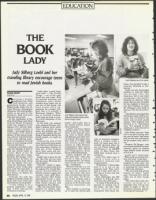
Loebl displays one of her books.
Judy Silberg Loebl reads to the
class while student Jessica Nack
skims through a book.
books," said Loebl, who is
the Jewish Library Associ-
ation chairman.
Loebl's traveling library
includes books on the Holo-
caust, b'not mitzvah train-
ing, Jews in South Africa
and Ethiopia and other Jew-
ish themes. She makes mon-
thly visits to 17 fifth, sixth
and seventh grade UHS
classes at Adat Shalom,
Congregation Beth Achim,
Congregation Shir Tikvah
and Congregation B'nai
Israel of West Bloomfield.
Loebl's students call her
"the book lady" when they
see her in class or even at
the supermarket. "It's better
than being called a bag
lady," Loebl jokes.
Because D.E.A.R. is a vol-
untary program, Loebl does
not force the students to
read. She knows they have
other commitments and may
not have time. Yet 95 per-
cent of her students sign a
contract saying they will
read one to 20 Jewish books
between September and
May.
Each student is encourag-
ed to meet the self-set goal
with an incentive program.
When a student reads a
book, his name goes into a
monthly drawing where he
can win Piston tickets, gift
certificates or an AM-FM
radio. In May, those who
fulfill their contract earn a
certificate.
Loebl also takes care to
match a book with a
student's interest and
reading ability.
"Sometimes I discourage
kids if it is not an ap-
propriate book. They won't
read it if they don't like it.
The idea is to have fun and
read," she says.
Since September, the 200
students in D.E.A.R. have
read more than 300 books.
"A couple of the kids never
planned on reading any of
the books," she says. "But
after hearing their
classmates talk about the
books, they decided to sign a
contract. Reading is con-
tagious."
Loebl not only encourages
students to read the books
she brings into the
classroom, but to use their
synagogue and public
libraries to discover other
books. She has also arranged
for her students to meet au-
thor Eve Feldman on April
22. Feldman's first book is
Seymour The Formerly Fear-
ful.
Adat Shalom principal Bea
Kriechman says Loebl's pro-
gram has revitalized the
sixth and seventh grade
classes. "The students look
forward to it," Kreichman
says. "It's unusual to have
anything to look forward to
in Hebrew school."
Ofra Fisher says the "kids
like to see she's coming with
her cart of books. And when
kids see she has enthusiasm
for the project, they catch it
too."
Student Ed Berger, who
has already fulfilled his book
contract, plans on reading
more Jewish books because
of D.E.A.R.
Loebl isn't surprised.
"When kids are having fun,
they will read," Loebl says.
Next year, Loebl wants the
students to write their own
stories. In the meantime, she
is searching for more books
to add to her collection.
"We can teach kids all the
history we want," Loebl
says, "but most of it will go
right out of their heads
again.
"But when they read a fic-
tional account or a
biography they will be less
likely to forget it. The in-
formation becomes special.
It has special meaning." ❑