

I FINE ARTS I
furniture by
WENDELL CASTLE
Sounds Of Music
Continued from preceding page
An exhibition of new interpretations of traditional
furniture forms.
December 5, 1989 — February 4, 1990
• The Detroit Institute of Arts
5200 Woodward Avenue
Detroit, Michigan 48202
(313) 833-7900
• Open 9:30 a.m. - 5:30 p.m.
Tuesday- Sunday.
Closed Mondays, holidays.
• FREE ADMISSION
• Also through January 28:
"Holy Image, Holy Space:
Icons & Frescoes From Greece."
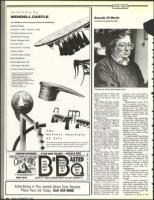
1.Moquette for Full Moon (detail), 1987-88.
Collection of Hammerson Canada, Inc.
2. Executive Desk No. 444, 1974.
Collection of Alan M. Markowitz.
3. Never Complain, Never Explain, 1985.
Collection of Wendell Castle and Nancy Jurs.
4. Desk and Chair (detail), 1965.
Collection of Norman S. and Louise R. Levy
5. Bench (detail), 1988.
The Detroit Institute of Arts.
Teaching and touring take Kovalsky's time.
The
Detroit
Detroit Institute
of Arts
The exhibition was made possible with the assistance of an anonymous
donor and David Schwarz. Additional support uvis provided by the
state of Michigan, the city of Detroit and the Founders Society.
•
COMPARE ANYWHERE! . . IF YOU WANT THE BEST — GIVE US A TEST! .
I OPEN 7 DAYS-SUNAHURS 11-10
DINE IN& CARRY-OUT AVAILABLE
hiG41.RISS
FRI-SAT. 11-11
by
or
co
CY)
a)
ci)
a)
0 X
MILES
LL1
0
0
118 SOUTH WOODWARD • ROYAL OAK
JUST NORTH OF 10 UWE NEXT TO ZOO
544-1211
QUALITY AND CONSISTENCY IS OUR PRIORITY!
Advertising in The Jewish News Gets Results
Place Your Ad Today. Call 354 6060
-
..RIDAY_,,D6C&MBERig,19
0
0
cently played in Italy and
Helsinki and is about to
begin his third tour of
Japan.
He hopes one day to play
again in the Soviet Union
where the audience, he says,
"is one of the most special."
Soviet audiences are
highly educated and view at-
tending classical concerts as
a part of everyday life,
Kovalsky says.
"Playing before Russians
you have much less risk not
to be understood. With a
cultured audience, you don't
have to exaggerate.
"It's like a lecture.
Perhaps you are talking
about physics. Sometimes,
you speak on an elementary
level because that's what
people understand. And
that's all right. Other times,
you are making more details
and don't need to be con-
cerned with the simple
things."
For Kovalsky, the word
"playing" means only per-
forming before a live au-
dience. To play a record of
Prokofiev's music is not to
know Prokofiev, he says.
"Recordings are like well-
prepared frozen food," he
says. "Live music offers the
excitement of the unknown.
It means someone is creating
a piece of live art in front of
you; you get to be a witness
to creation. And that cannot
be replaced by anything."
The co-founder of the
music conservatory
Kovalsky attended, the late
Anton Rubenstein, is buried
today in a crowded cemetery
beside Tchaikovsky and
Rimsky-Korsakov in Len-
ingrad. For Kovalsky,
Rubenstein's philosophy of
music is still very much
alive.
"Rubenstein said, 'If I
don't practice one day, I
notice immediately. If I don't
practice for two days, my
friends notice. And if I don't
practice for three days, the
audience notices from the
first notes I play."
Kovalsky says practicing
is more than afternoons fill-
ed with the quiet ticking of
the metronome on the edge
of the piano and the voice of
mother upstairs, "You'll
thank me for this one day!"
familiar to so many young
men and women.
"I catch myself practicing
all the time, even sometimes
when I'm driving," he says.
"Practicing is not only when
you're moving your fingers.
Practicing is part of creativi-
ty. People with visions of
bridges don't create only
when they're drawing."
Kovalsky's students in-
clude everyone from serious
musicians to beginners. He
treats them all with
discipline, because "without
discipline nothing will
happen," and with en-
couragement.
"If the interest in music is
there, it just needs to be put
in the right order and
through a certain system,"
he says.
"I try to teach students to
understand the sound. They
must have responsibility for
the sound they make. It is
the sound they are creating,
and the way they make this
is called technique."
Attention to sound is the
,