
(
TRENDS
I
Intermarry
Continued from preceding page
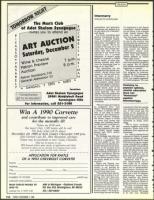
11
Satutdai, Decetsbet
Wine 8( Ctleese
Patron Preview
Auction
ations $10
$3
atron
Do
patron
General Adm
Location:
Adat Shalom Synagogue
29901 Middlebelt Road
Farmington Hills
For information, call 851-5100
*Complimentary
gift for all attendees!
Win A 1990 Corvette
and contribute to improved care
for the mentally ill!
Tickets are $100 each.
But hurry! Only 1,500 tickets will be sold.
The lucky ticket will be drawn
December 20, 1989 at Jack Cauley Chevrolet 7:00 p.m.
7020 Orchard Lake Rd., West Bloomfield, Michigan
Tickets may be purchased at Jack Cauley Chevrolet.
Need not be present to win.
Will forward tickets upon receipt of application and check.
Sponsored by Alliance for the Mentally Ill of Oakland County which
gives special thanks to Jack Cauley Chevrolet.
APPLICATION FOR RAFFLE
OF A 1990 CHEVROLET CORVETTE
Name
Address
City
State
Zip
Phone
NUMBER OF TICKETS
@8100 ea.
AMOUNT ENCLOSEDS
MAKE CHECKS PAYABLE TO:
SEND TO:
License No. R 14197 63S
114
FRIDAY, DECEMBER 1, 1989
AM! of Michigan - Oakland County
P.O. Box 515, Birmingham, Ml 48012
313 / 557-6440
assimilation and ignorance,
but anyone who expects it to
do the whole job is deluded,"
said Sp ack.
Les Levin, immediate past
director of planning for the
Council of Jewish Federa-
tions, the umbrella group for
federations throughout the
country, agreed. "All of our
studies of the past 30 to 40
years show that Jewish edu-
cation that ends with bar
mitzvah is not much of an
education. It's a juvenile
education. It doesn't equip
people to maintain a Jewish
life as adults, so when they
become parents they don't
have the knowledge base to
pass on to their kids."
The researchers are not
arguing that the Jewish corn-
munity should devote less
money to Jewish education,
but they do advise a re-
ordering of priorities. If the
presence of Jewish friends is
the strongest single factor
predicting against intermar-
riage, the Jewish community
should devote more of its
resources to building Jewish
social networks, they con-
tended. They also pointed out
that the structure and cur-
riculum of traditional Jewish
education does not facilitate
friendship.
Contrary to
popular opinion,
Jewish education
does not
"immunize"
against
intermarriage.
"We are trying very hard to
be judgment free," said
Mayer. "The findings suggest
a number of options for ac-
tion. If you want to stress
prevention, put resources in-
to social network building.
We haven't begun to invest
the same time, money and
energy into building Jewish
social networks as we have in-
to other areas." He and
Kosmin suggested that cam-
pus Hillels, Jewish singles
groups and JCC's receive
more funding.
The findings may also put
parents with pluralistic
values in a quandary. "It's
not very politic to say this
publicly, but the Jewish com-
munity has placed a lot of em-
phasis on the societal norm
that makes it illegitimate to
choose friends on the basis of
religion," said Mayer. "But we
then expect our children to
choose Jewish spouses. What
the study shows is, it's not
divisible."
Mayer and Kosmin con-
tended that the Jewish com-
munity is not putting its
money where its mouth is on
the intermarriage issue.
"The numbers show that in-
termarriage is going to be af-
fecting more and more peo-
ple," Mayer said. "How much
does the Jewish community
put toward this problem when
compared with Soviet Jewry,
anti-Semitism and Israel? A
lot more is said than done."
Kosmin added: "We study in-
termarriage because we think
surprised to find the session
was standing-room-only. The
size of the crowd and the
nature of the questions in-
dicated that a number of com-
munities recognized the pro-
blem and were concerned and
interested in doing some-
thing.
"We've since produced
resource booklets and model
programs. There used to be
resistance. Now, inquiries are
increasing."
An inter-congregational
program in Denver is geared
toward the children of inter-
married couples; the St. Louis
Federation's program targets
young intermarried couples;
and Louisville's Jewish Fami-
ly Service pioneered Jewish
family life education for inter-
married couples, Levin said.
Still, the programs are ex-
perimental and, he admitted,
"It's still not enough."
Baltimore, with a 39 per-
cent intermarriage rate in
Jews under 40, is another
community that has tried to
reach out to intermarrieds.
Recognizing a declining con-
version rate among intermar-
rieds and a lack of religious
identification among inter-
faith families, the Jewish
Family Services of Baltimore
and the Baltimore Board of
Rabbis decided to co-sponsor
the Project on Intermarriage.
Through workshops, sup-
port groups and lectures, the
program reached 790 people
in its first year. Marshall
it's important to the Jewish
community. Jewish children
are our future. A lot of people
study Jewish history. Few
study the Jewish present.
Very few study the future."
"As of this moment, there is
no one in this country who
has devoted any resources to
developing programs to coun-
teract the effects of intermar-
riage except the Reform
movement," Mayer said.
"There should be programs to
ensure that Jews produce
Jewish children no matter
whom they marry."
The CJF's Les Levin agreed
that more outreach programs
are needed. But he argued
that Jewish communities are
beginning to respond.
"Six years ago, we ran our
first program on intermar-
riage at the G.A. (the annual
summit of Federations), in
which Los Angeles presented
its model program. We were
Scanned image of the page. Keyboard directions: use + to zoom in, - to zoom out, arrow keys to pan inside the viewer.
December 01, 1989 - Image 112
- Resource type:
- Text
- Publication:
- The Detroit Jewish News, 1989-12-01
Disclaimer: Computer generated plain text may have errors. Read more about this.