

I
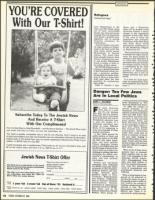
YOU'RE COVERED
With Our T-Shirt!
OPINION I
Refugees
Continued from Page 7
move Palestinians in the
Gaza and West Bank camps
out of their overcrowded
shacks into more permanent
housing. This will require the
Arab states to abandon their
opposition and to provide
financial assistance for
construction.
A second option is to reset-
tle large numbers of Palesti-
nians in the Arab world. The
Arab states should permit
Palestinians to become
citizens. This would allow
those already living in Arab
states to integrate into socie-
ty and permit Palestinians
living in camps to settle in
the nation of their choice.
The 300,000 Palestinians in
Lebanon, a destabilizing force
in that fractured nation, pre-
sent a particular problem.
Giving them the option of set-
tling in Syria or some other
Arab land offers the best
possibility for ameliorating
their plight.
Thday it remains a pipe
dream that a Palestinian
state will be created in the
territories without a radical
change in the negotiating
positions of both sides. Even
if thie were to occur, the
geographic and economic
limitations of the West Bank
and Gaza Strip would
preclude the resettlement of
all the Palestinian refugees
on Palestinian soil.
The United States can help
to stabilize the region and ad-
vance the peace process by
making it clear that there is
no conceivable Arab-Israeli
settlement that can alleviate
the refugee problem without
a commitment by the Arab
states to resettle large
numbers of Palestinians.
Historically, this is how all
refugee problems have been
solved.
It is time the Arab states
acept the responsibility they
have avoided for more than 40
years. ❑
Danger: Too Few Jews
Are In Local. Politics
MARC L. SOLOMON
Special to The Jewish News
Subscribe Today To The Jewish News
And Receive A T-Shirt
With Our Compliments!
From the West Bank to West Bloomfield — and all points in between — The Jewish News covers
your world. And with our T-shirt, we cover new subscribers, too.
The T-shirt is durable, comfortable, easy to care for and attractive And it comes in an array
of adult's and children's sizes. But most important, your new subscription will mean 52 information-
packed weeks of The Jewish News, plus our special supplements, delivered every Friday to your
mailbox. A $42.90 value for only $26!
A great newspaper and a complimentary T-shirt await you for our low subscription rates. Just
fill out the coupon below and return it to us. We'll fit you to a T!
Jewish News T-Shirt Offer
Yes! Start me on a subscription to The Jewish
News for the period and amount circled below.
Please send me the T-shirt.
This offer is for new subscriptions only. Cur-
rent subscribers may order the T-shirt for
$4.75. Allow four weeks delivery.
Please clip coupon and mail to:
JEWISH NEWS T-SHIRT
27676 Franklin Road
Southfield, Mich. 48034
NAME
ADDRESS
CITY
(Circle
One)
STATE
ZIP
1 year: $26 2 years: $46 Out of State: $33 Enclosed $
(Circle
one) ADULT EX. W. ADULT LARGE ADULT MED. CHILD LARGE CHILD MED. CHILD • SMALL
12
FRIDAY, OCTOBER 27, 1989
F
or most American
Jews, Iowa is a state
you fly over between
New York and Los Angeles.
Politically active Jews know
Iowa is the first real test for
Presidential aspirants. Iowa
is also the target of a
systematic anti-Israel cam-
paign on many different
fronts. If it's happening in
Iowa, we've learned, it's hap-
pening everywhere.
A new battle ground for
public opinion on Israel and
American policy in the Mid-
dle East has taken shape:
state and local politics.
Future American foreign
policy in the Middle East and
the full range of issues of con-
cern to Jews are at stake. Our
challenge is nothing less than
energizing the Jewish com-
munity's commitment to
state and local political
involvement.
Several new anti-Israel
campaigns have confronted
the Jewish community. Ballot
initiatives in San Fransisco,
Berkeley, Newton and Cam-
bridge. Political party
platform fights in Iowa,
California, Massachusetts
and Virginia. Conferences
held by mainline Christian
denominations. Position
statements by organizations
previously inactive on Middle
East issues, such as the
National Association of Social
Workers. Peace groups cir-
culating material and hosting
panel discussions on "Pro-
spects for Middle East Peace?'
In 1988, the number of
Jewish delegates at the
Republican and Democratic
national conventions fell from
1980 and 1984 levels. That
means fewer and fewer Jews
are active in local and state
party politics. Fewer and
fewer Jews serve as officials
at the municipal, county or
state level. School Boards,
City Councils and County
Commissions, institutions
where Jews could once be
found in positions of power,
are now sadly lacking in
Jewish office holders. Increas-
ingly, Jewish activists have
become content with persuad-
ing public officials to support
their. issues.
What do all of these devel-
opments have in common?
Taken together, they are the
most vivid examples of the
American Jewish commu-
nity's disengagement from
state and local politics in
favor of a singular preoccupa-
tion with the glamorous
world of congressional and
presidential elections and
lobbying.
When a group begins to lose
ground on its perceived or
real priority issues, the rest of
the agenda is sure to suffer as
well. Luckily, the concept of
building a grassroots political
network is easy. The im-
plementation, as usual, is the
difficult part. There is no
substitute for solid planning.