

the collections, "mostly in the flatter
furs," Blye adds. "In jackets, the look
was shown in shaped blazers and hack-
ing jackets, usually in mink, sheared
beaver and sheared nutria."
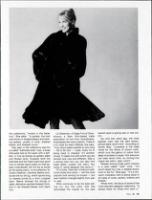
Also seen in the collections was the
so-called "bathrobe-style" coat, a loose
silhouette tied at the waist with a self-
belt, in furs as diverse as golden sable
and Persian lamb. However, both the
bathrobe and the fitted coats look good
only on certain figure types, so their ap-
peal undoubtedly will not be as broad
as the swing coat's. In his collection for
Goldin-Feldman, Geoffrey Beene intro-
duced the fur shrug, which sports long
fur sleeves joined by a short cropped
back. Beene showed the shrugs in
sable, dalmatian-spotted sheared mink,
and in red sheared beaver with black
trim.
Lili Glassman, of Saga Furs of Scan-
dinavia, a New York-based trade
association of furs from Scandinavia,
emphasizes the many options. There is
a fur style for every lifestyle, she says,
"from short bolero jackets to very long
— 50 to 52 inch — coats. Every fur is
being dyed or sheared. It's another
choice. It makes furs with which you are
familiar look new and different. Red is
a strong color but you can also find
loden green, purple, rust, berry. You
name it, some designer has done it."
Of course, there are numerous tradi-
tional styles and colors — still the most
popular look among fur-buyers — but
even tradition changes slightly from year
to year.
Mink continues to be the best sell-
ing fur, but the color that has
dominated the market for the past
several years is giving way to new col-
ors.
Up until two years ago, the most
popular color was the dark brown,
almost black ranch mink. According to
Sandy Blye, "Lunaraine is the trade
name for the family of brown mink,
which runs the gamut of colors from
deep chocolate to taupe. Not everyone
can wear ranch mink, so coming into
vogue are warm, easy colors."
Newest among these warm browns
is a color called "wild" mink. "It's
ranch-raised but has a reddish-brown
tone to the fur," Blye says. "It's a rich,
warm coloration and is being done in
all types of coats, jackets, boleros and
shawls."
White mink, the focus of some of the
more dramatic designer collections, "is
always there, for those who want it,"
FALL '89 111