

FICTION
is now accomplished and the
older woman and child sit sip-
ping their tea, feeling pride
and warmth. The older
woman takes small sips of her
tea, holding a sugar cube bet-
ween her teeth, getting the
sugar's sweetness. The child,
not having mastered this Old
World technique, drops her
two sugar cubes into her cup
and uses her spoon to mash
the cubes until they dissolve.
Then she, too, sips her tea un-
til it is finished. Finally they
clear the table.
When I was about six, we
went on to boiling water for
Jell-O. Again we start with
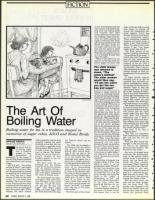
The child always
was allowed to
shout, "The
water's boiling!"
The older woman
would then say,
"I'll get the water
you get the tea
bag and sugar."
Art By Jean Casey
The Art Of
Boiling Water
Boiling water for tea is a tradition steeped in
memories of sugar cubes, Jell-O and Bintel Briefs.
MARLENE ROBERTS
T
Special to The Jewish News
he ritual and art
of boiling water
was a tradition
passed on from
generation to
generation in my house. It
was my first formal initiation
into womanhood and coming
of age.
The first part, "the proper-
boiling of water," was taught
to me when I was four years
old. My grandmother started
by teaching me to make good
tea. First you put a large
amount of water on the stove
to boil in a tea kettle that
whistles. Then you sit down
at the Formica kitchen table
to listen for the first sign of a
whistle, when you jump up to
start the actual task. While
waiting, the adult relaxes
52
FRIDAY, AUGUST 4, 1989
with a cigarette and the child
carefully watches the adult
smoking so one day she, too,
can smoke a cigarette while
boiling water. There was a lot
of water to boil, so it allowed
time to discuss The Bintel
Briefs, the Jewish Daily For-
ward's version of Ann
Landers geared to the im-
migrant audience.
The first time my ex-
husband saw me boiling
water for his tea his reaction
was, "Is someone having a
baby?" He was an insensitive
man who didn't understand
the ritual of boiling water.
The child always was allow-
ed to shout, "The water's boil-
ing!" The older woman would
then say, "I'll get the water-
you get the tea bag and-
sugar." This meant sugar
cubes, not loose sugar, and
the Swee-Touch-Nee tea bag,
not Lipton's which was for
guests.
The table was arranged, a
tea bag put into the adult's
cup and the boiled water
poured. After several dunk-
ings of the tea bag in the
adult's water, the bag is pass-
ed to the child's cup. The
dunkings start again, but a
spoon now is used to push the
tea bag against the side of the
cup to persuade it to release
more of its diminishing
essence. When the second cup
of water is the desired color,
the used tea bag is placed in
a glass of water. Hopefully, it
would give off just a little
more of its flavor to this
water, which then could be
used when several people had
tea, as "tea stock" in a teapot
with only one or two extra
bags needed.
The first part of the ritual
boiling a large amount of
water in a whistling tea ket-
tle and my having the respon-
sibility for shouting, "It's boil-
ing!" Jell-O is not the social
event that making tea is; this
is real cooking. While one is
waiting for the water to boil,
a large glass bowl is placed on
the table with a Pyrex
measuring cup close by. At
the appropriate time (deter-
mined by my grandmother)
I'd be told, "OK, pour the Jell-
0 powder into the bowl." Now
I can tear open the cardboard
top of the Jell-O package,
remove the package's top, and
take out of the open box the
plastic-like sack that holds
the Jell-O crystals. With care,
I tear acorss the top of the bag
and pour its contents into the
bowl. Then, when the water
had boiled, my grandmother-
measured out the exact
amount of water (as stated on
the Jell-O box) and stir until
all the crystals were dissolv-
ed. I would have to wait until
I was seven or eight before I
was allowed to pour the hot
water, "because you can burn
yourself!"
Sometimes, if company was
coming, pieces of fruit were
added to make it, as my
grandmother said, "fenncie."
On other rare occasions I was
allowed to have some of the
hot liquid Jell-O in a cup. The
norm, though, was to put the
liquid in the "icebox" (a
refrigerator), to "jell," and
have it for dessert that night.
At the time, Jell-O was
something fabulous for me.
Now I realize it was the
venerated dessert because it
was pareve (in kosher homes
this means that it can be
eaten with both milk or meat)
and cheap (in almost all
homes the inexpensive has
great appeal). Jell-0 has
become a heavily used simile
in my present-day speech.
When something wonderful
happens and great pride is
shown I say, "they kvelled."
When I'm asked what kvell
means, I say, "you know,
shake inside, like Jell-O."
The final section of my
primary cooking initiation is
"the grinding of the meat." I
had to wait until I was about
nine for this, which at the
time I attributed to the im-
portance of the act. Now I
realize it had more to do with
my strength. Then I was ter-
ribly honored to be considered
mature enough to have my
grandmother let me grind the
meat.
A major Jewish cultural
learning tool is to tell an
anecdote that rationally ex-
plains contradictory events.
An example of this Jewish ex-
istential logic is why the
"grinding of meat" is includ-
ed in the "boiling of water."
One of the great proponents
of this type of reasoning is my
friend Hazel's 84-year-old
father, Bob, whose own tale
may explain the seemingly
odd combination in my story.
Bob hates Chinese food. If
he hears Chinese food is com-
ing, he leaves before it arrives
and claims just the smell
would make him sick. One
night Bob, five business
associates and I held a
meeting at Cantonese East.
Bob ordered chow mein, egg
rolls and fried rice. One of the
guests said, "Bob, I thought
you hated Chinese food?"
Bob said, "I do. this is
Japanese food."
"But Bob, it's Cantonese
East; everything is Chinese;
how can you say it's not
Chinese?"
With that Bob looked him
straight in the eye and said,
"It has to be Japanese
because I hate Chinese." The
discussion was ended.
Our story of chopped meat
continues. My grandmother
went to her special kosher
butcher to get "a good piece of
chuck, not too much fat,"
which she then carefully
scrutinized. When I asked her
why she didn't have the but-
cher grind it, she said,
"because he'd put all sorts of
traif in it — just like the gar-
bage they put in pizza." She
already knew I was cheating
outside her kosher home.
We'd get back home and
take out the meat grinder
and the glass bowl. The
grinder was clamped to the
side of the kitchen table and
the bowl put under the spout
where the ground meat