
YEAR IN REVIEW 5748 YEAR IN REVIEW
ty in Israel is prepared to meet with the PLO,
though Israeli officials say that if the organization
recognizes Israel and renounces terror, there will
be little choice for Israel but to negotiate with their
archenemies.
Optimists suggest that such seemingly negative
events as the intifada and King Hussein's severing
of ties with the West Bank may actually encourage
Israel and the Arab side to rethink long-held posi-
tions and move, however gingerly, toward
negotiations.
Glasnost
for
oviet Jew
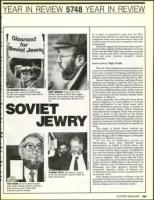
Soviet Jewry: High Profile
THE DECEMBER RALLY, which drew an
estimated crowd of more than 200,000 people,
was seen as the highlight of the 15-year national
struggle for Soviet Jewry.
JERRY GOODMAN, longtime head of the
National Conference on Soviet Jewry, stepped
down from his post amidst a major reshuffling of
the Soviet Jewry organizational structure in the
U.S.
SOVIET
JEWRY
VLADIMIR SLEPAK, after waiting 17 years for
an exit visa, was allowed to leave the USSR and
settle in Israel last fall.
YOSEF BEGUN was one of several long-time
Soviet Jewish refuseniks allowed to emigrate to
Israel this year, as part of Soviet leader
Gorbachev's glasnost campaign.
The role of the superpowers in such negotiations
cannot be overestimated and during this past year
there were a number of intriguing indications of an
improvement in Soviet-Israel relations, which were
formally severed following the Six-Day War in 1967.
Several East bloc countries, including Poland,
Bulgaria and Hungary, improved their ties with
Israel this year, clearly with the approval of Moscow.
And the Soviets, in an effort to involve themselves
in any future Mideast peace talks, made overtures
to the Israelis this year, sending a low-key delega-
tion to Jerusalem and later hosting a similar Israeli
delegation in Moscow.
Israel reportedly was calling for mass Soviet
Jewish emigration as a pre-condition to allowing
Soviet participation in any future peace talks.
Under Gorbachev's glasnost policy, a number of
well-known, long-time Soviet Jewish refuseniks
were permitted to emigrate. There were emotional
scenes in Israel at the arrivals of Ida Nudel,
Vladimir Slepak and Yosef Begun, though skeptics
insisted that Gorbachev was scoring public relations
points by releasing a handful of famous dissidents
while maintaining harsh conditions on most Soviet
Jews.
The plight of Soviet Jewry received un-
precedented attention this year as the result of the
two summit meetings held between Gorbachev and
President Reagan, first in Washington in December
and then in Moscow in June.
On the eve of Gorbachev's arrival in
Washington, more than 200,000 people
demonstrated on behalf of Soviet Jewry, the
culmination of some 15 years of protests organized
by a variety of Soviet Jewry groups. A highlight of
the event was hearing Natan Sharansky, the sym-
bol of the movement, address the rally he worked
so hard to organize. "How many times did I hear
it was impossible to get hundreds of thousands of
people to march in Washington in the winter?" he
asked. "And yet, look, it is winter and you are here."
Sharansky, and other speakers, stressed that
emigration depends neither on Reagan nor
on Gorbachev, but rather on the conscience of Jews
around the world.
Still, Reagan did his share in Moscow when he
pointedly invited and met with a number of Soviet
dissidents, including Jewish refuseniks, despite the
obvious displeasure of his Kremlin hosts.
THE DETROIT JEWISH NEWS
125
Scanned image of the page. Keyboard directions: use + to zoom in, - to zoom out, arrow keys to pan inside the viewer.
September 09, 1988 - Image 166
- Resource type:
- Text
- Publication:
- The Detroit Jewish News, 1988-09-09
Disclaimer: Computer generated plain text may have errors. Read more about this.