

LIFE IN ISRAEL
SUMP PUMP failure
OR POWER OUTAGE IS NO PROBLEM IF YOU
HAVE AN AUTOMATIC JET PUMP. $149.50
INSTALLATION AVAILABLE
352-9350
H. B. LEWIS PLUMBING
A DAVID ROSENMAN'S
A Mae
mom PlUIRCHASEIRS
NEW & USED CAR
BROKER
Talent Agency
Wilmot
Seasons
Sunset Boulevard
Fenby-Carr
Shelby Lee
Eric Freudigman
George Benson Jazz
Jerry Fenby-Big Band
DJ's including ERIC HARRIS
SAVE TIME! SEE OUR BANDS ON VIDEO
WATS IM
A MIME?
EVERYTHING!
IF YOU'RE
INTERESTED
Iti DIRMOMDS,
s
SE O UP
PIAN,(! , : o
The Diamond People For Over 50 Years
30555 SOUTHFIELD RD., CONGRESS BLDG., SUITE 100
ONE BLOCK SOUTH OF 11 MILE ROAD
PHONE 645.9200
v unn
HURT.
•
Don't walk in pain! We take care
of painful corns, bunions, callouses,
diabetic foot, arthritis and hammer
toes. House calls, transportation
available at no extra charge.
FREE GIFT on
First Visit
DR. CRAIG BROD
FOOT SPECIALIST
5755 W. Maple, Suite 111
West Bloomfield
We accept most insurance as full payment. No out of pocket
expense to you. Call for an appointment.
855-FEET
38
FRIDAY, AUGUST 19, 1988
(855-3338)
erusalem — It was a
twist of fate rather
than intent that led to
the publication of "Letters
from Jerusalem, 1947-1948"
by Zipporah Porath. Porath
had been sorting through the
personal items of her late
mother during a visit to
America, when she came
across a batch of letters she
had written to her parents
while a student on a one-year
scholarship program at the
Hebrew University during
the year Israel won its
independence.
"I realized as I read the let-
ters that if my grandchildren
were to ask me what it was
like during that momentous
year, I could not have describ-
ed events and feelings as well
as they are presented in the
letters," she says.
Nevertheless, the notion of
making the letters into a
book had still not occurred to
Porath. It was only later
when she was typing the let-
ters as part of an exercise to
master her word processor
that she realized the letters
could form a fascinating book.
The letters were published
i
t recently by the Association
of Americans and Canadians
in Israel as part of their
40th anniversary celebra-
tions. Stretching from
September 1947 to November
1948, the letters offer an ab-
sorbing and exhilarating in-
sight into the transitional
period of the country's war of
independence and what it
was like to be a part of that
era.
Porath had come to Israel
through the urgings of her
father, the American
Hebraicist Samuel Borowski,
on a scholarship from the
Zionist Organization of
America. The events she
writes about are all the more
exciting because of her infec-
tious enthusiasm. Here is her
description of the morning of
Nov. 30, 1947, as Jerusalem
went wild with joy following
the United Nations resolution
to partition Palestine into
Jewish and Arab states:
"I dodged motorcycles,
wagons, cars and trucks
which were racing madly up
and down King George
Street, missing each other
miraculously, their running
boards and headlights
overflowing with layer upon
layer of elated, happy people.
I pushed my way past the cry-
j
World Zionist Press Se rvice
-FENBY-6TEIN
553-9966
SIMON GRIVER
Special to The Jewish News
(313) 476-AUTO (2886)
Jerry Fenby
Tim Hewitt & Feelings
Perfect Blend
Loving Cup
Mirage
Krosswinds
Rare Blend
Rendezvous
The Ritz
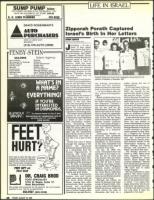
Zipporah Porath Captured
Israel's Birth In Her Letters
Zipporah Porath and friends hold newspapers announcing the U.N.
partition of Palestine in November 1947.
.
ing, kissing, tumultuous
crowd and the exultant
shouts of mazal tov and came
back to the quiet of my room
. . . to try to share with you
this never-to-be-forgotten
night."
Porath recollects that it was
at this point that the object of
her letter writing took on a
new dimension. "Initially I
saw myself as a vanguard spy-
ing out the land for my
Zionist family," she says. "My
letters were part of my obliga-
tion to share the experience
with them. But after the U.N.
vote on Nov. 29, the chatty
style of the letters changed. I
became acutely conscious
that I was living through a
time of incredible significance
and the letters became
something of a historical
record?'
Increasingly, Porath's en-
thusiasm and optimism
became mingled with sadness
during the months prior to in-
dependence as Arab attacks
on the Jews intensified and
the hardships of the siege of
Jerusalem took hold.
On Jan. 19, 1948, she
wrote: "Jerusalem's face was
sad today. It isn't easy to ac-
cept the fact of death and
even harder when you know
personally many of those who
died. But 35 boys is heart-
breaking, all young, wonder-
ful people. The 35 Haganah
fighters, mostly university
students, were sent to relieve
the Gush Etzion kibbutzim
and were massacred by the
Arabs as the British stood by
without intervening."
Through the letters, we
follow the dramatic and tragic
events of Israel's birth. Join-
ing the ranks of the Haganah,
Porath served as a medic and
nurse during the siege of
Jerusalem and later as a
soldier during the war of
independence.
In the last letter of this col-
lection, written on Nov. 29,
1948, she reveals to her
parents that Israel is where
she sees her future: "I can't
believe this year. So much has
happened but the most impor-
tant thing by far is the birth
of the state. I've been a part
of it and it will forever be part
of me. I guess that means I
am telling you I intend to see
this war through and then re-
main on, whatever happens.
This is now my home."
A year later she returned to
America to wind up her af-
fairs, but was unable to
return immediately to Israel
because she was hired by the
Foreign Ministry to be the ex-
ecutive secretary of Israel's
consul general in New York.
At a reception for Foreign
Minister Moshe Sharett, she
met her husband-to-be,
Joseph Porath, Israel's assis-
tant military attache at the
Washington embassy. At
their wedding, Col. Chaim
Herzog, now president of
Israel, was their best man.
The Poraths returned to
Israel in 1952. Forty years
later, Zipporah Porath re-
mains optimistic about
Israel's future despite the
country's problems. "Israelis
have always been good at cop-
ing with problems," she says.
"We know how to make
things happen."
She has mellowed in some
matters. Her letters preach
aliyah and show impatience
with those American Zionists
who do not make their home
in Israel. "I no longer feel
angry about Jews who do not
come here," she explains, "but
I still feel sad about it. Israel
can only exist if Jews are
prepared to live here."
(
<