

O
0
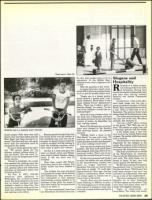
Street scene in Gaza City.
Palestinian boys on a residential street in Ramallah.
Israeli people. Polls show that half
believe even more than before that the
West Bank and Gaza should be re-
tained. The other half say with equal
fervor that the territories must be
returned to the Arabs.
No one in Israel ignores the upris-
ing. "We cannot speak for two
minutes without talking about it,"
says one Israeli. The very word "in-
tifada" is now an integral part of the
Israeli lexicon.
Viewed in hindsight, the events
that sparked the uprising seem like
a car careening down a hill out of con-
trol, gaining speed and destructive
potential, as bystanders watch with
increasing horror.
On Dec. 6, 1987, 200,000
American Jews gathered in
Washington, D.C., to rally for Soviet
Jewry. Few paid attention to the news
that an Israeli merchant had been
stabbed to death in Gaza City. Two
days later, an Israeli truck struck two
Arab cars, killing four Palestinians
and injuring seven others.
Rumors spread through Gaza that
the Israeli driver was the brother of
the murdered man and was out for
revenge. An Israeli inquiry called the
crash an accident, but did nothing to
calm the bubbling emotions which
were ready to ignite into violence.
On Dec. 9, a clash took place bet- -
ween an Israeli patrol and Palesti-
nian youth in Gaza's Jabaliya refugee
camp. It left one dead and 16
wounded.
Since then, nearly 200 Palesti-
nians have died in the violence. One
Israeli soldier has been stabbed to
death.
The intifada has both disrupted
and reinforced normal life for Israelis
and Palestinians. They continue to
live unhindered in their separate
communities, coming together to do
business, all the while very aware of
that other reality. No one quite knows
what to do about it.
"It's very complicated;' more than
one Palestinian and Israeli has said.
On this, both peoples seem to be in
agreement. In the Middle East,
nothing is ever what it appears to be
at first.
Take the question of fair trials.
An Israel television report accus-
ed the IDF of allowing arrested Arabs
to sit in jail for months before trial.
"People say in a decent society
people deserve a speedy trial;' com-
ments Professor David Ricci of the
Israel Defense Forces' Spokesman's
Office. "Some say it takes a poet to
describe things;' he muses. "In the
case of the intifada it would take an
anthropologist?'
Ricci did a tour, of reserve duty in
the Arab city of Ramallah and saw
the obstacles placed in the way of the
pursuit of justice. In Ramallah, he
says, nothing worked.
Most of the Palestinians arrested
there were charged by the Israelis
with throwing stones. All pleaded
innocent.
"Nobody threw a stone in the
West Bank," he says with irony. "If
everyone who was given a parking
ticket pleaded innocent and demand-
ed a trial, nothing would work."
That was just the beginning of the
problem. The local Arab police force
had resigned, following orders of the
uprising's leaders. There was no one
to take the accused from jail to court.
By the time a prisoner had his day
in court, the soldier who was witness
to the stone-throwing incident was
often no longer stationed in
Ramallah. The army now had to track
him down to testify. "It could take
days to find him;' Ricci says. And the
soldier's commanding officer would
not always agree to release him to
travel back to Ramallah.
Finally, Ricci says, the charge of
stone throwing is difficult to prove.
"So what happens is we arrest people.
And instead of coming to trial, they
sit in jail a couple months and they're
released:"
Slogans and
Hospitality
R
amallah is a rather prosper-
ous looking Arab town north
of Jerusalem. Driving from
central Jerusalem to Ramallah takes
less time than driving between
Detroit's two Jewish Community
Centers.
Around 5 p.m., when a late after-
noon hush hangs over the city, a
group of residents mingles on Nasser
Street. They are picking berries from
a tree. There is little else to do in
Ramallah. The general strike keeps
stores closed all but three hours a day.
The strikes are becoming a way of
life, says one of the men. He seems
amiable. Not everyone is.
"Are you a Jew?" asks a woman
in the group. "Yes? Well, get out of
here." She makes an angry face and
a "shooing" gesture with her hands.
A few blocks away, a man who
once lived in the United States stops
to speak. He quickly shifts from small
talk to politics.
The situation is very bad, he says.
Especially for the refugees in the
camps. The solution to the problem is
for Israel to pull out of the territories
and grant the Palestinians a state.
The Arab countries are no friends
of the Palestinians, he continues.
They divide the Palestinians for their
own ends. The Arab states are no
threat to Israel. In fact, they help
Israel against the Palestinians.
By this time a group of young boys
has gathered. One or two pass by on
bicycles and shout, "PLO forever:' but
most seem curious to see who I am
and why I am in Ramallah. They take
me on a tour of the neighborhood.
The town is beginning to wake up.
Families sit in their backyards.
Children appear on the streets. They
wear jeans and tennis shoes and T-
shirts with English lettering.
Signs of construction are
everywhere. The white and cream-
THE DETROIT JEWISH NEWS
25