

CLOSE-UP
Illusion
Upon
Illusion
Nothing is quite what it seems in the
Palestinian uprising
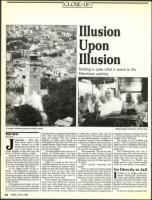
A mosque's minaret dominates the Nablus skyline.
DAVID HOLZEL
Staff Writer
Jr
erusalem — Brig. Gen.
Ze'ev Livne wears a tired
smile. Trained as a - tank
commander, he wants to re-
turn to his troops on the
Golan Heights to face the very real
threat of Syrian military might.
Instead, he is closeted in a hot,
run-down former British police sta-
tion in the heart of the Arab city of
Nablus. Once a warrior, Livne is now
more like an old-time sheriff, brought
in to tame the Wild West Bank.
In the eighth month of the in-
tifada — the Palestinian uprising —
Livne is the military commander of
the Samaria region, the northern part
of the West Bank, home to 600,000
Palestinians, 40,000 Israelis and now
3,000 soldiers.
His headquarters bustles with ac-
tivity. Soldiers move briskly through
the dark, narrow hallways. At the foot
of the stairs, two Palestinians are be-
24
FRIDAY, JULY 22, 1988
ing detained in an improvised holding
area. They look blankly at the com-
ings and goings. The two young
soldiers on guard seem almost as
disengaged as their prisoners. No one
makes threats. Each seems resigned
to play his part. This is just another
day in the intifada.
Two days before there was an in-
cident. An Israeli patrol had been
stoned from the buildings above. The
patrol opened fire and a Palestinian
was wounded.
Today it is quiet in this city of
120,000 residents. The town is obser-
ving the Palestinian general strike.
Shops are open for three hours begin-
ning at 9 a.m. At noon their steel
doors are slammed shut. One mer-
chant who remained open had his
shop torched, Livne says.
Fewer people are demonstrating
now, Livne says. Those who remain
active are more desperate and rely
more often on Molotov cocktails and
guns than stones. This makes it
easier for the army, he says, because
Regular patrons convene at a Tel Aviv cafe.
it shifts the violence back into the
realm of terror. The army is militari-
ly and psychologically equipped to
respond to terror. It had no adequate
response to children throwing stones.
Livne says he recently met with
one of Nablus' leaders. "I asked, 'How
do we solve the problem?'
"He answered, 'You are too soft.
You should do what [Jordan's King]
Hussein does. Put two or three tanks
through the casbah. Open fire, kill
200 people and you will have quiet for
10 years!
Livne quickly dismisses this
option.
There is a joke circulating among
soldiers who faced the rocks and bot-
tles in the more heated days of the in-
tifada. If you buy a felafel in Nablus,
they say, you get a free bottle of pop.
On the road to Nablus, a hillside
covered with fancy homes is disrupted
by a neighborhood of tiny, cramped
buildings. This is the Balata refugee
camp. No fences surround it. There is
nothing to distinguish or separate the
camp from the surrounding town but
a certain griminess and the jarring
density of the dwellings.
The shops on the roadside are
closed. "Until six months ago, half of
Israel was here on Shabbat to fix their
cars, because it was cheap," an army
guide says.
The Palestinians are not a
faceless enemy. The web that weaves
them and the Israelis together is a
subtle but very real one. Says the
guide, "Thmorrow in Nablus you
might arrest a man whose brother
works for your father in Jerusalem!'
Go Directly to Jail
I
ntifada is an Arabic word that
means "shaking off!' The Palesti-
nians hope to shake off the Israeli
occupation. But the real effect of the
uprising has been to cause many
Israelis and Palestinians to shake off
old ideas and perceptions about each
other.
It also has further polarized the