

e
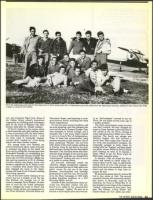
Part of the student body at the Israel Air Force flying school in Rome during Israel's War of Independence pose at the airfield where their flight lessons took place. Standing at right is Danny Arber, today
, a captain on Jumbos for El Al Airlines.
tors, and American Piper Cubs. Some of
the Italian flying school's instructors
augmented our teaching staff, including a
pilot by the name of Molinari who later
became chief pilot for Alitalia Airlines.
Of the 25 students in the course, about
a third eventually quit pilot training, most-
ly from frustration with the then embry-
onic and often inefficient air force — a far
cry from what it eventually became.
Another third "washed out" of our flying
school and other similar courses.
But among those who finished our
school and became pilots, many eventual-
ly assumed top posts in the Israel Air
Force and in civilian life. Among them were
Yechezke'el Somekh, an outstanding stu-
dent who eventually became Number Ikvo
man in the Air Force and later a flight cap-
tain and top executive in El Al Airlines.
Another student was Danny Arber, who
became a captain for El Al. Henry Levin-
son, a volunteer from South Africa who
later changed his name to Uri Aylon,
became the head of one of Israel's leading -
advertising agencies.
One of the most noted veterans of our
school was not a student at all. He was
Dan Pachter, the teenage son of the
school's caretaker, lb.via Pachter. He later
went to work for the Israeli newspaper
Davar, changed his name to Pattir and
became media adviser and spokesman to
two Prime Ministers, Yitzchak Rabin and
Menachem Begin, participating in num-
erous historic events, including the Camp
David negotiations.
For me, the most unusual students, and
the most inspiring, were four refugees who
survived the war in Eastern Europe. They
were examples of Jewish courage, and a
reminder why I and many others wanted
to serve in Israel's War of Independence.
Three of them had concentration camp
numbers tattooed on their forearms. One of
them, nicknamed "Monick," had survived
half a dozen of the worst camps, ending up
at Dachau where he had lain in the mud,
half conscious, during the last days before
liberation. The American forces who liber-
ated the camp thought he was too far gone
to save so they took him to a hospital for
"experimental" feeding and care, to serve
as a guide in saving others.
He survived, eventually joined the
"Breicha" (illegal immigration organiza-
tion), and found his way to Italy and to our
pilots' course. He was one of the most
pleasant, even-tempered and basically
good persons I had ever met. He was kill-
ed in the Sinai Campaign in 1956 while
strafing Egyptian positions in a P51
Mustang fighter aircraft.
Another of the concentration camp sur-
vivors was Yerucahm Amitai, who pre-
ferred to be called by his concentration
camp nickname, "Ingber." He went on to
become a multi-engine pilot and eventual-
ly an "aluf-mishneh" (colonel) in the Air
Force. He was killed several years ago in
a traffic accident.
The third concentration camp survivor
was Zeev Londner. He later changed his
name to Liron, became a pilot and rose to
full colonel in the Air Force, serving in
many important posts. lbday, he is a busi-
nessman. The fourth war refugee was
Nachum Degani, who had survived a
Soviet slave labor camp and a Soviet ar-
my work and punishment battalion. He
eventually escaped to Italy where he
worked with the "Breicha" and later joined
our pilots' course. While he did not finish
pilot training, he went on to become a
senior officer in the Air Force where he
filled many sensitive posts.
In January 1949, we closed the Rome
school and moved to Israel where we
tried to open it at St. Jean, an old British
airfield north of Acre. The attempt was
short-lived, and it was decided to move the
school and the planes to Aqir, later re-
named Ibl Nof.
We moved the planes from St. Jean to lel
Nof in that winter of 1949. The aircraft
consisted of three AT-6 advanced trainers,
also known as Harvards, used by the
American Air Force in World War II. It
was decided to have three of the American
"machal" (volunteers) fly them there. They
were led Gibson, Irving Soltow and
Chester Black, all "hot" pilots and affec-
THE DETROIT JEWISH NEWS
61